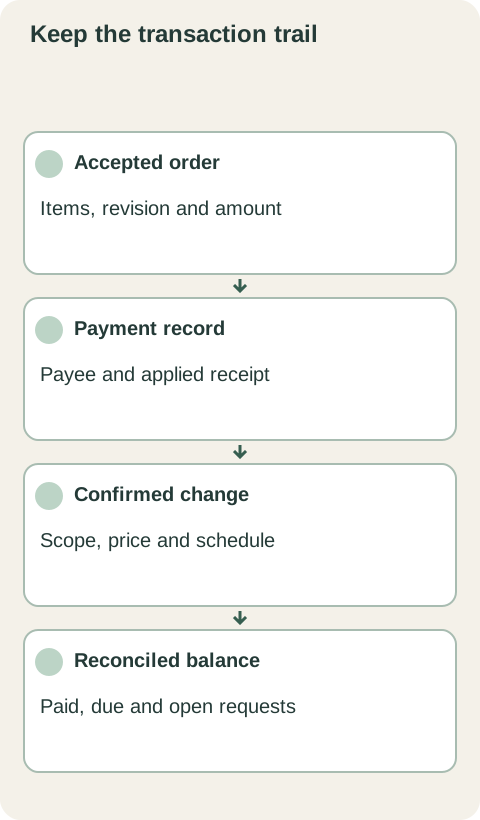
If you need to change an approved cabinet order, contact the seller promptly with an exact description of the affected items. Ask whether the change can still be made and what it would alter in price, timing and related components. Treat it as a request until confirmed. Editing your own drawing or sending a new selection does not establish that the supplier has replaced the accepted order.
Diagram Keep the requested change and final seller confirmation together. The diagram provides no right or deadline to modify an order.
State the change against the accepted baseline
Identify the order, accepted revision and specific cabinet or component. Describe the current selection and the requested replacement in plain terms, including relevant size, finish or quantity. Attach a marked drawing when useful, but also write out the change. A circle on a rendering may show where you are looking without explaining what the seller is supposed to manufacture differently.
Preserve the previous approved version. Do not erase it or reuse its filename for a different document, because the comparison needs a visible starting point. Distinguish a product change from a delivery-address change or a request for information. Combining unrelated requests into an informal message can make it difficult to tell which items were reviewed and which were actually accepted.
Confirm the actual order stage
Ask the seller where the affected items stand and whether they can still be revised. Do not infer flexibility from a distant delivery estimate; production or procurement may follow a different sequence. If you need the seller to pause work while reviewing the request, ask explicitly and obtain a response. Sending the request is not evidence that processing has stopped.
Barker Cabinets states that accepted changes are documented with a new order confirmation. That manufacturer example illustrates the difference between asking and receiving a confirmed revision; its particular change conditions do not become usaKT's policy. Use the confirmation process specified by the seller handling your order.
Identify everything affected by the proposal. A different finish may involve a matching side panel or trim; a changed drawer front may affect hardware preparation. Ask the seller and installer to review relevant dependencies rather than changing only the most visible line. Avoid assuming that a component not mentioned in the reply will automatically be updated to match your intent.
Imagine requesting a darker front finish while leaving an exposed end panel on the original product list. A reply that confirms only the fronts does not settle the side panel. Send a concise affected-item list and ask for each disposition. This keeps the review specific without requiring the seller to reconstruct your intentions from several messages or an old inspiration photograph.
Review the whole consequence before accepting
Request the revised product description, additional or reduced amount, remaining balance and any effect on the planned schedule. Ask whether already processed items remain part of the order and whether new pieces would ship separately. Do not assume an accepted product change preserves every earlier price or delivery arrangement. The decision should be based on the actual revised package.
If the change is not possible, ask what alternatives the seller can offer and price them separately. A later replacement part, a new order or keeping the approved selection have different practical consequences. Do not proceed with field alteration merely because the desired factory change was unavailable. Have any proposed modification evaluated for the actual product and installation before committing to it.
Close the revision across the project team
Once the seller confirms the change and you accept its consequences, distribute the revised order and drawings to the people who rely on them. Mark earlier versions as superseded while keeping them in the history. Identify any unchanged parts explicitly where confusion is likely. Check that a receiving list or installer packet does not still describe the rejected selection.
Retain the request, seller response and final confirmation together. Before shipment, verify the changed items against the current order information, without claiming that a paperwork check proves physical production. A completed change leaves a coherent record of what was requested, what was accepted and which version governs the purchase, rather than an unresolved chain of messages.
Pure White
Cream White
Light Warm Gray
Gray
Navy
Black
Oak Tone
Dark Walnut Tone
Design study These finish studies are design references, not a list of currently orderable colors. Screens and lighting change the appearance; compare a physical sample before choosing.See all finish options →
The sample shows the door frame, a separate center panel, the face frame and the cabinet box. Each component has its own place in this Shaker construction.
Shaker construction: door frame, center panel, face frame and cabinet box. The cutaway helps locate these parts; confirm each material in the specifications for the selected cabinet.
01 / Door frame
The Shaker door has rails and stiles around a separate center panel. The frame and center panel are different components; confirm their materials in the specifications for the selected cabinet.
02 / Face frame
The face frame surrounds the opening at the front of the cabinet box and sits behind the doors. The face frame, door frame and cabinet box are separate parts.
03 / Cabinet box
The sample exposes the cabinet sides, interior surfaces and layered edges. The image does not establish the wood species or material specification of a selected cabinet.