

For professionals
When should a cabinet dealer restock—and when should the order stay job-specific?
Set a replenishment rule for repeatable cabinet items without turning every quoted kitchen into warehouse demand. The useful number accounts for commitments and incoming stock, not just cartons on the shelf.
Restock repeatable items; buy unusual combinations for the job
A cabinet dealer should replenish an item when recurring demand, verified replenishment conditions and its available inventory justify another purchase. A customer quote is not automatically demand, and a warehouse full of boxes is not necessarily available stock. The rule has to identify the exact cabinet, construction option and finish before it can tell anyone what to buy.
Job-specific purchasing remains sensible for combinations that sell irregularly or depend on an approved room plan. Keeping a common base cabinet available may support many projects. Keeping every possible tall cabinet in every finish can consume space while still leaving the next kitchen incomplete. Separate those decisions before setting a warehouse target.
Define the item before defining the trigger
Use a replenishment identity that matches what a customer can actually receive. Different hinge arrangements, finished ends or factory options may prevent apparently similar units from being interchangeable. If the business treats variants as substitutes, document the accepted substitution and who must approve it. Do not combine their sales history merely because the cartons share a general product name.
Separate saleable stock from displays, customer-reserved units, damaged goods and items waiting for an identification check. A display may remain useful for selling while being unavailable for immediate shipment. A damaged cabinet may retain some usable parts but should not be counted as a complete unit ready for another kitchen. These distinctions belong in the inventory record, not in a salesperson's memory.
Shopify defines a reorder point as the stock level that triggers replenishment and describes a basic calculation using demand during replenishment lead time plus safety stock. That retail concept is useful here; it does not establish a cabinet supplier's delivery performance or the right reserve for a particular dealer.
Reading note: Shopify — Reorder Point Formula: A Retailer’s Guide.
Compare the trigger with the position you have defined
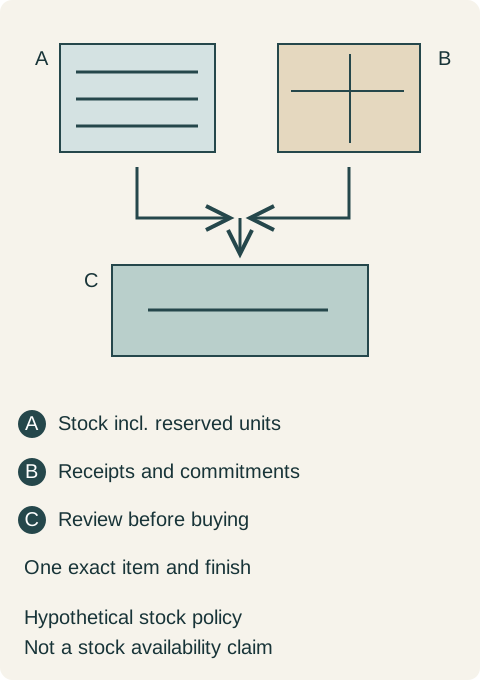
Physical stock answers what is present. For a purchasing review, also identify confirmed incoming units and the quantity already committed to customers. Keep the expected receipt tied to its actual order and current status. An unacknowledged purchase request should not carry the same confidence as a confirmed shipment, even if both appear in an incoming column.
Do not use the same incoming units to support several sales promises. Likewise, avoid subtracting a customer commitment twice because it appears in both the order list and a separate warehouse reservation. The calculation is only as useful as the meaning of each field. Agree a single treatment of reservations, backorders and unconfirmed quotes before automating alerts.
For a hypothetical example, an exact cabinet variant has a forecast of 4 units of new demand per week. This forecast excludes the 5 units already committed to customers in the next paragraph. Assume replenishment takes 3 weeks and the dealer deliberately chooses a reserve of 2 units. The illustrative trigger is 4 × 3 + 2 = 14 units. These are invented planning inputs, not a suggested stock level or a supplier promise.
In the same hypothetical review, 9 usable units are physically present, including the stock reserved for existing customers; 8 confirmed units are expected, and 5 units are already committed. Those 5 units have not already been deducted from the physical count and are excluded from the forecast of new demand, so they are counted only once. The defined inventory position is 9 + 8 − 5 = 12. That falls below the illustrative trigger of 14 and calls for a purchasing review. It does not by itself authorize any particular order quantity.
The reorder quantity is a separate decision
The trigger tells the buyer when to look. The next purchase still has to reflect pack requirements, shipment economics, storage positions, the expected sales mix and cash available for stock. Buying an arbitrary large quantity because an alert appears can replace a stockout problem with a slow-moving inventory problem. Obtain the actual supplier conditions before deciding the quantity.
Suppose, continuing the hypothetical case, the accepted purchasing unit is a lot of 6 cabinets. That lot may be a workable next order; it is not derived merely by subtracting 12 from 14. The buyer reviews the resulting stock exposure against current confirmed work and the next expected receipt. All quantities in this example remain assumptions.
Look at the rest of the cabinet set. Replenishing a popular base does little for a promised complete kitchen if the matching wall cabinets, finished panels or required trim remain unavailable. A stock policy can legitimately cover only selected items, but the sales promise must describe that limitation. Availability of an individual cabinet and availability of a complete order are different checks.
Do not let a project spike become the permanent warehouse target
Review why the item moved. A single development release can produce a large shipment that is unlikely to repeat in ordinary retail demand. Treating it as the new average may lead the next buyer to refill the warehouse after the project has ended. Keep project allocations visible so recurring trade demand can be evaluated separately.
The opposite also matters. A low recent sales count can reflect a long stockout rather than lack of interest. Review missed orders and accepted alternatives alongside shipment history, while keeping those observations distinct from completed sales. Forecasting is a judgment about future demand; it should not rewrite the transaction record to make the forecast look proven.
Finish changes and discontinued options deserve a specific review. A mathematically neat alert should not automatically reorder a version the supplier has replaced or one the dealer intends to leave. Confirm the continuing product identity and the plan for remaining matching pieces before purchasing another lot.
A mixed purchasing policy can serve the customer better
Imagine a dealer that keeps frequently ordered base and wall units in a selected finish but orders unusual pantry configurations for approved projects. Initially, the salesperson promises an entire kitchen from stock because several visible boxes are present. A complete order check reveals that the pantry and finished side are not available.
The dealer changes the sales process: it confirms each project's complete supply plan, reserves the actual stock items and requests the remaining job-specific pieces. Its replenishment buyer uses recurring item demand for warehouse stock and keeps the exceptional pieces attached to the customer's approved order. Nobody needs to pretend that all cabinets follow the same supply route.
This policy may involve more than one shipment or a coordinated later release. Compare the complete fulfillment arrangement with the customer's real readiness before accepting it. A replenishment rule supports accurate buying; it cannot replace order confirmation, a delivery plan or the final check that the kitchen's necessary parts are all accounted for.
Review the rule with results you can observe
Keep the replenishment assumptions, review date and owner beside the item record. After actual receipts, compare expected and observed replenishment intervals, stockouts, substitutions and slow stock. Change the inputs when the evidence supports a change. Do not keep moving the target solely to explain away every inconvenient result.
Start with a manageable group of genuinely repeatable cabinets. A clear policy for those items is more useful than a warehouse-wide formula applied to unverified variants. Keep unusual project purchases under their own approvals, and let the sales team describe what is stocked with the same precision the buyer uses to replenish it.
Sources & further reading
- Shopify — Reorder Point Formula: A Retailer’s Guide