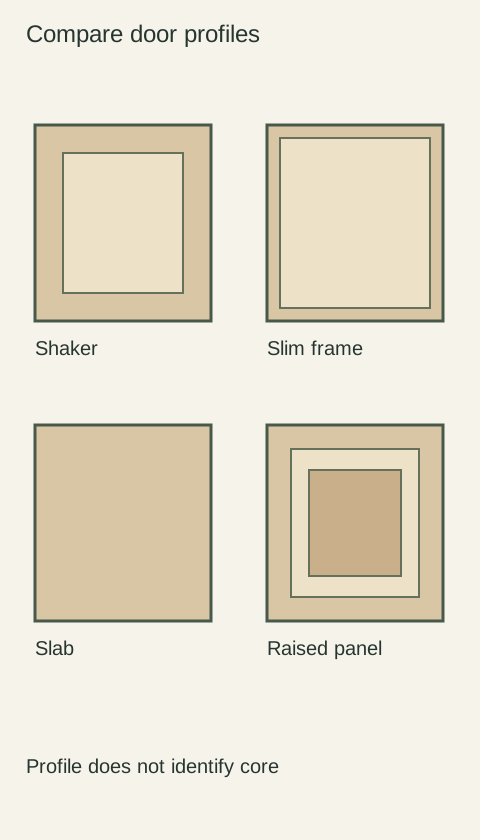
A limited cabinet display works best when each sample answers a distinct buying question. Choose an assortment that lets visitors compare door profiles, finish appearance, edge details and selected working mechanisms without treating every color as a separate full display. Start with the decisions your customers repeatedly struggle to make, then choose the physical format that can demonstrate each difference honestly.
Diagram A profile comparison can answer a question that a small flat finish chip cannot. The diagram is a style reference, not a current showroom inventory.
Give every sample a specific job
A finish chip is useful for putting colors beside a countertop reference. A complete sample door can show how the profile, joints and finish relate across the face. KraftMaid's sample guidance distinguishes these uses, describing chips for finish comparison and doors for profiles, proportions and workmanship. The distinction helps plan a display; it does not establish which samples another supplier currently offers.
Write the question a proposed sample will answer before giving it display space. Does a visitor need to feel an edge, see the depth of a recessed profile or operate a particular drawer mechanism? If a photograph is enough to introduce the option, reserve the physical space for a difference that cannot be understood well from that photograph alone.
Build comparisons, rather than a collection of favorites
Group samples so that visitors can isolate a decision. Comparable door forms in a similar finish help focus attention on profile; similar profiles with different finishes help focus on surface appearance. Where the samples differ in several ways, say so. Otherwise a preference for grain or sheen can be mistaken for a preference for construction or door style.
Imagine a small dealer display already contains many flat white chips but no physical example of a deeply recessed door. Another nearly identical chip may add less useful information than the missing profile. However, retain a subtle white comparison when customers actually struggle to distinguish those undertones. Useful variety is measured by unresolved questions, not by how many colors the display appears to contain.
Separate appearance samples from working demonstrations
A loose door can show a profile, but it cannot demonstrate the behavior of the installed hinge system. A working drawer should identify the actual runner and relevant configuration, with a clear note when the mechanism differs from the quoted product. Do not let a convenient display component silently stand in for the hardware a customer is considering.
Keep claims proportionate to the demonstration. Opening a display drawer can help a visitor compare access and operating feel; it does not prove a rated load, long-term durability or compatibility with another box. If the requested feature is missing, record that gap and arrange the appropriate information or sample rather than using a broadly similar mechanism as proof.
Make sample identity and condition easy to check
Keep a discreet but readable record of product family, style, finish and the sample's intended use. Maintain a link to current selection information and check it before using an older sample for an order. The existence of a sample on a shelf does not establish current supply. Separate historical references from samples being used to select a currently quoted configuration.
Review handling damage, faded labels, loose demonstration components and altered surfaces. A worn sample can misrepresent a new finish, while an unrecorded repair may conceal a detail the customer wants to inspect. Replace or clearly identify compromised examples. When loaning samples, track what left, who has it and which comparison is temporarily unavailable in the display.
Adjust the assortment using actual consultations
Keep brief notes when a visitor cannot resolve a choice with the available samples. Distinguish a missing finish from a missing format: adding another small chip will not solve a question about a door's full profile. Use repeated unanswered questions to guide the next acquisition, and consider moving rarely useful duplicates into a reference archive instead of removing their identities entirely.
A compact display cannot show every variation or establish what every delivered piece will look like. Its purpose is to support a clear next decision and identify when a project-specific sample is needed. Review the assortment alongside current quoting activity, with accurate labels and working examples that staff can explain, rather than expanding it simply to look more comprehensive.
Pure White
Cream White
Light Warm Gray
Gray
Navy
Black
Oak Tone
Dark Walnut Tone
Design study These finish studies are design references, not a list of currently orderable colors. Screens and lighting change the appearance; compare a physical sample before choosing.See all finish options →
Translate the design into identifiable products, details and responsibilities. A useful handoff lets another professional price and build the intended arrangement without reconstructing private conversations.
The sample shows the door frame, a separate center panel, the face frame and the cabinet box. Each component has its own place in this Shaker construction.
Shaker construction: door frame, center panel, face frame and cabinet box. The cutaway helps locate these parts; confirm each material in the specifications for the selected cabinet.
01 / Door frame
The Shaker door has rails and stiles around a separate center panel. The frame and center panel are different components; confirm their materials in the specifications for the selected cabinet.
02 / Face frame
The face frame surrounds the opening at the front of the cabinet box and sits behind the doors. The face frame, door frame and cabinet box are separate parts.
03 / Cabinet box
The sample exposes the cabinet sides, interior surfaces and layered edges. The image does not establish the wood species or material specification of a selected cabinet.