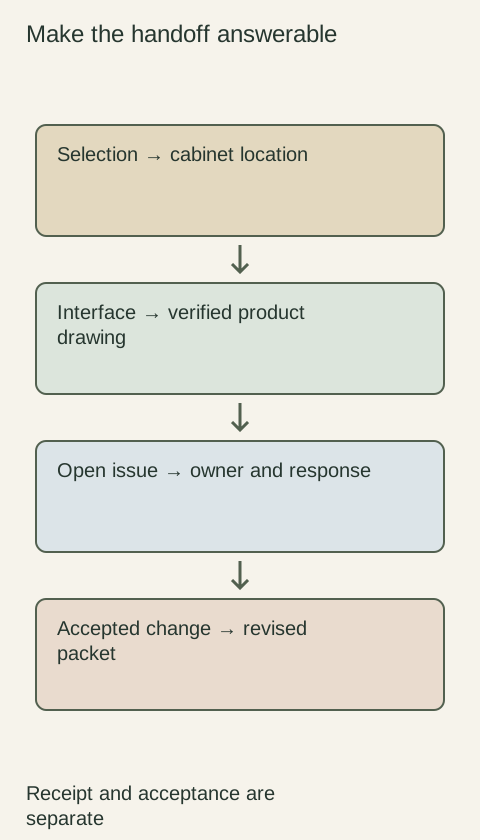
A cabinet project account should show who handles invoices, who confirms product decisions and who coordinates physical receipt. These roles may belong to the same person, but they should not remain implicit. The contact who answers a delivery call may not know the accepted finish, and the person copied on an invoice may not be checking its product quantities. Assign the work as well as the names.
Diagram Route each question to the person assigned to resolve it; receiving a copy does not show that the task is complete.
Separate messages by the action they require
Start with typical incoming information: an invoice, a selection question, an order acknowledgment, an appointment request and a report of missing components. For each, name the person who should take the next action. Add the record they need to consult and the person who can resolve a question outside their task. A long distribution list is not a substitute for this assignment.
Stripe's billing guidance, for example, provides for additional invoice-email recipients. It illustrates that message routing can be configured deliberately; it does not mean a recipient has completed the review or that a cabinet seller uses that system. Ask how the actual supplier records billing and project contacts, including where an additional recipient must be entered.
Give the billing contact an identifiable transaction
The person handling invoices needs the current order reference, the applicable revision and the agreed billing destination. Establish who checks product scope and who reconciles amounts already recorded against the order. If those are different people, identify how a question moves between them. Do not expect accounting staff to infer a changed panel selection from a revised total alone.
Keep billing identity separate from physical delivery details. An office mailing address may be correct on an invoice while unsuitable for the cabinets. Check the supplier's confirmation to see that each address is in the intended field. When a contact changes, specify whether the change affects future invoices, existing open items, delivery calls or all of those communications.
Name the person who resolves product choices
Selection questions need a person who can reference the accepted door style, finish, component options and current drawings. Identify any choices that still require an owner's or designer's input. A coordinator can collect those answers without silently becoming the decision-maker for every substitution. Record the final response against the affected product or drawing rather than relying on a brief reply detached from its context.
Imagine a supplier asks whether a different finished end panel is acceptable. The receiving contact answers that the site can take delivery, intending only to confirm access. That reply does not resolve the product question. Route the panel decision to the selection contact and return a separate delivery response so the supplier has an unambiguous answer to each issue.
Prepare the receiving contact for the actual shipment
Give the receiving contact the shipment reference, expected location, available packing information and the agreed handoff arrangements. Confirm that this person can be reached during the relevant period and knows where to send photographs or discrepancies. They need enough information to distinguish a scheduled cabinet shipment from an unexpected replacement or a separate accessories delivery.
State how observations will reach the people managing the order. A carton label, a visible condition note and a photograph may need to accompany the report. Do not assume a delivery contact is also assigned to unpack every component, reconcile an invoice or decide a finish substitution. Define any additional inspection work separately so it is neither omitted nor assumed completed.
Keep the contact plan usable when people change
Maintain a brief current contact sheet with project identity, tasks, preferred communication channels and a backup for time-sensitive questions. Send revisions to the supplier and affected project participants, then confirm the relevant record was updated. Forwarding an email internally does not establish that the supplier now has the new delivery number or billing destination.
Use an unresolved issue to check whether the arrangement works: can the recipient identify the correct order, find the person who must answer and preserve the response where others can retrieve it? This is a practical division of project work, not a determination of legal signing rights. Review it when phases or personnel change so routine messages do not become decisions made by whoever happens to reply first.
Pure White
Cream White
Light Warm Gray
Gray
Navy
Black
Oak Tone
Dark Walnut Tone
Design study These finish studies are design references, not a list of currently orderable colors. Screens and lighting change the appearance; compare a physical sample before choosing.See all finish options →
Translate the design into identifiable products, details and responsibilities. A useful handoff lets another professional price and build the intended arrangement without reconstructing private conversations.
The sample shows the door frame, a separate center panel, the face frame and the cabinet box. Each component has its own place in this Shaker construction.
Shaker construction: door frame, center panel, face frame and cabinet box. The cutaway helps locate these parts; confirm each material in the specifications for the selected cabinet.
01 / Door frame
The Shaker door has rails and stiles around a separate center panel. The frame and center panel are different components; confirm their materials in the specifications for the selected cabinet.
02 / Face frame
The face frame surrounds the opening at the front of the cabinet box and sits behind the doors. The face frame, door frame and cabinet box are separate parts.
03 / Cabinet box
The sample exposes the cabinet sides, interior surfaces and layered edges. The image does not establish the wood species or material specification of a selected cabinet.