Wet film, dry film and volume solids: compare what remains on a cabinet surface
Equal coat counts or equal wet-film thickness do not necessarily produce equal dry film. Use volume solids to understand the comparison before judging the finish package.
When two cabinet finishing proposals quote the same number of coats, that does not establish the same amount of dry coating. The liquid film applied in the shop and the film remaining after drying are different quantities. Identify the coating system and whether a quoted thickness is wet or dry before comparing them. A thicker figure can describe a different basis rather than a more substantial finished surface.
Follow the quantity through the drying step
Elcometer explains the theoretical relationship as dry-film thickness equal to wet-film thickness multiplied by the volume-solids fraction. Its wet-film-comb guidance also describes a reading bracket between wet and dry teeth. The calculation is an estimate; the comb observes the wet layer.
Volume solids is the proportion relevant to that volume relationship. Do not insert a solids-by-weight percentage just because it appears nearby on a data sheet. A value expressed by mass answers a different question. Similarly, the amount of liquid purchased is not a measurement of film remaining on a door. Product left in equipment or lost during application has not become part of the finished cabinet.
Keep the system boundary clear. A primer layer and a topcoat can serve different functions, so their thicknesses should not be collapsed into a boast about the thickest paint. A quotation may include a preparation coat that another system does not need. Compare the specified complete system, the intended finished result and the way conformity is checked. A single coat count cannot describe all of those decisions.
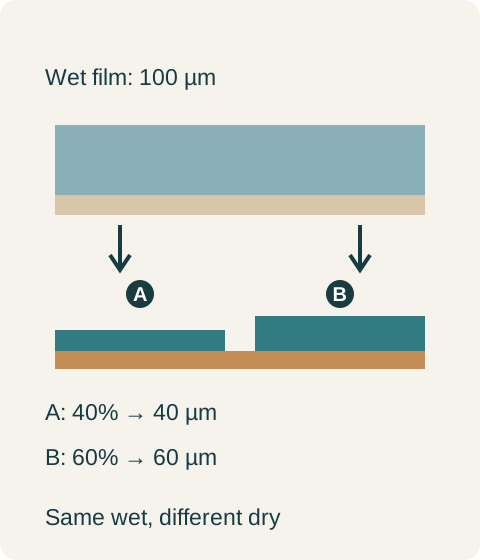
Teaching example Hypothetical arithmetic: equal 100 µm wet films at 40% and 60% volume solids predict 40 µm and 60 µm dry. These are not recommended cabinet coating thicknesses.
Compare coatings at the same required dry-film thickness
Suppose two hypothetical coatings are applied at 100 micrometers wet. Coating A has 40% volume solids, so the theoretical dry film is 100 × 0.40 = 40 micrometers. Coating B has 60% volume solids, giving 100 × 0.60 = 60 micrometers. If the comparison requires a hypothetical 40-micrometer dry basis, A corresponds to 40 ÷ 0.40 = 100 micrometers wet, while B corresponds to 40 ÷ 0.60 = approximately 66.7 micrometers wet. The buyer asks for both estimates on that same dry-film basis before comparing material quantities. These numbers are not instructions to apply either product at those thicknesses; an actual coating must permit the intended film build.
In that hypothetical comparison, the larger dry result from equal wet application does not establish that B is better. Adhesion, appearance, compatibility and performance under the intended use remain separate. The buyer accepts the corrected comparison basis and rejects the claim that equal wet readings prove equivalent finished coating. Selection between the actual systems then follows their documented suitability, approved finish sample and complete quoted scope, rather than a shortcut based on the larger solids percentage.
Separate a process reading from final acceptance
A wet-film reading can give the applicator feedback while work is underway. It does not prove that every location has the same film or that the eventual finished film meets the full specification. Keep the measurement location, method and process stage with the result. Do not record an estimated dry thickness as though an instrument directly measured the cured surface.
Profiled doors make the location especially important. A convenient flat test area may not describe a recess, sharp transition or edge. Decide how the finishing process is evaluated for the actual component instead of extrapolating a single easy reading over its entire shape. The selected coating instructions and the agreed inspection method should govern those locations; a generic numerical example cannot replace them.
Also distinguish theoretical film quantity from a purchase quantity. Real consumption includes the shop’s application process and losses. A procurement comparison can show the theoretical basis and the stated allowance separately, making an assumption visible rather than hiding it in an unexplained coverage claim. Changing the application method or part mix can change that allowance even if the finish code stays the same.
A useful finish submittal therefore identifies the system, the wet or dry basis, the product’s relevant data and how the completed surface will be assessed. It does not need to turn the homeowner into a coating inspector. It needs to keep similar-looking numbers from concealing different work, and to ensure the quoted finish is judged against its own intended construction.
Pure White
Cream White
Light Warm Gray
Gray
Navy
Black
Oak Tone
Dark Walnut Tone
Design study These finish studies are design references, not a list of currently orderable colors. Screens and lighting change the appearance; compare a physical sample before choosing.See all finish options →
A color name does not identify a finish system. Compare the decorative surface, the core, the edge and the repair method before choosing a cabinet front.
A ranked list can hide its comparison rules. Find the tested product, the scoring priorities and the missing conditions before applying the result to your cabinet order.
The sample shows the door frame, a separate center panel, the face frame and the cabinet box. Each component has its own place in this Shaker construction.
Shaker construction: door frame, center panel, face frame and cabinet box. The cutaway helps locate these parts; confirm each material in the specifications for the selected cabinet.
01 / Door frame
The Shaker door has rails and stiles around a separate center panel. The frame and center panel are different components; confirm their materials in the specifications for the selected cabinet.
02 / Face frame
The face frame surrounds the opening at the front of the cabinet box and sits behind the doors. The face frame, door frame and cabinet box are separate parts.
03 / Cabinet box
The sample exposes the cabinet sides, interior surfaces and layered edges. The image does not establish the wood species or material specification of a selected cabinet.