To compare a cabinet finish upgrade, request complete versions of the same order in the original and proposed finishes. Track doors, drawer fronts, visible ends and finishing pieces together. A price attached to a sample or door style is not enough to establish the total change. The useful comparison shows what changes, what stays the same and what still needs a separate quotation.
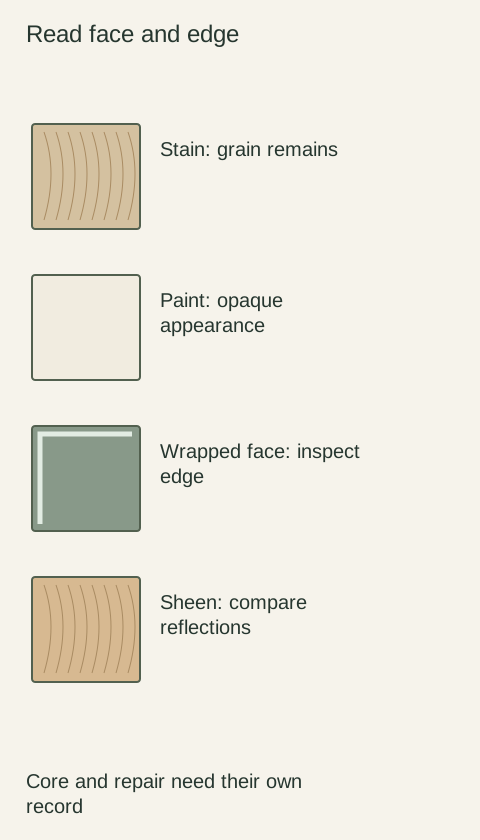
Diagram Use finish distinctions to identify the complete alternate. The diagram supplies no surcharge or guarantee that separate components will match.
Freeze the product list before comparing finishes
Keep the cabinet quantities, sizes, construction choices and hardware constant while pricing the appearance change. Otherwise a lower total could reflect a missing component or a different cabinet rather than a less expensive finish. KraftMaid identifies finish among several configuration factors affecting its cabinet prices; it does not supply a universal finish-upcharge formula.
Ask the seller to identify the starting finish and the alternate with their actual product names or codes. Descriptions such as premium white or upgraded wood are too broad to reconcile later. If moving to the new finish also requires a different door material or product series, identify that as a linked product change rather than hiding it inside a finish surcharge.
Trace every visible surface
Review the order for exposed cabinet sides, decorative end panels, fillers, toe-kick coverings and mouldings that are actually part of the project. Identify which require the new appearance. A cabinet box may retain an interior finish while an exposed end needs separate treatment; those decisions should be written, not inferred from the front-view drawing.
For each finishing piece, establish whether it is factory finished, supplied unfinished for field finishing or provided by another party. Include relevant edges and returns when describing the intended result. Do not assume that changing the door selection automatically updates separately ordered panels or trim. Ask the seller to mark any component unavailable in the proposed finish before approving the change.
Evaluate coordination as well as nominal color
Matching names do not explain how different substrates, grain directions or profiles will look together. Ask for representative samples or an appropriate manufacturer explanation for the specific combination. Compare visible panel and trim surfaces with the door, especially where pieces meet directly. The objective is an acceptable coordinated result, not a promise that every surface will reflect light identically.
Imagine replacing a painted option with a stained wood appearance. The doors may be priced clearly, but a plain end panel and a shaped moulding also need a coordinated selection. If those components require different materials, the comparison must include them. Keeping the original trim price while replacing only the door line would describe an incomplete alternate, even if the displayed total looks attractive.
Include work created by the change
Ask whether the proposed finish changes any preparation, field finishing, touchup materials or installation handling included in the project. These are questions for the actual supplier and installer, not automatic charges to add. If an unfinished trim item needs outside finishing, obtain that scope separately and identify who approves its appearance before it is installed.
Also establish whether sample approval or availability changes the planned release sequence. A new color choice is not ready to order merely because its price is known. Keep unresolved appearance approval visible, and ask whether any previously selected accessories or replacement pieces must be revised. Do not treat a generic surcharge percentage as a complete answer to these project-specific dependencies.
Compare completed alternatives and record the choice
Place the original and alternate totals beside the same component list. Mark additions, deletions and unchanged items. Where a price remains unknown, show the gap rather than treating it as free. Ask the seller to explain differences in the final amount and any new conditions, so the purchase decision reflects the complete appearance package you intend to receive.
Once selected, update the order description, approved sample identity and drawing notes together. Retire the rejected finish from the active paperwork to prevent a panel being ordered from an earlier sheet. Preserve the alternate comparison for the budget record. The result should be a chosen, coordinated finish with a traceable full-order price, not an isolated upgrade number that leaves the finishing pieces undecided.
Pure White
Cream White
Light Warm Gray
Gray
Navy
Black
Oak Tone
Dark Walnut Tone
Design study These finish studies are design references, not a list of currently orderable colors. Screens and lighting change the appearance; compare a physical sample before choosing.See all finish options →
The sample shows the door frame, a separate center panel, the face frame and the cabinet box. Each component has its own place in this Shaker construction.
Shaker construction: door frame, center panel, face frame and cabinet box. The cutaway helps locate these parts; confirm each material in the specifications for the selected cabinet.
01 / Door frame
The Shaker door has rails and stiles around a separate center panel. The frame and center panel are different components; confirm their materials in the specifications for the selected cabinet.
02 / Face frame
The face frame surrounds the opening at the front of the cabinet box and sits behind the doors. The face frame, door frame and cabinet box are separate parts.
03 / Cabinet box
The sample exposes the cabinet sides, interior surfaces and layered edges. The image does not establish the wood species or material specification of a selected cabinet.