Before trusting a cabinet material ranking, check how it chose the winner
A ranked list can hide its comparison rules. Find the tested product, the scoring priorities and the missing conditions before applying the result to your cabinet order.
A best-to-worst material list is useful only when you can tell what was compared and how the winner was chosen. The headline may name broad material families while the evidence concerns a particular board, finish or cabinet assembly. Before applying the order of that list to your purchase, trace the verdict back to its comparison rules. An attractive ranking without those rules is a prompt for questions, not a specification.
Find out what actually entered the comparison
Read past the material names and look for identifiable products or specimens. Were complete cabinets compared, loose panel samples, finished doors or manufacturers’ published descriptions? Those are different starting points. If the article does not say, you cannot assume its conclusion represents a test of finished cabinetry.
Also check what the entries have in common. A comparison of one premium construction with one lower-cost construction cannot isolate the effect of material when joints, supports and finish all differ. The article can still describe those products, but a broad claim that the material alone caused the result needs evidence beyond that side-by-side example.
Ask what the ranking rewards
Look for the priorities behind the order: purchase price, appearance, weight, a specified performance measure, repair options or some combination. A list may call its winner best overall without explaining the tradeoffs. Do not silently substitute your own priorities for the writer’s and assume the order still holds.
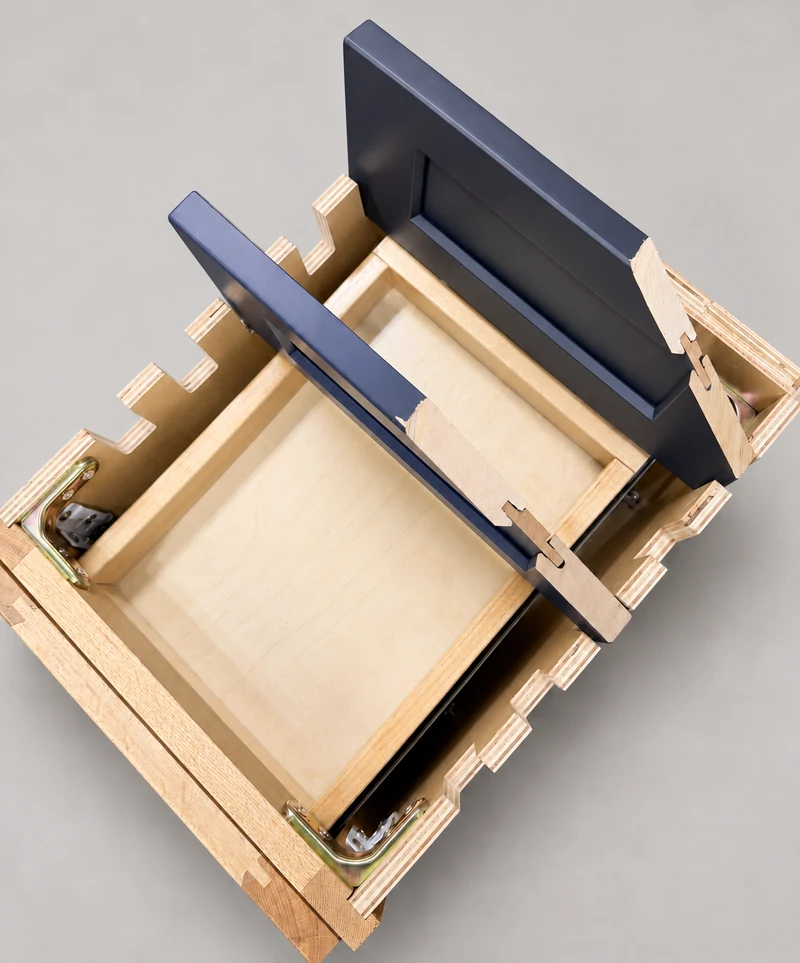
Physical sample A cutaway helps identify what part a claim concerns. It cannot supply the missing test method or scoring rules of a material ranking.
Consider a hypothetical list that rewards a low purchase price and another that prioritizes a particular finish appearance. They may place the same product differently without either describing your intended use. For a visible kitchen end, appearance may matter more to you than it does in a hidden utility cabinet. Write down the decision you need before accepting someone else’s overall score.
Separate an observation from a repeatable comparison
If a ranking cites a demonstration, find the described specimen, procedure and endpoint. A photograph after a spill is an observation; it does not by itself tell you exposure conditions or how other products were treated. A test report with a defined scope still answers only the conditions it covers. Neither should be expanded into an unlimited lifetime promise.
Follow a cited source far enough to see whether it supports the claim beside the link. A manufacturer’s description may establish what that manufacturer sells without validating the reviewer’s whole ranking. Check whether a missing method is acknowledged. A sales relationship or affiliate link does not automatically make a conclusion false, but it does not replace a method either.
Carry useful questions into the quote, not the score
Extract the narrow finding that actually matters, then ask whether the quoted construction matches it. Keep the product identity, component, relevant conditions and unresolved differences together. If the article leaves a dimension or construction detail unspecified, mark it as missing rather than inventing a match to your order.
For example, a list may persuade you to examine shelf support or finish edges more closely. That is useful even if its overall winner is not applicable. Use the component guide to identify the relevant parts and obtain the selected product’s construction information. The outcome should be a better-informed cabinet comparison, not a borrowed score that conceals what remains unknown.
Pure White
Cream White
Light Warm Gray
Gray
Navy
Black
Oak Tone
Dark Walnut Tone
Design study These finish studies are design references, not a list of currently orderable colors. Screens and lighting change the appearance; compare a physical sample before choosing.See all finish options →
Separate product, delivery, installation and service experiences. Look for comparable details and repeated mechanisms, not just repeated adjectives or an overall star rating.
Borrow the design idea, then test it against your room and cabinet list. A project award does not identify every product or establish how each part performs.
The sample shows the door frame, a separate center panel, the face frame and the cabinet box. Each component has its own place in this Shaker construction.
Shaker construction: door frame, center panel, face frame and cabinet box. The cutaway helps locate these parts; confirm each material in the specifications for the selected cabinet.
01 / Door frame
The Shaker door has rails and stiles around a separate center panel. The frame and center panel are different components; confirm their materials in the specifications for the selected cabinet.
02 / Face frame
The face frame surrounds the opening at the front of the cabinet box and sits behind the doors. The face frame, door frame and cabinet box are separate parts.
03 / Cabinet box
The sample exposes the cabinet sides, interior surfaces and layered edges. The image does not establish the wood species or material specification of a selected cabinet.