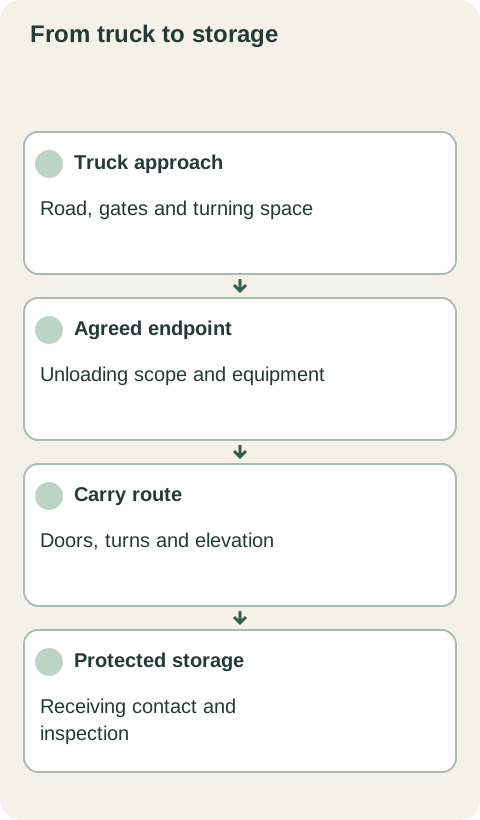
Treat a cabinet delivery window as information to organize receiving, and verify what the booked service actually promises about arrival. Do not assume the opening of the window is the truck's arrival time or that a request has become a confirmed appointment. Make the receiving contact, access arrangements and unloading help available for the agreed plan, with a clear way to handle a changed estimate.
Diagram Coordinate the confirmed receiving period with access and help. The diagram does not promise a particular arrival time.
Identify the status of the time you were given
A sales estimate, a tracking estimate, a proposed appointment and an accepted receiving window are different records. Ask which you have, who confirmed it and which shipment it concerns. Keep the date, local time basis, delivery address and reference together. A forwarded message without its shipment context can easily be attached to the wrong phase or replacement delivery.
XPO's retail-service descriptions distinguish a scheduled appointment from a separate service benefit guaranteeing an arrival window. That example shows why the word appointment alone does not define a guarantee for every shipment. Check the actual booking and its conditions rather than importing another service's promise into your cabinet delivery plan.
Arrange a person who can answer delivery communications and carry out the agreed receiving task during the applicable window. If responsibilities change during that period, make the handover explicit and keep the delivery contact informed. A buyer who is reachable by phone but far from the site may not be able to perform the physical handoff when the truck arrives.
Check how the appointment relates to the time needed for receiving work. Ask whether a stated window refers to arrival and how any building access cutoff affects unloading. Do not assume the truck will arrive at the beginning or that the site can remain accessible indefinitely afterward. Share actual constraints with the delivery organizer before accepting a plan that depends on them.
Coordinate helpers around the confirmed service scope
Identify which unloading or moving work the carrier performs and which work requires people arranged by the buyer. Give those people the confirmed window and the way updates will be shared. Their availability should match the task they are expected to perform, rather than a single optimistic arrival estimate mentioned during an earlier sales conversation.
Imagine the receiver books help only near the start of a morning delivery window because the cabinets are expected early. The truck arrives later within that window, after the helpers have left. The appointment may still match the agreed range, but the receiving plan no longer works. Resolve coverage or the booked service beforehand instead of relying on an unconfirmed arrival at the opening time.
Establish the update and fallback conversation
Confirm how scheduling changes will be communicated and which number or message channel the receiving person should monitor. Keep the shipment reference and scheduling contact readily available. If the status changes or an expected update does not arrive, ask for the current information rather than interpreting silence as confirmation that the original timing remains unchanged.
Decide who can discuss a revised window and inform the installer, helpers or property contact. If the site can no longer receive the shipment, contact the organizer promptly and confirm the next arrangement. Do not assume a request to move the appointment has been accepted, or that the driver can improvise an alternative destination when the planned handoff is unavailable.
Keep dependent work separate from the arrival estimate
Consider what must happen after delivery before installation can use the goods: receiving, checking the relevant components and moving them to the agreed location. A delivery window is not a completion time for all those tasks. Avoid scheduling the next trade on the assumption that arrival, unloading and verification will all happen at the first moment of the window.
Retain the latest confirmation and record material changes so everyone can distinguish current plans from old messages. After the handoff, update the people waiting on the goods with what actually arrived and what remains unresolved. The goal is a workable receiving arrangement with an informed response to change, without claiming a universal arrival guarantee or treating an estimate as an exact appointment.
Pure White
Cream White
Light Warm Gray
Gray
Navy
Black
Oak Tone
Dark Walnut Tone
Design study These finish studies are design references, not a list of currently orderable colors. Screens and lighting change the appearance; compare a physical sample before choosing.See all finish options →
The sample shows the door frame, a separate center panel, the face frame and the cabinet box. Each component has its own place in this Shaker construction.
Shaker construction: door frame, center panel, face frame and cabinet box. The cutaway helps locate these parts; confirm each material in the specifications for the selected cabinet.
01 / Door frame
The Shaker door has rails and stiles around a separate center panel. The frame and center panel are different components; confirm their materials in the specifications for the selected cabinet.
02 / Face frame
The face frame surrounds the opening at the front of the cabinet box and sits behind the doors. The face frame, door frame and cabinet box are separate parts.
03 / Cabinet box
The sample exposes the cabinet sides, interior surfaces and layered edges. The image does not establish the wood species or material specification of a selected cabinet.