A cabinet allowance is useful as a planning amount only when you know what it is intended to cover. It does not identify a finished product selection by itself. Before choosing a package, connect the allowance to a specific cabinet list, finish, hardware and assigned services, then compare the confirmed price for that same scope with the amount already carried in the project budget.
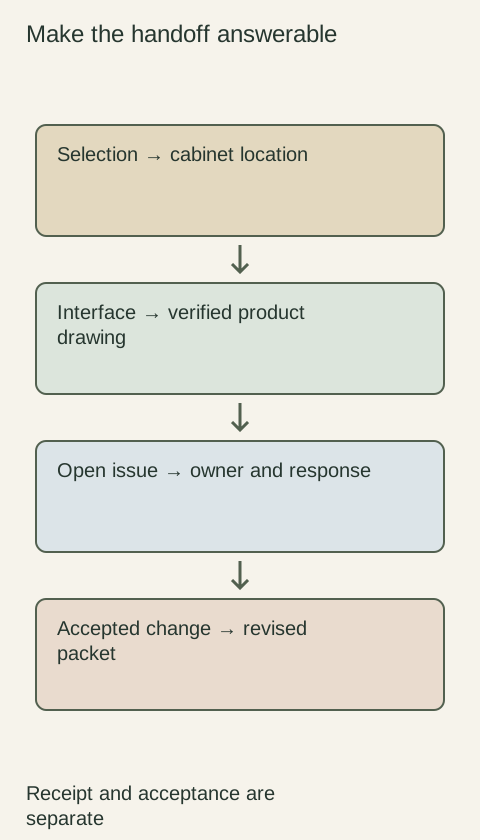
Diagram Connect the budget line to the accepted products and scope. The diagram does not establish a cabinet price or payment arrangement.
Ask what the allowance is based on
Find out whether the amount was based on a preliminary cabinet list, a particular product level or simply an early budget target. Request the assumptions that were used, including which components and work were included. Without that starting point, it is difficult to tell whether a later difference results from changed selections or an incomplete original estimate.
NAHB describes a selection allowance worksheet that connects categorized customer selections with an overall allowance. The useful idea is to link choices to the budget record rather than leaving a total without supporting selections. The description does not establish how your project handles an increase, decrease or unspent balance.
A fixed quoted amount should be attached to the exact products and work being priced: cabinet quantities and dimensions, fronts, finish, hardware, panels and other required components. Identify the drawing revision and the services included. A firm-looking total with unresolved selections still leaves uncertainty about what the buyer will receive.
Check the quote’s stated validity and any remaining conditions before treating it as the amount available for an order. Clarify whether unfinished measurements or undecided options require another quote. The distinction is not that an allowance is bad and a fixed price is always complete; each needs an honest description of what has and has not been decided.
Compare the same cost boundary
If the allowance includes cabinet supply and delivery, compare it with those same elements in the selected proposal. Do not compare a product-only figure with an allowance that was intended to include additional work. Conversely, do not add a service again if it already appears elsewhere in the overall project budget.
Ask the project’s purchasing contact to show how the selected amount replaces the provisional cabinet line. Keep separate any related work that remains outside that line. This prevents the old allowance and new purchase from both being counted as expenses, while also preventing omitted work from disappearing simply because the cabinet choice has been finalized.
A changed door choice may not explain the whole difference
Imagine an early allowance based on a simple painted cabinet package. The final selection uses a wood finish and includes finished end panels and decorative pulls that were never identified in the original amount. The buyer sees an overage and assumes it is entirely the cost of changing the door finish.
Request a comparison that separates the changed finish from newly defined components and services. Then evaluate practical alternatives within the same scope: retain the original finish, choose another approved option or adjust selected features while preserving required finishing pieces. Removing necessary end panels from the comparison would make the price smaller without answering how the intended cabinet installation will be completed.
Record the budget decision before purchase
Have the responsible party explain how any difference will be recorded, who approves it and what evidence supports the selected amount. Do not assume that buying below the allowance automatically creates a cash refund or that every difference is handled the same way. Establish the project’s actual arrangement and keep the decision with the accepted quote.
Once the selection is accepted, record the exact configuration, its price scope and any choices deliberately left pending. Update the project budget so it reflects the decision rather than an obsolete placeholder. An allowance becomes a useful purchasing tool when it leads to a documented selection and a clear budget adjustment; it remains uncertain when everyone agrees to the total but imagines different cabinets and services behind it.
Pure White
Cream White
Light Warm Gray
Gray
Navy
Black
Oak Tone
Dark Walnut Tone
Design study These finish studies are design references, not a list of currently orderable colors. Screens and lighting change the appearance; compare a physical sample before choosing.See all finish options →
The sample shows the door frame, a separate center panel, the face frame and the cabinet box. Each component has its own place in this Shaker construction.
Shaker construction: door frame, center panel, face frame and cabinet box. The cutaway helps locate these parts; confirm each material in the specifications for the selected cabinet.
01 / Door frame
The Shaker door has rails and stiles around a separate center panel. The frame and center panel are different components; confirm their materials in the specifications for the selected cabinet.
02 / Face frame
The face frame surrounds the opening at the front of the cabinet box and sits behind the doors. The face frame, door frame and cabinet box are separate parts.
03 / Cabinet box
The sample exposes the cabinet sides, interior surfaces and layered edges. The image does not establish the wood species or material specification of a selected cabinet.