Compare cabinet quotes only after identifying what each includes, excludes and leaves unresolved. Similar door pictures and totals do not establish equivalent purchases. Match the actual product schedule, finishing components and assigned work, then obtain prices for the gaps that matter to your project. An exclusion is not necessarily a problem, but an unassigned excluded task can become one.
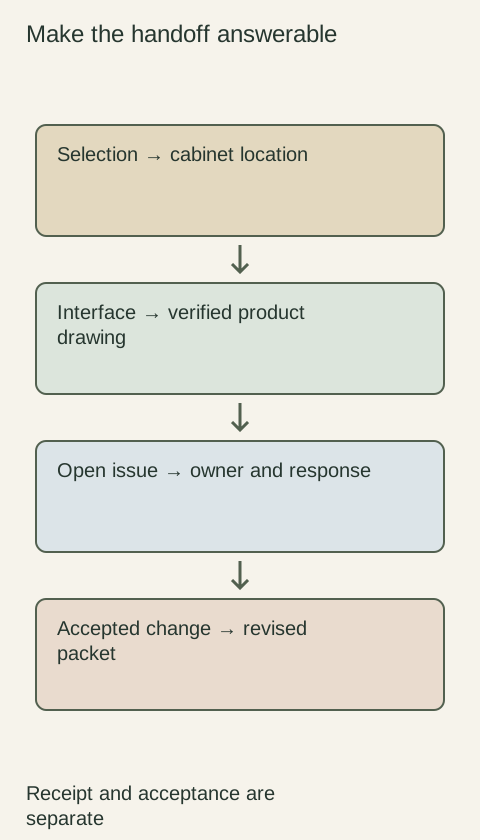
Diagram Compare product details and assigned work together. The diagram does not imply that any particular service is included in a usaKT quote.
Start with the product schedule
KraftMaid explains that its cabinet pricing depends on choices including cabinet type and size, door style, wood, finish and construction options. The useful principle is that a price belongs to a configuration. A broad style label does not establish that competing quotes describe the same product choices.
Compare the listed cabinets by their identifiers, dimensions and quantities, then check fronts, construction and hardware. Keep proposed alternatives identified rather than treating them as exact matches. If a supplier uses another naming system, ask for a clear mapping to the requested items. A lower total could reflect a different configuration, a missing item or a lower price for the intended scope; the schedule helps distinguish them.
Find the pieces outside the main cabinet boxes
Review exposed ends, fillers, finished panels, toe-kick materials, moldings and other specified finishing pieces. Confirm which are supplied, which arrive unfinished and which must be sourced elsewhere. A rendering may show a continuous finished appearance even when some of the visible components are absent from the quoted list.
Treat decorative pulls, special fittings and separately supplied inserts the same way. “Hardware included” might refer to hinges and runners while leaving decorative pulls to the buyer. Request an explicit list rather than interpreting the phrase in whichever way makes the quote look most complete. The goal is not to add every possible accessory, but to account for the ones in the accepted design.
Distinguish supply from the work around it
Identify assembly, delivery, unloading, carry-in and installation as separate responsibilities when they apply. A cabinet supplied assembled still needs other work to reach its installed condition. Clarify who provides site fitting, hardware installation and final adjustment if those tasks are required. Do not assume an attractive product package includes labor simply because its image shows a finished room.
For each excluded activity, name the party expected to perform it and obtain the relevant estimate or confirmation. Avoid counting the same activity in both the cabinet and installer totals. Also mark work that remains unknown, such as fitting to conditions not yet measured, so the comparison does not quietly treat uncertainty as a free service.
A lower offer can contain an unresolved finish gap
Imagine receiving similar cabinet schedules from different sellers. The lower offer excludes finished end panels because it assumes the installer will fabricate them, while the other offer supplies matching panels. The buyer compares only cabinet boxes and interprets the difference as a discount for the same finished result.
To compare fairly, identify the installer’s material, finish and labor requirements for the excluded panels and confirm that the proposed result meets the intended appearance. Then compare complete, assigned scopes. The lower offer may still be preferable, but that decision should include the work needed to complete it. A blank line is not evidence that the missing task has no cost or effort.
Resolve assumptions before accepting the total
Ask the seller to state the assumptions behind unclear items and distinguish an exclusion from an allowance or a price still to be determined. “By owner” assigns responsibility; it does not identify the actual product or its cost. “Included” should identify the supplied item or service closely enough that the receiving or installation team can recognize it.
Keep the clarified scope with the accepted quote and corresponding drawings. If some choices remain deliberately deferred, record how they will be resolved and keep them visible in the project budget. You can choose a supply-only purchase or a broader package, but the comparison becomes useful only when it shows what you receive and what you still need to arrange to reach the intended result.
Pure White
Cream White
Light Warm Gray
Gray
Navy
Black
Oak Tone
Dark Walnut Tone
Design study These finish studies are design references, not a list of currently orderable colors. Screens and lighting change the appearance; compare a physical sample before choosing.See all finish options →
The sample shows the door frame, a separate center panel, the face frame and the cabinet box. Each component has its own place in this Shaker construction.
Shaker construction: door frame, center panel, face frame and cabinet box. The cutaway helps locate these parts; confirm each material in the specifications for the selected cabinet.
01 / Door frame
The Shaker door has rails and stiles around a separate center panel. The frame and center panel are different components; confirm their materials in the specifications for the selected cabinet.
02 / Face frame
The face frame surrounds the opening at the front of the cabinet box and sits behind the doors. The face frame, door frame and cabinet box are separate parts.
03 / Cabinet box
The sample exposes the cabinet sides, interior surfaces and layered edges. The image does not establish the wood species or material specification of a selected cabinet.