Aluminum or stainless outdoor cabinets: compare the storage system inside
The metal name does not tell you whether the kitchen uses an open modular frame or an enclosed cabinet box. Compare the support, shelves, doors and appliance modules as one purchase.
Choose between outdoor cabinet proposals by the complete storage and appliance system, then assess the specified materials for the location. An aluminum-framed modular kitchen and a stainless cabinet-box kitchen can solve different needs even when their closed fronts have similar colors. The main metal name does not identify every shelf, panel or accessory. Begin with what the household will store and how the cooking modules will be supported, rather than assuming one material label defines a complete kitchen.
An aluminum frame can carry different shelf material
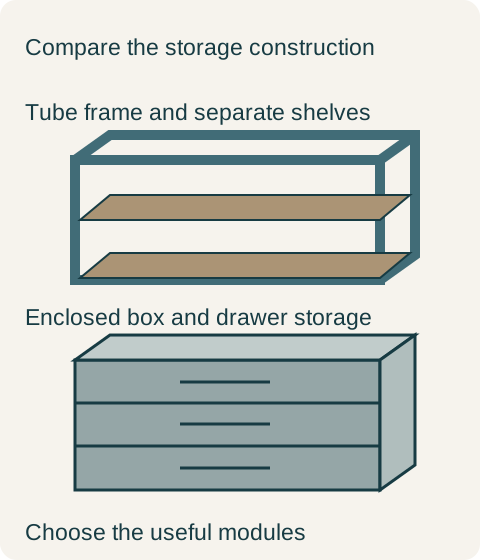
NewAge’s Essential Aluminum line uses powder-coated aluminum tube frames, removable panels and doors, and wood-plastic shelves with aluminum framing. This is a particular mixed-material modular system; aluminum in its name does not mean every component is aluminum.
Danver describes stainless doors, drawers and cabinet boxes, with double-wall drawers and rain gaskets, delivered assembled. That is a different cabinet construction example. It does not establish a waterproof interior or represent every product sold as stainless outdoor cabinetry.
Storage begins with the objects, not the exterior finish
Lay out the things that should stay outdoors: serving trays, bulky pots, grill tools and the small items that need a drawer. Then assign them to the actual offered modules. A wide opening with shelves may suit a bulky item better than a drawer layout, while smaller utensils may benefit from divided storage. Compare usable spaces in the specific units rather than inferring capacity from the overall kitchen length. Decorative panels and equipment can occupy space that a front elevation makes look available.
Teaching example Hypothetical comparison of a framed shelf module and an enclosed drawer cabinet. It illustrates storage architecture, not the dimensions, weather sealing or load capacity of any named product.
A household can prefer the modular frame
Consider a hypothetical household that carries food and utensils out from its indoor kitchen but wants outdoor storage for large serving pieces and a place for the selected cooking module. It compares an aluminum-frame system with accessible shelves and an enclosed stainless arrangement emphasizing drawers. The shelf arrangement fits its actual serving pieces and the chosen equipment package, so it selects the framed system with the offered removable door panels. It does not pay for extra drawer storage it has no plan to use.
This choice would change if the household wanted a different storage routine. A buyer leaving many small tools outdoors might prefer the enclosed cabinet arrangement and its drawers. But enclosure alone does not establish that any cabinet can safely store every object through all weather. Keep the selected product’s storage and care limits in view. In the example, the owners intend to bring their vulnerable or seldom-used items indoors rather than interpreting a closed door as a promise of dry, dust-free storage.
A frame opening is not a universal appliance opening
An outdoor system may organize its grill, sink, drawer top or refrigerator around particular modules. Choose the equipment and matching module together. A measured gap that looks wide enough does not by itself confirm support, access or the required installation arrangement. If an appliance changes, review the cabinet pairing again. Do not treat a supplier’s compatible set as permission to substitute any similarly sized appliance without addressing the resulting construction.
Compare the countertop scope on the same basis. A module described as supporting a particular top is different from a complete order that includes that top, its finished edges and any appliance opening. The distinction matters when two quotations appear far apart in price. One may contain more completed work and accessories. The purchaser should be able to point to the actual top, module and finishing pieces in each proposal, rather than filling a missing line with an assumption based on the showroom image.
Removable panels and assembled boxes change the work
Think through installation access and later service using the actual system. A framed product with detachable panels may offer a different route into the interior than an assembled box, but the useful access depends on its final placement. A removable panel facing a wall is not necessarily convenient to remove after the kitchen is built. Establish the intended service route before surrounding the cabinet with other fixed parts; do not assume the word modular makes every future change simple.
An assembled cabinet also needs a realistic route onto the site and into its final position. Compare what arrives assembled, what must be connected and which tasks are included. These are purchase-scope differences, not reasons to rank all frames above all boxes. A household paying for a complete installed arrangement should understand who handles the connections and final alignment, while a purchaser accepting an assembly task should see the corresponding instructions and parts list before delivery.
Keep material suitability separate from storage preference
Once the arrangement works, evaluate the named metals, coatings and other components for the intended exposure using that product’s guidance. Do not use this storage comparison as a shortcut around coastal-material selection or maintenance. The hypothetical owners choose a particular aluminum-frame package because its modules and shelf access fit their routine. Their order names the complete mixed-material construction and equipment pairing, giving them a concrete kitchen to evaluate rather than a contest between two metal words.
Pure White
Cream White
Light Warm Gray
Gray
Navy
Black
Oak Tone
Dark Walnut Tone
Design study These finish studies are design references, not a list of currently orderable colors. Screens and lighting change the appearance; compare a physical sample before choosing.See all finish options →
Powder coating changes the cabinet surface; it does not change the alloy beneath. Salt exposure, exposed interior metal and practical cleaning access belong in the same outdoor cabinet choice.
An outdoor-suitable polymer sheet does not make a wood cabinet drawing interchangeable. HDPE needs a fabrication plan that accommodates thermal movement and sustained loading.
Compare the actual countertop products, heat-source routine and fabrication proposal. A fired porcelain slab and resin-bound quartz are different materials, but neither label replaces a complete kitchen specification.
The sample shows the door frame, a separate center panel, the face frame and the cabinet box. Each component has its own place in this Shaker construction.
Shaker construction: door frame, center panel, face frame and cabinet box. The cutaway helps locate these parts; confirm each material in the specifications for the selected cabinet.
01 / Door frame
The Shaker door has rails and stiles around a separate center panel. The frame and center panel are different components; confirm their materials in the specifications for the selected cabinet.
02 / Face frame
The face frame surrounds the opening at the front of the cabinet box and sits behind the doors. The face frame, door frame and cabinet box are separate parts.
03 / Cabinet box
The sample exposes the cabinet sides, interior surfaces and layered edges. The image does not establish the wood species or material specification of a selected cabinet.