Coastal outdoor cabinets: choose the steel grade and the finish separately
Powder coating changes the cabinet surface; it does not change the alloy beneath. Salt exposure, exposed interior metal and practical cleaning access belong in the same outdoor cabinet choice.
A colored door does not identify the steel underneath
For a coastal outdoor kitchen, choose the cabinet's stainless steel grade and its surface finish as separate specifications. A powder-coated door can have the same color over different alloys. The coating does not turn the underlying metal into another grade, and a stainless label does not promise a cabinet that never needs cleaning.
IMOA explains that Type 316 contains a molybdenum addition compared with Type 304, improving resistance to chlorides. This is a material-selection distinction, not a guarantee that a particular cabinet will remain unchanged in every seaside location.
A roof can reduce rain without removing salt exposure
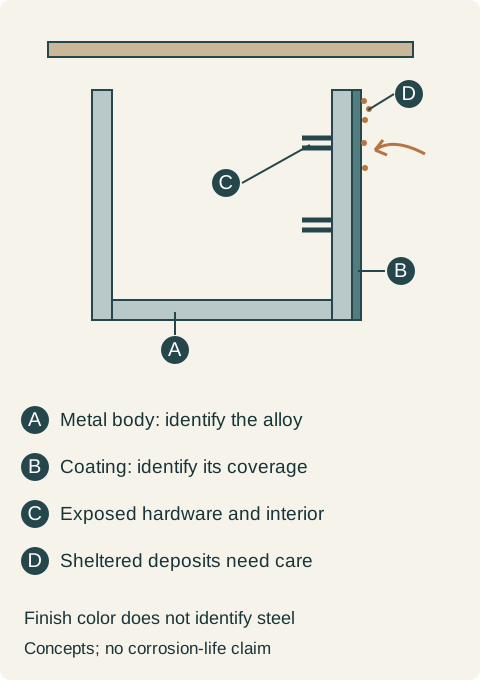
IMOA also explains that sheltered locations can accumulate corrosive deposits when they are not regularly cleaned. Protection from rainfall is therefore not the same as protection from salt-bearing dirt. The cabinet's position beneath an overhang should remain part of the exposure assessment.
Describe the actual installation to the cabinet manufacturer: open coast or a more sheltered setting, locations where spray or deposited dirt reaches the cabinet, and which faces can be cleaned after installation. Do not convert a map distance into a universal alloy rule. Exposure, finish, details and maintenance work together.
Teaching example Conceptual cabinet section separates the metal body from its exterior coating and identifies exposed internal hardware. The sheltered example shows salt-bearing deposits can remain on protected surfaces. It is not a corrosion test or coating specification.
Specify what is coated and what remains exposed
Danver's outdoor-kitchen guidance recommends a stainless-grade upgrade for corrosive salty environments and still calls for care of cabinets, handles and hinges. It also distinguishes powder-coated faces from exposed stainless areas, including cabinet interiors. This is a useful cabinet example: selecting a colored finish does not make the rest of the assembly disappear.
Request the actual scope of both specifications. Does the named alloy apply to the box, doors and drawers, or only a listed component? Which surfaces receive the chosen coating? What hardware remains exposed? Different components may be appropriate, but an unspecified component should not silently inherit the main panel's description.
Keep the manufacturer's cleaning instructions for the selected coating and exposed metal. A cleaner suitable for bare stainless is not automatically suitable for a colored finish. The purchase comparison should include whether the installed corners, backs and hinges can be reached for that care; a maintenance plan that depends on routinely dismantling the kitchen is a different ownership commitment.
Spend on the environment before adding decorative detail
A hypothetical coastal proposal offers the preferred color over the standard steel specification, with an ornate door option consuming the remaining allowance. A second proposal keeps a simpler door, identifies the manufacturer's recommended higher-resistance alloy for the location and defines both coated and exposed areas. The household chooses the second, preserving the exposure-related specification rather than spending the same allowance on door ornament. It also accepts the stated cleaning responsibility; the upgrade is not purchased as a promise of zero care.
If the household cannot provide the required access or maintenance, compare another documented cabinet system or location rather than assuming more coating solves everything. Keep the accepted alloy scope, finish coverage and care access together in the order. This resolves a real construction choice hidden behind the same painted color.
Pure White
Cream White
Light Warm Gray
Gray
Navy
Black
Oak Tone
Dark Walnut Tone
Design study These finish studies are design references, not a list of currently orderable colors. Screens and lighting change the appearance; compare a physical sample before choosing.See all finish options →
A plywood bond label addresses a particular panel and exposure classification. It does not establish the moisture performance of the finish, joints, hardware or complete cabinet.
A painted door, a wood-grain side and a plywood cabinet box can belong to the same cabinet. Here is how to read those parts, what the sample photos actually show, and which details to put on a quote.
The sample shows the door frame, a separate center panel, the face frame and the cabinet box. Each component has its own place in this Shaker construction.
Shaker construction: door frame, center panel, face frame and cabinet box. The cutaway helps locate these parts; confirm each material in the specifications for the selected cabinet.
01 / Door frame
The Shaker door has rails and stiles around a separate center panel. The frame and center panel are different components; confirm their materials in the specifications for the selected cabinet.
02 / Face frame
The face frame surrounds the opening at the front of the cabinet box and sits behind the doors. The face frame, door frame and cabinet box are separate parts.
03 / Cabinet box
The sample exposes the cabinet sides, interior surfaces and layered edges. The image does not establish the wood species or material specification of a selected cabinet.