HDPE outdoor cabinets: buy the movement and support details with the panels
An outdoor-suitable polymer sheet does not make a wood cabinet drawing interchangeable. HDPE needs a fabrication plan that accommodates thermal movement and sustained loading.
Compare complete HDPE cabinet assemblies, including their supports, fasteners and movement allowances. An outdoor-suitable sheet can remove the need for a wood-style finishing process while introducing different construction requirements. Replacing plywood with plastic in an unchanged cutting list does not establish that the resulting cabinet will work.
Moisture resistance does not remove creep
King Plastic’s fabrication guide for StarBoard ST and WG explains that these HDPE products can move or bow gradually under sustained mechanical stress, including gravity. It requires flat horizontal support for sheets and cut parts and rejects ordinary sparse lumber stickers or leaning storage. A sheet can resist moisture and still acquire distortion from poor support; those are different material behaviors.
The guide carries the same concern into cabinet construction: wider or heavily loaded base floors need sufficient runners, and upper cabinets may need partitions. Its support discussion is not a load rating for any proposed cabinet. A quote should identify how the selected material and intended contents are supported, rather than treating a water-resistant panel description as evidence that a long unsupported floor is suitable.
Thermal movement belongs in the drawing
King also requires allowance for expansion and contraction, including around fronts and at fasteners, and warns against trapping side and end panels. Its worksheet uses a coefficient of 0.00006 per degree Fahrenheit with part dimensions in inches. That is a named manufacturer’s calculation basis, not a universal coefficient for every polymer board. It predicts dimensional change; it does not by itself specify the finished joint or installation clearance.
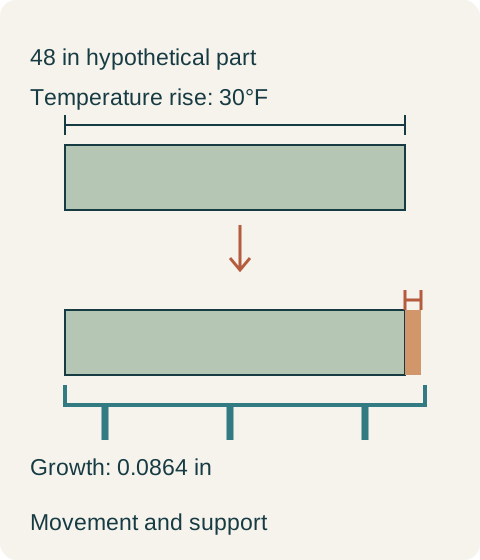
Teaching example Hypothetical calculation using King Plastic’s stated coefficient. Growth is for the complete 48 in dimension; the diagram does not prescribe edge clearance or a load capacity.
A panel cannot grow into a fixed opening
In a hypothetical comparison using that worksheet, a 48 in panel fabricated at 70°F reaches 100°F in service. The 30°F rise gives 48 × 30 × 0.00006 = 0.0864 in of growth along that dimension. A proposed rigid detail with only 0.04 in total available movement cannot accommodate even that calculated change. The buyer rejects the unchanged wood-style detail and selects the revised assembly with compatible movement fixings and sufficient designed allowance, plus the specified floor supports.
The calculation is for the whole measured dimension; it is not an instruction to add that amount independently at every edge. Actual design must also address contraction, tolerances, restraints and the temperatures the part itself may experience. The chosen revised assembly in this example includes those decisions. Buying a sheet and leaving the movement details for installation would leave the fabrication comparison unfinished.
A hybrid box is a separate design decision
For its described cabinet method, King recommends like material throughout the cabinet box and cautions against inserting wood components because the materials move at different rates. That does not prove every engineered hybrid assembly is impossible. It means a proposal to combine an HDPE exterior with an unreviewed wood box cannot borrow the named all-polymer method as its justification.
Two different failures need two different responses
Consider a cabinet that is square when unloaded but whose bottom gradually sags under stored dishes. Enlarging its door gaps would not address the unsupported load path. Now consider a well-supported cabinet whose panel ends are restrained while the material gets warmer. Adding another runner beneath the floor would not supply movement space at those restraints. These are practical consequences of the separate creep and thermal-movement behaviors described above. A useful fabrication review therefore follows both the weight to its supports and the growing panel to a boundary that can accommodate it. The same attractive exterior can conceal either problem.
A sealed seam is not necessarily a structural joint
King separately explains that ordinary adhesives do not provide the required bond for its HDPE products. A water-sealing caulk can seal without making a permanent structural connection; the manufacturer prefers mechanical fastening or welding and discusses specialist bonding as a distinct process. This changes the meaning of a familiar cabinet detail. A seam filled neatly with sealant may look finished, but its appearance says nothing about how the adjoining parts transfer load. A fabricator must identify the actual connection, rather than present a clean glue line as proof that a wood-style joint has been reproduced.
The WG FAQ also says that its sheet cannot be painted and discourages gluing. A buyer choosing this particular wood-grain polymer should therefore treat its supplied appearance as part of the material selection. An instruction to match an interior painted kitchen later is not a minor finishing allowance. It would require a different material or an independently established finish system, not an assumption that the normal wood paint schedule carries across. In a mixed indoor and outdoor project, coordinating the two areas can mean deliberately choosing complementary finishes instead of promising an exact painted match on both constructions.
Keep the material identity, service conditions, support arrangement and fixing details in the accepted fabrication package. Compare those same items if a supplier offers an alternative panel. The outdoor material choice is useful only when the completed cabinet preserves the behavior the fabricator designed for, rather than relying on the sheet’s weathering description alone.
Pure White
Cream White
Light Warm Gray
Gray
Navy
Black
Oak Tone
Dark Walnut Tone
Design study These finish studies are design references, not a list of currently orderable colors. Screens and lighting change the appearance; compare a physical sample before choosing.See all finish options →
Compare the actual countertop products, heat-source routine and fabrication proposal. A fired porcelain slab and resin-bound quartz are different materials, but neither label replaces a complete kitchen specification.
The sample shows the door frame, a separate center panel, the face frame and the cabinet box. Each component has its own place in this Shaker construction.
Shaker construction: door frame, center panel, face frame and cabinet box. The cutaway helps locate these parts; confirm each material in the specifications for the selected cabinet.
01 / Door frame
The Shaker door has rails and stiles around a separate center panel. The frame and center panel are different components; confirm their materials in the specifications for the selected cabinet.
02 / Face frame
The face frame surrounds the opening at the front of the cabinet box and sits behind the doors. The face frame, door frame and cabinet box are separate parts.
03 / Cabinet box
The sample exposes the cabinet sides, interior surfaces and layered edges. The image does not establish the wood species or material specification of a selected cabinet.