AIA’s 2026 pantry signal: a showroom idea, not a cabinet sales forecast
The working-pantry result supports a useful demonstration, but it cannot set a dealer’s stock order. Separate the reported momentum from the buying decisions in your own inquiries.
A cabinet dealer can use the AIA kitchen report to decide which customer conversation deserves a better display. It cannot use that result alone to decide how many pantry cabinets to stock. A working-pantry demonstration may help visitors compare secondary preparation with ordinary food storage, but actual orders still depend on the projects reaching that showroom.
The distinction matters when a display budget competes with inventory and floor space. A representative room arrangement can teach a customer something that a door sample cannot. A large commitment to finished cabinet stock is a different decision, with different consequences if the expected buyers do not appear. Do not treat interest in the report as evidence that both investments should happen together.
Read the dated result before planning a response
AIA released this report on March 5, 2026. Figure 2 compares Q4 2025 with Q4 2024; the report year is not the observation period.
Working pantries show a net popularity balance of 45.3 in 2025 versus 51.5 in 2024. The measure subtracts respondents reporting decreasing popularity from those reporting increasing popularity; it is not an installation share.
The positive balance and the lower reading can both be true. There is no need to turn the release into either an instruction to buy more inventory or a claim that the feature has stopped being useful. A retailer needs a separate account of its own customers, the work they are considering and the products that could serve them.
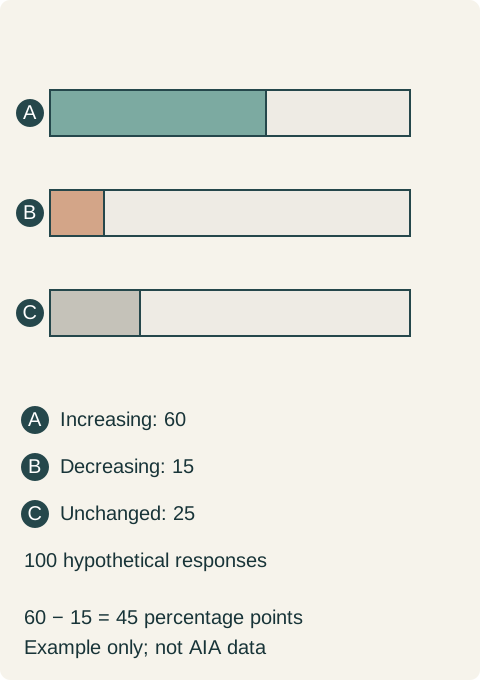
Teaching example Hypothetical responses explain a net popularity balance: 60 increasing minus 15 decreasing gives 45 percentage points; 25 report no change. These are teaching figures, not AIA results, purchases or household shares. The diagram does not reproduce the original survey chart.
A net balance cannot become a stock percentage
Consider a teaching example with 100 responses: 60 report increasing interest, 15 decreasing interest and 25 no change. Subtracting 15 from 60 produces a net balance of 45 percentage points. It does not say that 45 households ordered a pantry, that 60 cabinets were sold or that 25 projects were canceled. These invented figures explain the calculation and are not the AIA sample.
A stock order needs quantities and configurations. Even a real increase in requests could be spread across different cabinet widths, fronts, appliance arrangements and project stages. A design inquiry may never become an order; a completed order may need fewer cabinets than a preliminary drawing. The public net balance supplies none of those details.
Keep the source statement intact in any internal proposal. Then label the separate business hypothesis: visitors might understand a secondary preparation area better if they can see a usable example. That hypothesis is testable in the showroom without claiming that the survey has already proved local demand.
Demonstrate the difference between food storage and a working pantry
Show one coherent activity. A visitor should be able to see where groceries wait, where a small preparation task happens and where the associated dishes return. If the proposal is merely a wall of shelves, describe it as storage. Adding an appliance to a rendering does not turn an unresolved corner into a complete preparation room.
The display can use a clearly identified non-operating appliance representation when a live installation is unnecessary. Any working appliance installation needs its actual requirements resolved. In either case, keep the cabinet storage visible and usable. A demonstration that hides all everyday items to look spacious cannot explain the trade a customer will make at home.
Give the visitor a credible alternative using the same project assumptions. That may be a conventional tall pantry with the preparation activity retained in the main kitchen. The alternative prevents the display from becoming a one-way sales pitch. The useful question is whether the secondary activity solves a problem worth the space and complete project cost.
Listen for project constraints before expanding the assortment
Record why a visitor considered the display and what prevented or enabled a proposal. A request for additional dry-food storage belongs in a different category from a request to move preparation out of the main kitchen. A household that likes the appearance but lacks a suitable room is also different from a project with an accepted secondary area awaiting cabinet selection.
Use actual proposals to identify recurring cabinet configurations. Keep unquoted ideas, priced proposals and accepted orders separate. A preference expressed in front of a display is useful information, but it is not permission to count an order. Likewise, one successful project is an example to understand, not a reliable purchase frequency by itself.
A dealer tests a display without loading the warehouse
Imagine a dealer considering a large stock purchase after reading the pantry headline. Its recent inquiries contain interest in hiding preparation, but the requested rooms and cabinet combinations vary. The dealer instead approves a reusable showroom arrangement using components it can demonstrate clearly, with a defined display budget and a conventional-storage alternative beside the proposal materials.
In the following customer discussions, several visitors actually need better dry storage. Their proposals remain ordinary pantry cabinetry. Another household has a suitable secondary room and a clear preparation task; its design proceeds as a project-specific cabinet package after the full scope is resolved. The dealer does not convert every display visit into a presumed working-pantry sale.
The business retains the useful demonstration and orders the accepted project against its confirmed cabinet list. It postpones an expanded stock commitment until its own repeated purchasing evidence supports particular items. The decision buys a better customer explanation now while keeping warehouse quantities tied to actual configurations and demand.
The report has therefore done useful work without becoming a forecast it never supplied. Keep the dated source available, review the display against real conversations and revise the product offer when actual proposals justify it. A stronger showroom can begin with an interesting industry finding; a defensible stock decision needs more than that finding.
Pure White
Cream White
Light Warm Gray
Gray
Navy
Black
Oak Tone
Dark Walnut Tone
Design study These finish studies are design references, not a list of currently orderable colors. Screens and lighting change the appearance; compare a physical sample before choosing.See all finish options →
Decide which work leaves the main kitchen before adding a second sink or appliance. A room that hides equipment still needs receiving surfaces, tool storage and a route back to the meal.
The quarter’s current-activity and near-term readings pointed in different directions. For cabinet businesses, that distinction matters when choosing between preparing for demand and committing to additional inventory.
The sample shows the door frame, a separate center panel, the face frame and the cabinet box. Each component has its own place in this Shaker construction.
Shaker construction: door frame, center panel, face frame and cabinet box. The cutaway helps locate these parts; confirm each material in the specifications for the selected cabinet.
01 / Door frame
The Shaker door has rails and stiles around a separate center panel. The frame and center panel are different components; confirm their materials in the specifications for the selected cabinet.
02 / Face frame
The face frame surrounds the opening at the front of the cabinet box and sits behind the doors. The face frame, door frame and cabinet box are separate parts.
03 / Cabinet box
The sample exposes the cabinet sides, interior surfaces and layered edges. The image does not establish the wood species or material specification of a selected cabinet.