Zero-joint cabinet edging: what the functional layer changes and what it does not
A nearly invisible edge line describes a specific bonding and finishing result. It does not mean the cabinet is made from one solid piece or that the complete assembly is waterproof.
Specify zero-joint edging by the actual edge system and accepted finished corner, not by the word laser alone. The important distinction is how the edge bonds to the panel and how that interface looks after fabrication. A small visible line can be an appearance requirement, but it should not be converted into an untested claim about every joint, hole or surface of the cabinet.
The bond layer is built into the edging
REHAU describes its LaserEdge system as having a pre-applied coextruded polymer functional layer. A suitable laser, hot-air or NIR edgebander activates that layer so it fuses to the board. Thus this named system does not require a laser as the only activation method.
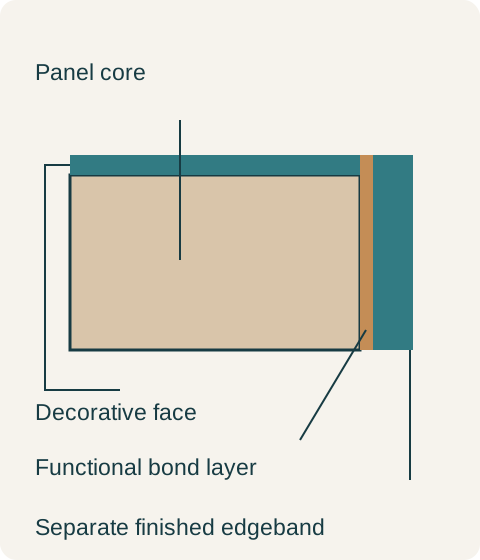
The process still joins an edgeband to a panel. It does not erase the panel core, turn a composite into solid acrylic or make the face and edge one continuous sheet. Keep the face material, core, edge material and bonding system as separate entries. A polished product photograph can make the interface difficult to see while leaving all of those material choices unresolved.
The visible result also depends on the proposed edge color, surface texture, profile and corner treatment. A narrow bond line does not by itself make a textured edge match a smooth face. Review a finished corner, including the reverse and the meeting of adjacent edges. A flat face sample cannot settle the part of the appearance that justified the upgrade.
Teaching example Conceptual edge section, exaggerated for readability. The functional layer joins a separate edge to the panel; the diagram does not establish bond strength, water resistance or a usaKT product specification.
Choose which visible edges justify the upgrade
Suppose a hypothetical order has frequently viewed door edges and concealed interior edges. The buyer approves the functional-layer edge sample for the visible doors because its face-to-edge line meets the appearance target. The concealed parts retain their separately specified conventional edging, which already meets their requirements. The order identifies each edge treatment by component. The buyer has purchased a defined visible-edge upgrade, not an unspecified premium for every board in the cabinet.
In that hypothetical order, a proposal processed with a compatible hot-air machine is not rejected merely because a sales conversation used the word laser. It is accepted only as the same documented edge system and approved finished result. Conversely, a conventional glue-line edge is not treated as that system just because the line is hard to see in a photograph. Process identity and appearance are related evidence, but one does not prove the other.
A neat bond line is not a complete moisture specification
A claim about the edge bond addresses that interface. A cabinet has additional cutouts, holes, joints and surfaces. Any moisture-use claim must apply to the actual completed construction and its intended conditions. Do not infer a waterproof cabinet from a close-up showing a clean edge, and do not assume ordinary edge care becomes unnecessary because the seam is subtle.
Later field cuts can create a new edge that was not part of the factory-applied system. Include the finishing method for planned altered edges in the fabrication scope before the parts are produced. A small field trim does not automatically inherit the bond construction of the other sides. This is a manufacturing handoff issue, not a reason to improvise adhesive on site.
For purchasing, compare the parts and operations actually included. A pre-edged door, a pressed panel awaiting edging and a roll of compatible edgeband are different deliverables. Confirm the completed component described by the quote before comparing the amount. The functional layer explains a process; it does not tell you how much fabrication a seller has included.
Keep the accepted corner sample and the component-by-component edge schedule together. If an alternate changes edge material, activation system or finished profile, compare the changed result explicitly. That lets a buyer pay for the appearance that matters without relying on absolute words such as seamless to carry unrelated product promises.
Pure White
Cream White
Light Warm Gray
Gray
Navy
Black
Oak Tone
Dark Walnut Tone
Design study These finish studies are design references, not a list of currently orderable colors. Screens and lighting change the appearance; compare a physical sample before choosing.See all finish options →
Thin banding covers a panel edge; solid lipping adds a separately specified wood member. Compare the finished outline, profile and assembly before treating thicker edging as an upgrade.
The sample shows the door frame, a separate center panel, the face frame and the cabinet box. Each component has its own place in this Shaker construction.
Shaker construction: door frame, center panel, face frame and cabinet box. The cutaway helps locate these parts; confirm each material in the specifications for the selected cabinet.
01 / Door frame
The Shaker door has rails and stiles around a separate center panel. The frame and center panel are different components; confirm their materials in the specifications for the selected cabinet.
02 / Face frame
The face frame surrounds the opening at the front of the cabinet box and sits behind the doors. The face frame, door frame and cabinet box are separate parts.
03 / Cabinet box
The sample exposes the cabinet sides, interior surfaces and layered edges. The image does not establish the wood species or material specification of a selected cabinet.