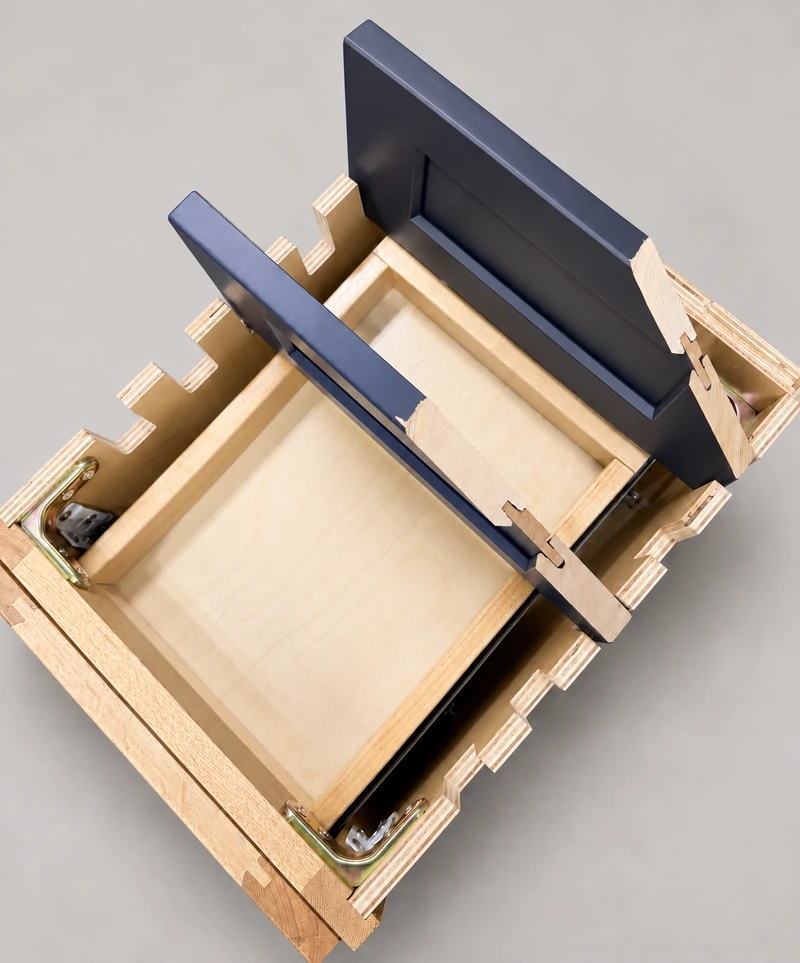
When a cabinet description says laminate, ask what the laminate covers. The visible surface and the supporting panel are separate purchase details. Record both for the door, shelf or cabinet side you are comparing, then check the edges and reverse face. A familiar surface name or convincing wood pattern does not identify the core or establish the performance of the assembled component.
Physical sample The image illustrates why a face and the material beneath it must be distinguished. It does not identify the sample as TFL, HPL or any particular core specification.
Use the surface term accurately
The Composite Panel Association describes TFL as resin-treated decorative paper fused directly to a substrate. It describes HPL as a laminate sheet bonded to a panel. These are different surface constructions, not names for the underlying cabinet core.
A seller may use laminate casually, so ask for the precise product description rather than correcting the vocabulary without learning what is supplied. Does the description refer to the door face, the cabinet interior or both? If the same wood-look pattern is available in different surface systems, a color match alone does not make their construction identical.
Follow each surface back to a specific component
Request the core material and specified overall thickness of the actual component. Keep the door, case side, shelf and applied end panel separate. A laminate door with a particular core does not establish that the shelves use the same core. Similarly, a plywood cabinet box does not establish what lies beneath a laminate door face.
Ask whether the reverse side has the same finish, a different backing surface or another specified treatment. If the panel is intended for an exposed end or open interior, the reverse and edges can affect the appearance you actually receive. A face-only sample may leave these parts unresolved even when its color is approved.
Read the edge as a separate finishing decision
Look at a finished sample showing where the face meets the edge. Identify whether the edge uses a separate strip, a wrapped surface or another documented treatment. Do not infer the core solely from a narrow dark line. A cutaway can locate layers, but the written construction description should identify what those layers are.
Compare the edge color, texture and sheen with the face under ordinary light. If a field cut is planned, confirm how that new edge is to be finished before the panel is ordered or altered. An unplanned exposed edge can leave a purchase detail unresolved even though the broad surface matches the chosen finish.
A worked comparison of matching wood-look fronts
Imagine two cabinet proposals using a very similar oak-tone pattern. One identifies its decorative surface and core; the other says only “oak laminate.” The second wording does not tell you whether oak names the visual pattern, a real wood layer or something else in the construction. Request a component description and representative finished sample before treating the proposals as equivalent.
Then compare the actual front and its edge with the rest of the package. The preferred appearance may be available with different interior treatments or construction options. Keep those differences visible in the decision instead of assigning the entire price difference to the face material. Also confirm the ordered finish identifier; a marketing color name may not be the supplier’s complete selection code.
Ask performance questions about the finished product
If resistance to a particular household exposure matters, obtain the manufacturer’s information for the actual surface and component. Avoid treating general descriptions such as durable, easy clean or moisture resistant as permission to soak an edge, use an abrasive cleaner or place a heat source against the panel. A practical care document should address the finish you are receiving.
Retain the surface identity, core description, overall thickness, reverse finish and edge treatment with the order. At receiving, compare the part labels and finished faces with that record before installation. If the supplied description changes, resolve it before assuming that the same printed pattern makes the replacement equivalent. This gives you a meaningful specification beneath the word laminate.
Pure White
Cream White
Light Warm Gray
Gray
Navy
Black
Oak Tone
Dark Walnut Tone
Design study These finish studies are design references, not a list of currently orderable colors. Screens and lighting change the appearance; compare a physical sample before choosing.See all finish options →
A painted door, a wood-grain side and a plywood cabinet box can belong to the same cabinet. Here is how to read those parts, what the sample photos actually show, and which details to put on a quote.
Inspect finished corners, shelf edges and accessible surfaces, and obtain the care instructions for the actual interior rather than judging it only by color.
Review the cabinet finish, appliance instructions and exposed edge locations together before choosing foil-covered doors near equipment that produces heat or steam.
The sample shows the door frame, a separate center panel, the face frame and the cabinet box. Each component has its own place in this Shaker construction.
Shaker construction: door frame, center panel, face frame and cabinet box. The cutaway helps locate these parts; confirm each material in the specifications for the selected cabinet.
01 / Door frame
The Shaker door has rails and stiles around a separate center panel. The frame and center panel are different components; confirm their materials in the specifications for the selected cabinet.
02 / Face frame
The face frame surrounds the opening at the front of the cabinet box and sits behind the doors. The face frame, door frame and cabinet box are separate parts.
03 / Cabinet box
The sample exposes the cabinet sides, interior surfaces and layered edges. The image does not establish the wood species or material specification of a selected cabinet.