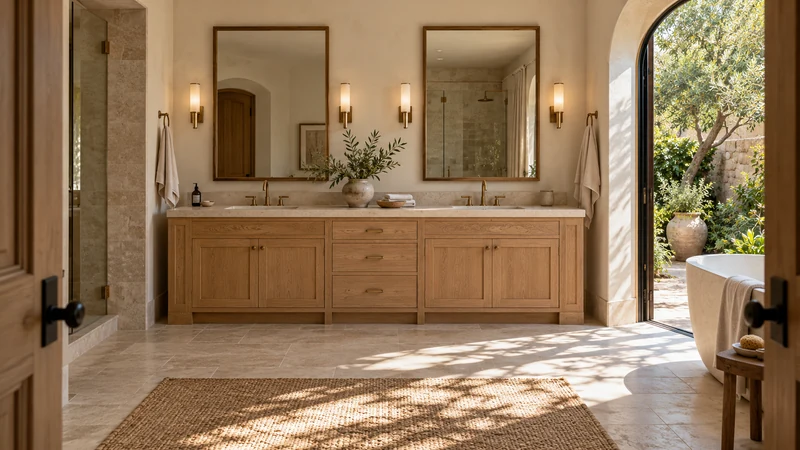
Choose a stained wood finish from a representative range, not only the small piece whose color you like best. A range sample shows several possible appearances of the proposed wood-and-finish combination. It helps you decide whether the variation works as a group and gives the supplier a clearer reference for discussion. It is useful only when its scope is identified.
Design study The design study illustrates how several wood-tone fronts read together. It does not document real veneer, a stain range, delivered variation or an installed customer project.
A stain name does not describe every board
KraftMaid explains that wood varies among individual pieces and that the finish influences how much of its natural character remains visible. This is background for evaluating stained cabinetry, not a reason to accept any delivered difference. Your selected supplier still needs to explain the expected appearance of its particular product.
Ask which wood, surface construction and finish the samples represent. A stain shown on a different species is not the same approval. Nor does a smooth central panel necessarily represent every frame member or matching end panel. Keep the combination intact when comparing alternatives: changing the wood and the stain together makes it harder to understand why the result changed.
Request variety with a defined purpose
Look for samples that show the lighter and darker ends of the offered appearance, along with noticeable grain or character variation. Ask whether the group is an intended approval range, a general illustration or simply the pieces available in the showroom. A convenient collection should not quietly become a promise about every part of an order.
Label what each piece is meant to demonstrate. Color depth, grain contrast and visible character are separate observations. You may accept a broad color range but dislike prominent knots, or enjoy pronounced grain while wanting closer color similarity. Saying only “I like natural wood” leaves those distinctions unresolved and gives neither side a practical basis for reviewing the result.
Judge the group before choosing a favorite
Arrange the samples in the orientation and neighboring relationship that matter to the project. Stand back to judge the overall rhythm, then inspect close details. Move the lightest and darkest examples next to each other to understand a conspicuous pairing. This is an appearance exercise, not a commitment that the supplier will arrange pieces in your preferred sequence.
If arrangement matters, ask whether selection or matching is actually available and how it would be specified. Do not assume installers can swap every front freely to improve color distribution; sizes, handing and hardware preparation may differ. A range approval and an agreed placement requirement solve different questions and should be recorded separately.
A worked decision after seeing the full range
Imagine approving a small, calm brown sample for its subtle grain. A fuller sample group includes stronger contrast and lighter areas that you find distracting when pieces are adjacent. The original sample has not necessarily been misleading; it was simply insufficient to reveal whether the broader appearance suits you.
You might choose a different wood-and-finish combination, ask about a documented selection option, or decide that the broader variation is part of the look you want. Do not sign off while expecting the entire order to resemble only your favorite piece. If the range you can accept is narrower than the offered product, resolve that difference before the order is released.
Keep the approval bounded at delivery
Retain the labeled range or the agreed reference record, including what it represents and what remains outside its scope. Photographs help document the group, but cannot preserve exact color across screens and lighting. If you receive only a single sample, describe that limitation honestly rather than calling it a full range approval.
At receipt, compare representative neighboring components with the identified range before installation. Record any concern with labels, whole-piece views and close detail. Natural variation does not by itself explain scratches, coating loss or damage, and an isolated unusual piece deserves assessment rather than an automatic verdict. The purpose of the range is to make the discussion specific: which appearance was expected, which component differs and what review or remedy is being requested.
Pure White
Cream White
Light Warm Gray
Gray
Navy
Black
Oak Tone
Dark Walnut Tone
Design study These finish studies are design references, not a list of currently orderable colors. Screens and lighting change the appearance; compare a physical sample before choosing.See all finish options →
A color name does not identify a finish system. Compare the decorative surface, the core, the edge and the repair method before choosing a cabinet front.
The sample shows the door frame, a separate center panel, the face frame and the cabinet box. Each component has its own place in this Shaker construction.
Shaker construction: door frame, center panel, face frame and cabinet box. The cutaway helps locate these parts; confirm each material in the specifications for the selected cabinet.
01 / Door frame
The Shaker door has rails and stiles around a separate center panel. The frame and center panel are different components; confirm their materials in the specifications for the selected cabinet.
02 / Face frame
The face frame surrounds the opening at the front of the cabinet box and sits behind the doors. The face frame, door frame and cabinet box are separate parts.
03 / Cabinet box
The sample exposes the cabinet sides, interior surfaces and layered edges. The image does not establish the wood species or material specification of a selected cabinet.