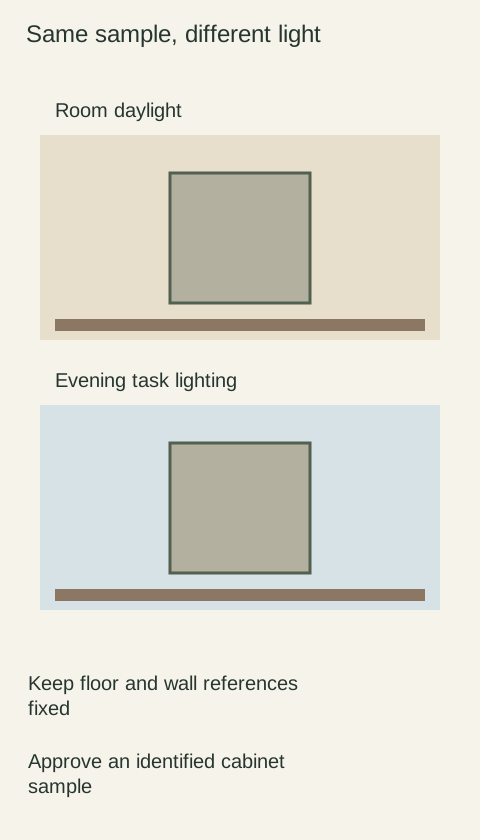
When a cabinet door and a neighboring panel match in daylight but separate visibly under room lighting, compare the pair under each relevant light source before changing either finish. One possible explanation is metamerism, but a casual room observation does not prove the cause. The immediate buying task is to find out whether the actual combination stays acceptable in normal use.
Diagram The diagram prompts a change of viewing conditions. It does not simulate metamerism or show measured colors for a real material pair.
Understand what the term describes
Konica Minolta describes metamerism as a color match between objects under one light source that fails under another, often involving different pigments or materials. It concerns the relationship between samples. A single cabinet simply looking warmer at night is not, by itself, evidence of a metameric pair.
This matters when coordinating a painted door with a different panel surface, edge treatment or separately supplied trim. Matching names and apparently similar daytime colors do not establish how those materials will look together under every lamp. Keep the exact product identities visible during the comparison so a favorable result does not accidentally approve a substitute material.
Give the pair the same viewing conditions
Place samples beside each other with comparable orientation, rather than comparing a door standing near a window with a panel lying under a lamp. Begin with clean, dry surfaces and avoid direct glare. Move yourself, not just one sample, when checking another viewing angle. If one piece is shaded or reflecting a bright object, correct that uneven setup before interpreting a difference.
Check the pair under daylight and the room’s normal electric lighting separately where practical, then in the mixture commonly used. Leave the surrounding references in place. Record which lights were on and whether the difference concerns hue, lightness or reflection. The exercise is a practical selection check, not a calibrated laboratory test, and no phone photo can settle it on its own.
Use a simple observation record
Write a short note for each condition: acceptable together, visibly different but acceptable, or unacceptable together. Describe which piece appears different and in what way. Avoid deciding in advance that a difference must come from a wrong batch, a defective coating or an incorrect lamp. Those are possible investigations, not findings supplied by the viewing exercise.
If a mismatch persists, give the supplier both sample identities and the conditions that reveal it. Ask whether the pieces were intended to coordinate or to be an exact match, and whether the finish constructions differ. A supplier or color specialist may need a more controlled comparison to investigate the cause. Your notes help them reproduce the concern without pretending to replace that assessment.
A worked comparison of a door and end panel
Imagine a door sample and an end-panel sample that look close beside the daytime window. Under the evening fixtures, the end panel appears pinker while the door remains more neutral to your eye. You place them in the same plane, remove a colored object reflected nearby and repeat the check. The pairing still bothers you.
The useful decision is whether to seek a revised compatible sample, accept a deliberately distinct panel appearance or reconsider the proposed lighting as part of the wider design. Do not buy new lamps merely to make the pair agree in one test while ignoring the rest of the room. Any replacement material or lighting choice should be checked with all of the important fixed surfaces before approval.
Approve the relationship you actually tested
Record the exact door, panel and trim finishes, along with the lighting conditions used for review and the physical samples that were accepted. A color name alone is too weak when several materials must work together. Do not promise that a pairing will match under every future bulb or every viewing condition; define the actual project conditions that matter.
At delivery, confirm the supplied identities before comparing appearance. If the combination differs from the approved pair, document the whole grouping, labels and relevant lighting. Preserve the original samples while the supplier assesses it. This gives the discussion a concrete basis without confusing a visual concern, a technical explanation and an agreed resolution.
Pure White
Cream White
Light Warm Gray
Gray
Navy
Black
Oak Tone
Dark Walnut Tone
Design study These finish studies are design references, not a list of currently orderable colors. Screens and lighting change the appearance; compare a physical sample before choosing.See all finish options →
A color name does not identify a finish system. Compare the decorative surface, the core, the edge and the repair method before choosing a cabinet front.
The sample shows the door frame, a separate center panel, the face frame and the cabinet box. Each component has its own place in this Shaker construction.
Shaker construction: door frame, center panel, face frame and cabinet box. The cutaway helps locate these parts; confirm each material in the specifications for the selected cabinet.
01 / Door frame
The Shaker door has rails and stiles around a separate center panel. The frame and center panel are different components; confirm their materials in the specifications for the selected cabinet.
02 / Face frame
The face frame surrounds the opening at the front of the cabinet box and sits behind the doors. The face frame, door frame and cabinet box are separate parts.
03 / Cabinet box
The sample exposes the cabinet sides, interior surfaces and layered edges. The image does not establish the wood species or material specification of a selected cabinet.