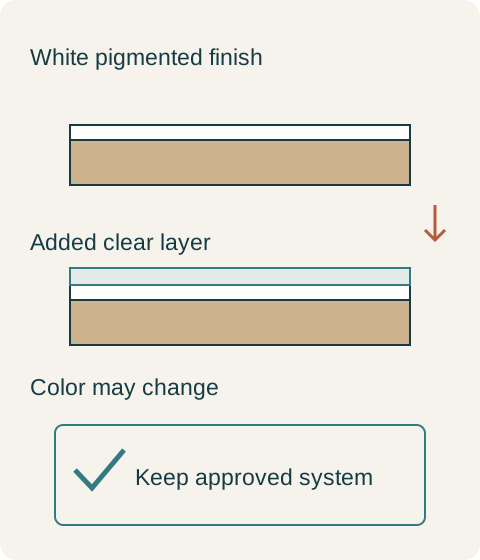
Do not approve a clear-coat upgrade merely because it adds another layer. Start with the named pigmented coating and its specified finishing system. Some cabinet paints supply the final exposed surface themselves; others are intended to receive additional compatible coatings. Compare the completed finish, including color, sheen and maintenance, rather than counting the products applied.
When the paint is already the final coating
General Finishes describes its Milk Paint as self-sealing and says a clear topcoat is not required for increased durability. Its instructions specifically caution against clear coats over its white and light paints because yellowing can occur. This is a concrete product example, not a rule that every cabinet paint needs no protective coat. An added clear layer over this white paint cannot be justified simply as the standard final step.
GF explains that a water-based clear coat can react with wood or an earlier finish, drawing out tannins, dyes or other substances. A liquid that dries clear in isolation does not guarantee a colorless result over an existing white cabinet finish. A trial can reveal an immediate problem but cannot reliably rule out a later change. This differs from selecting a white undertone against a countertop: the coating stack itself is changing.
Choose the sheen through the whole system
A buyer wanting a smoother, higher-sheen white finish should compare an appropriate pigmented system rather than assume transparent varnish is the only route. GF identifies its white pigmented polyurethane products as standalone alternatives and distinguishes them from clear topcoats used over darker colors. The applicator must follow the actual product instructions; similar brand names do not make preparation and application schedules interchangeable.
Teaching example Hypothetical decision: an optional clear layer is declined over the approved self-sealing white finish. The layers illustrate a choice, not thickness or a prediction of yellowing.
Keep the approved white finish
In a hypothetical repaint, the buyer approves a properly prepared sample finished with white GF Milk Paint, including its low-luster appearance. The contractor offers an added water-based clear layer as a durability upgrade. The buyer declines that addition and orders the documented Milk Paint system without clear. This retains the approved appearance and follows this product’s self-sealing route; it does not promise that white paint can never age or discolor.
If the buyer instead insists on another sheen, the order changes to a fully sampled, compatible pigmented system before production. The quote includes the actual preparation and application for that system. An unused clear-coat allowance is not silently converted into permission to use any other white coating. A new finish needs its own approved appearance, not only the original color name.
A clear label does not describe aging
GF’s retail comparison chart lists both non-ambering and ambering water-based topcoats. Enduro-Var II is listed as water-based and ambering, while High Performance is listed as non-ambering. This distinction concerns the finish’s own appearance; it does not cancel the substrate-reaction caution above. Neither “water-based” nor “clear” is a sufficient cabinet color specification.
Keep the coating name and version, preparation system, final sheen and approved complete sample with the order. Treat a later proposal for extra clear coats as a finish substitution requiring another appearance decision. The buyer can then pay for a defined result instead of buying extra layers on the assumption that more coating must always be better.
Pure White
Cream White
Light Warm Gray
Gray
Navy
Black
Oak Tone
Dark Walnut Tone
Design study These finish studies are design references, not a list of currently orderable colors. Screens and lighting change the appearance; compare a physical sample before choosing.See all finish options →
A color name does not identify a finish system. Compare the decorative surface, the core, the edge and the repair method before choosing a cabinet front.
Compare the actual countertop products, heat-source routine and fabrication proposal. A fired porcelain slab and resin-bound quartz are different materials, but neither label replaces a complete kitchen specification.
The sample shows the door frame, a separate center panel, the face frame and the cabinet box. Each component has its own place in this Shaker construction.
Shaker construction: door frame, center panel, face frame and cabinet box. The cutaway helps locate these parts; confirm each material in the specifications for the selected cabinet.
01 / Door frame
The Shaker door has rails and stiles around a separate center panel. The frame and center panel are different components; confirm their materials in the specifications for the selected cabinet.
02 / Face frame
The face frame surrounds the opening at the front of the cabinet box and sits behind the doors. The face frame, door frame and cabinet box are separate parts.
03 / Cabinet box
The sample exposes the cabinet sides, interior surfaces and layered edges. The image does not establish the wood species or material specification of a selected cabinet.