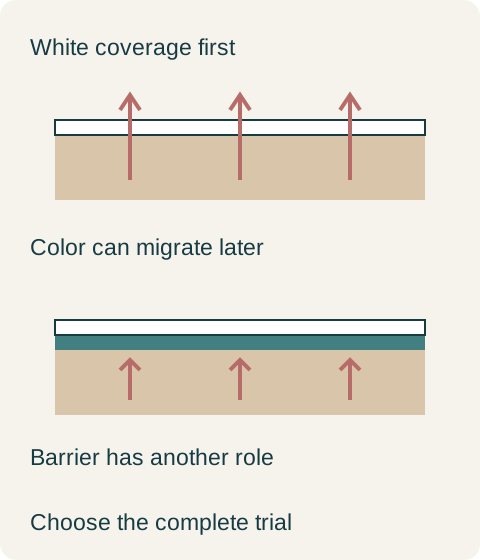
A cabinet refinishing quote that includes primer is incomplete unless the primer’s purpose matches the substrate. Covering a dark surface with a white layer is an appearance result at that moment. It does not, by itself, establish that color from the wood or an earlier finish will remain below the new coating. The distinction matters when a retained stained cabinet is being changed to a light painted finish.
Hiding and blocking are different functions
General Finishes describes its Enduro White Undercoat as a physical barrier and directs users toward Stain Blocker for wood exhibiting tannin bleed-through. This named comparison shows why primer cannot be treated as a single interchangeable step in every refinishing quote.
The company explains that a later topcoat can activate wood tannins or dyes from a previous finish, producing yellow or pink bleed-through. A system may therefore look covered before all of its intended layers have been applied. An attractive primer-only sample answers less than a completed sample of the proposed finishing sequence.
For the buyer, the specification should identify the existing substrate and the complete proposed system. Do not replace that information with a promise to add more white paint if a mark appears. Extra opacity and a compatible barrier address different tasks. The applicator still needs to establish adhesion and suitability over the retained finish; a stain-blocking description alone does not answer those questions.
Teaching example Hypothetical coating-section concept. Colored arrows represent possible migration, not a measured reaction, universal defect diagnosis or a layer-thickness specification.
Include the barrier stage shown in the completed door
Suppose a hypothetical retained stained door is used for the shop’s representative trial. Both proposals look white after the initial coating, but the first complete trial develops a pink area after its later coating. A second, compatible system that includes the specified stain-blocking stage produces the accepted completed trial. The buyer selects the second system for the refresh, including its preparation and barrier stage, instead of accepting the first proposal with an unspecified promise of extra paint.
In that hypothetical purchase, the finished trial and its substrate identity remain with the work order. The decision is to buy the demonstrated complete process, not to claim that the second primer can make every unknown old finish suitable. If replacement doors and retained frames have different substrates, each belongs in the scope assessment rather than being assumed identical because both will receive the same paint color.
A trial has useful but limited evidence
General Finishes also states that not all bleed-through can be prevented and that later staining remains possible even after testing. Accordingly, the accepted trial supports the chosen process for the assessed material; it is not an indefinite no-discoloration guarantee. A buyer who needs an outcome the retained substrate cannot support may need a replacement-component proposal instead.
At quote review, compare preparation, barrier function and completed finish together. A lower proposal that omits a needed stage is a different manufacturing scope. At acceptance, evaluate the finished door under the agreed conditions and retain the process record for any later investigation. Avoid calling every yellow mark tannin bleed: its location, timing and actual coating history still matter.
Pure White
Cream White
Light Warm Gray
Gray
Navy
Black
Oak Tone
Dark Walnut Tone
Design study These finish studies are design references, not a list of currently orderable colors. Screens and lighting change the appearance; compare a physical sample before choosing.See all finish options →
A color name does not identify a finish system. Compare the decorative surface, the core, the edge and the repair method before choosing a cabinet front.
The sample shows the door frame, a separate center panel, the face frame and the cabinet box. Each component has its own place in this Shaker construction.
Shaker construction: door frame, center panel, face frame and cabinet box. The cutaway helps locate these parts; confirm each material in the specifications for the selected cabinet.
01 / Door frame
The Shaker door has rails and stiles around a separate center panel. The frame and center panel are different components; confirm their materials in the specifications for the selected cabinet.
02 / Face frame
The face frame surrounds the opening at the front of the cabinet box and sits behind the doors. The face frame, door frame and cabinet box are separate parts.
03 / Cabinet box
The sample exposes the cabinet sides, interior surfaces and layered edges. The image does not establish the wood species or material specification of a selected cabinet.