Wet bar or dry bar: buy the entertaining space your home will actually use
A bar sink changes preparation and cleanup, but it does not make the kitchen unnecessary. Compare a complete wet-bar cabinet package with a dry serving cabinet before giving up drawers or adding plumbing.
Choose a wet bar when having water and a small sink at the entertaining area makes a recurring job meaningfully easier, and the complete installation fits the project. Choose a dry bar when the nearby kitchen already handles water and washing well, leaving the bar to serve drinks and hold glasses. A dry bar is not automatically a temporary version of a better wet bar. It can be the finished arrangement that gives the household more useful storage and a larger uninterrupted serving surface.
Start with an ordinary gathering rather than a photograph of a hotel lounge. Who prepares drinks, where do guests stand, and what happens to the used glasses? The answer may point toward a sink, but it may also show that the proposed cabinet mostly needs room for pitchers, trays and the glasses people already own. Buying a miniature second kitchen for that job can add equipment without improving the gathering.
What the added sink does—and what it leaves unfinished
Kohler's entertainment-sink catalog describes small sinks as helping with food or drink preparation and cleanup. That establishes a useful role for the category; it does not confirm that a listed model is currently offered or that a sink alone completes the washing process.
At a wet bar, the household may want to fill a pitcher, rinse a utensil or empty a remaining drink without walking back to the kitchen. Write down those particular jobs. Then examine the actual sink and faucet combination with the intended containers. A small basin that works for a glass may not suit the pitcher or serving vessel that motivated the purchase. The manufacturer’s installation and use requirements still govern the selected products.
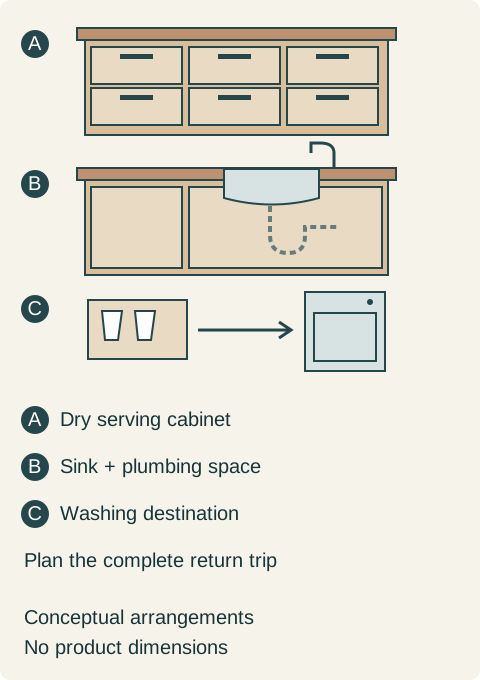
Separate rinsing from the household's complete washing routine. If used glasses ultimately go into the kitchen dishwasher, they still make that return trip. A sink can reduce some errands without eliminating the trip carrying dirty glasses. If a glasswasher or dishwasher is part of the proposal, it is additional equipment with its own capacity, loading, utility and installation requirements. Do not treat it as a feature included merely because the drawing says wet bar.
Teaching example Conceptual alternatives, not a cabinet plan. A shows a dry serving surface above drawers. B uses a schematic cutaway to show a sink and a plumbing compartment. C shows that used glasses still need a planned washing destination. Refrigeration and ice equipment are separate choices; sizes and installation details are not shown.
Water, cold drinks and ice are separate purchases
A dry bar may include refrigeration, and a wet bar does not necessarily include it. Similarly, keeping ice in a serving container is a different arrangement from purchasing an ice-making appliance. Decide those functions individually, then check how the selected combination changes the cabinet package and room.
For a proposed appliance, use the actual installation documentation to establish the opening, ventilation, connections and service access. A loose furniture opening is not proof that a freestanding refrigerator may be enclosed. Nor does an appliance hidden behind a cabinet front become ordinary storage. Leave the chosen equipment visible in the drawing, including its opening action and the person using it.
The same discipline prevents an unnecessary escalation. If the family normally brings a prepared pitcher from the kitchen and returns it after dinner, a cabinet with a clear serving surface may accomplish the job. A larger equipment package should earn its place through the way the space is used, rather than through a list of features associated with the word bar.
Count the storage that the sink displaces
Compare the complete fronts and interiors. The wet arrangement needs space for the basin and its plumbing, with access for installation and service. Do not count that same area as a full-depth drawer stack. The dry arrangement may offer a continuous top and useful drawers, but its actual dimensions and hardware still determine what fits.
Place the retained glasses, trays and supplies in both proposals. Tall glasses may suit an adjustable shelf; small accessories may be easier to organize in a drawer. A wide tray needs a usable opening and removal path. The preferred arrangement is the one that fits the real collection without forcing everyday supplies into another room merely to make room for a sink used occasionally.
Keep the surface usable during a gathering. Space for a tray of clean glasses, drink preparation and a temporary return tray can compete with a basin and faucet. A top can look generous when empty and feel crowded in use. Draw the working objects, not only the equipment cutouts, and preserve a place where the host can set something down safely.
Decide whether the room justifies the installation
A remote entertaining room can make repeated kitchen trips inconvenient. That supports studying a wet bar; it does not prove that its water supply, drainage and installation are simple. Have the responsible professionals determine the feasible work and its cost before committing to cabinets, surfaces or fixtures.
For a cabinet next to an existing kitchen, the return route may already be short and unobstructed. In that setting, adding plumbing can buy less convenience than the same work would in a distant room. Look at the whole route, including doors and the places guests occupy. Physical distance alone does not describe how easy the trip will be during a gathering.
Ask for proposals at the same finished stage. Include the selected cabinetry, exposed ends, top, fixtures, appliance scope and agreed installation work. Clarify which preparatory work is outside each proposal. A cabinet-only dry-bar price and a fully installed wet-bar price answer different questions. No general price multiplier is needed to compare the actual alternatives.
The dining-area owners keep the drawers
Consider a hypothetical dining area connected directly to the kitchen. The owners entertain with prepared drinks and want guests to take glasses without entering the cooking area. The kitchen remains the agreed washing destination. They initially request a sink because the inspiration photograph includes one.
Both proposals accommodate the same retained glass collection. In the wet-bar version, the sink compartment replaces the drawers intended for small serving supplies, so those supplies would move back to the kitchen. The dry version retains those drawers and a continuous surface for the pitcher and clean-glass tray. A separate return tray keeps used glasses together until someone carries them to the dishwasher.
The owners choose the dry cabinet after accepting its complete quote and confirming the short kitchen route. They are not giving up an independent washing station, because neither proposal included one. The rejected sink would have handled occasional rinsing while reducing storage they use at every gathering. Cold-drink and ice arrangements remain the existing ones in both proposals, keeping that comparison honest.
In a remote room with frequent preparation, the decision could reverse. A verified wet-bar installation may remove repeated water and rinsing trips that matter to the household. The buyer would still plan the final washing destination and purchase only the other equipment the room needs. The sink's value comes from those particular jobs, not from making the cabinet sound more complete.
Put the chosen use into the order
Before ordering, retain the accepted cabinet arrangement, sink and appliance identities where applicable, the contents assigned to each compartment, and the agreed installation scope. If the equipment changes, check the affected cabinet and surface details again. Similar-looking fixtures do not establish identical installation requirements.
Keep a usable route for both serving and cleanup. A successful dry bar lets the kitchen do work it already handles conveniently. A successful wet bar takes on specific repeated jobs at a location where that helps. Either can be a considered, complete cabinet purchase; the difference is the work the room is expected to perform.
Pure White
Cream White
Light Warm Gray
Gray
Navy
Black
Oak Tone
Dark Walnut Tone
Design study These finish studies are design references, not a list of currently orderable colors. Screens and lighting change the appearance; compare a physical sample before choosing.See all finish options →
An extra sink earns its cabinet space when it creates an independent preparation station. Compare that gain with the drawers, uninterrupted worktop and access the new sink removes.
The sample shows the door frame, a separate center panel, the face frame and the cabinet box. Each component has its own place in this Shaker construction.
Shaker construction: door frame, center panel, face frame and cabinet box. The cutaway helps locate these parts; confirm each material in the specifications for the selected cabinet.
01 / Door frame
The Shaker door has rails and stiles around a separate center panel. The frame and center panel are different components; confirm their materials in the specifications for the selected cabinet.
02 / Face frame
The face frame surrounds the opening at the front of the cabinet box and sits behind the doors. The face frame, door frame and cabinet box are separate parts.
03 / Cabinet box
The sample exposes the cabinet sides, interior surfaces and layered edges. The image does not establish the wood species or material specification of a selected cabinet.