A voice-connected bathroom mirror or lighting you control locally?
Buy voice operation for a task the household wants to perform, with its account and service requirements understood. Keep local lighting control when that already serves the bathroom; a connected mirror is not automatically a better mirror, light or storage solution.
Decide whether you want a connected product in this room
Choose a voice-connected mirror when speaking a particular command would improve a routine you actually have, and the household accepts the associated setup and ongoing account arrangements. Choose a locally controlled lighted mirror when operating its light directly already works well. The difference is not simply an extra button: one purchase includes a relationship with connected services as well as the physical mirror.
A showroom demonstration can make that relationship almost invisible. Someone else has already supplied the account, network and configuration. A successful command proves that the display responds in that state. It does not show who will set up the purchased mirror, which supported functions the household will use, or how other users will operate the light without that person's phone.
Separate the physical controls from the voice feature
Kohler's Verdera Voice quick reference describes an Amazon account, apps and Wi-Fi setup for voice operation. It separately describes a manual lighting control on the mirror.
Those are different operating paths. The presence of a local control should not be confused with a guarantee that every feature works without a connection. Nor should a voice-enabled label lead a buyer to assume there is no manual alternative. Ask the supplier to demonstrate the exact model's supported behavior, including the light control that household members and guests would normally use.
Make the demonstration answer a real question: can this person reach and understand the control in the proposed basin arrangement? If they want voice control to avoid a particular reach, try that particular task. Do not treat a successful sales command as proof that every spoken request, language or other smart-home device is supported.
Before assigning value to a connected feature, confirm that the required setup and services are currently supported for the offered product. An instruction manual describes an operating arrangement; it is not a promise that a remote service will remain available for the life of the glass. Ask what the supplier provides at handover and what continuing support covers, without assuming either permanent support or inevitable failure.
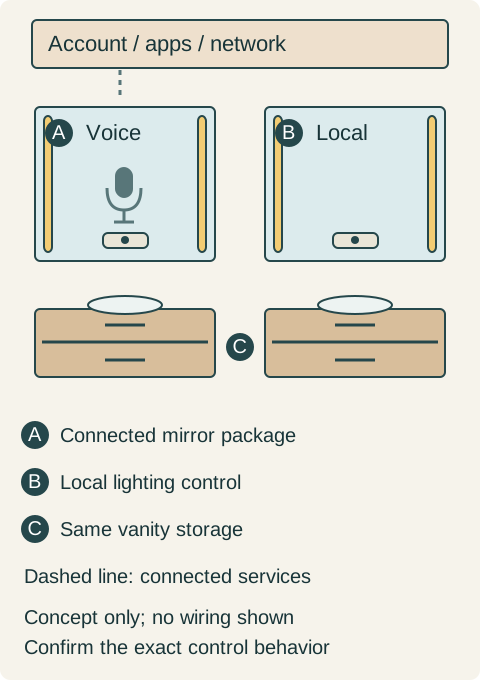
Diagram Conceptual purchase comparison. A links a voice-enabled mirror to the account, app and network arrangements that its selected system requires; the dashed line is a service relationship, not a wiring diagram. B represents a mirror with local lighting control. C keeps the same reviewed vanity storage in both alternatives. The diagram does not claim that every mirror supports the same online or offline functions.
The account belongs in the handover, not inside a vague installation charge
Agree who establishes the household's account and who demonstrates the accepted functions. Do not leave the bathroom depending on an installer's personal account simply because that is how the demonstration was made to work. The owner should know the normal control route, the relevant account responsibilities and the manufacturer's process for a later change of user or network.
These are purchasing questions, not a reason to turn the cabinet order into a software project. A buyer who already uses a compatible ecosystem may find the setup ordinary. Another household may prefer to avoid maintaining another connected product in a shared bathroom. Both preferences are legitimate, but they should be stated before the feature is credited as an improvement.
Include people who will not manage the account. A guest or family member may only want light at the mirror. Show how that person operates the selected product under its documented conditions. If a control is difficult to find or reach, resolve that issue in the complete mirror-and-vanity arrangement rather than expecting the primary account holder to handle every use.
Keep the ordinary bathroom purchase equally complete
Compare actual reflection, useful face lighting, physical controls and installation scope in both alternatives. Voice operation cannot make a poorly placed mirror give a better view, and it does not establish that the light suits grooming. Keep the lighting demonstration focused on the person's task and the proposed room, not just whether a command changes brightness.
Also identify whether either product actually includes storage. A flat mirror with electronic features is not a medicine cabinet. If replacing a storage mirror, show where its contents will go and include that cabinet work in the quote. If both alternatives use the same already suitable vanity storage, keep that constant so that the connected feature is not given credit for an unrelated drawer change.
Ask the seller to distinguish the physical installation from setup and demonstration of the functions purchased. Electrical work remains with the responsible professionals and the actual product instructions. A working reflection, a powered light and an accepted voice function are not interchangeable completion criteria. The handover should show the behavior the owner agreed to buy.
A shared bathroom stays with local control
Consider a hypothetical household replacing a plain mirror above a vanity whose drawers already hold the daily supplies. The owners compare a voice-connected flat mirror and a locally controlled lighted mirror. Both proposed arrangements pass their reflection and face-lighting trials, and both retain the same vanity, room lighting and storage. Neither adds hidden shelves.
The connected demonstration works, but the owners cannot identify a recurring task they want to perform by voice. They normally set the light directly and prefer other bathroom users to do the same. The proposed local control is reachable and understandable from the chosen basin position. They decide that managing the additional connected setup is not worthwhile for the way this room is used.
They select the locally controlled mirror and accept its complete installation proposal. They remove the connected mirror and its setup scope from the order; they do not add a speaker or another device merely to reproduce a feature they did not need. The vanity remains as selected, because storage was already resolved in both proposals.
A household with a useful, demonstrated voice task could reasonably choose the connected alternative instead. It should buy the confirmed package, including the agreed owner setup and ordinary control behavior. The sensible distinction is a feature the users will use and support, rather than assuming that connectivity makes the whole bathroom more capable.
Pure White
Cream White
Light Warm Gray
Gray
Navy
Black
Oak Tone
Dark Walnut Tone
Design study These finish studies are design references, not a list of currently orderable colors. Screens and lighting change the appearance; compare a physical sample before choosing.See all finish options →
Choose the event that should turn a cabinet light on before buying a sensor. Door position, deliberate hand control and timed motion detection serve different routines.
Compare a plain mirror cabinet, user-started defogging and automatic defogging as complete purchases. The useful difference is what happens during the real grooming routine, not how many electronic features appear in the listing.
The sample shows the door frame, a separate center panel, the face frame and the cabinet box. Each component has its own place in this Shaker construction.
Shaker construction: door frame, center panel, face frame and cabinet box. The cutaway helps locate these parts; confirm each material in the specifications for the selected cabinet.
01 / Door frame
The Shaker door has rails and stiles around a separate center panel. The frame and center panel are different components; confirm their materials in the specifications for the selected cabinet.
02 / Face frame
The face frame surrounds the opening at the front of the cabinet box and sits behind the doors. The face frame, door frame and cabinet box are separate parts.
03 / Cabinet box
The sample exposes the cabinet sides, interior surfaces and layered edges. The image does not establish the wood species or material specification of a selected cabinet.