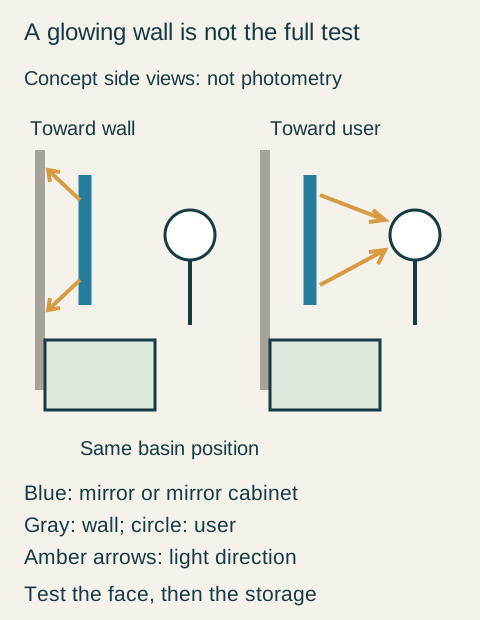
Choose a lighted vanity mirror by what it lets you see at the basin, not by the brightness of its outline in a room photograph. Light aimed mainly at the wall behind the mirror and light delivered toward the user do different jobs. Before removing separate vanity lights or trading a mirror cabinet for a flat mirror, verify which job the selected product actually performs.
Look beyond the catalog label
The U.S. Department of Energy's residential lighting guide treats the vanity mirror as a demanding task area. Its bathroom section discusses illuminating the face from the sides as well as above to reduce shadows. This is a lighting-design principle, not proof that any particular illuminated mirror will suit your room.
Product names do not reliably describe the whole light path. Claris identifies BOCA as forward-lighting and explains that its backlit MORENO also passes light forward through a frosted border. Those documented constructions show why the exact emitting surfaces matter more than a simple front-lit or backlit category.
Ask which surfaces emit light, which controls operate them and whether the manufacturer supplies relevant performance information. A photograph of a bright wall halo cannot establish the light on a person's face. Conversely, do not reject a product solely because its LEDs sit behind the glass; the diffuser and exposed light openings may send useful light forward.
The distinction also changes the cabinet purchase. A flat illuminated mirror may give the desired lighting but provide no storage. A lighted mirror cabinet may preserve storage while projecting farther toward the user. A plain cabinet with separate fixtures can remain a viable combination. Compare those complete arrangements rather than declaring a single mirror feature the winner.
Test from the basin position you will keep
Teaching example Concept side views compare light directed toward the wall behind a mirror (left) with light directed toward the user (right). Amber arrows show intended emission direction, not measured beams or brightness. The green shape is the basin cabinet and the circle represents the user. Some products combine both directions; evaluate the exact mirror or cabinet, not its category name.
Use the actual proposed product or a representative lighting demonstration with the same emission arrangement. Stand where the cabinet depth and basin place you. Look at the ordinary detail you need for shaving, makeup or grooming without leaning into a special pose that you would not maintain at home.
Include the room lighting intended for that task. Extra showroom illumination can conceal what the mirror contributes, while a demonstration in darkness can misrepresent a normally lit bathroom. Have the lighting provider compare the intended conditions. Note shadows, uncomfortable brightness and whether the task remains clear for each user, rather than treating a photograph or a general brightness claim as the test result.
For a mirrored cabinet, open the door and retrieve the daily kit, then close it before repeating the reflection test. Confirm that the chosen cabinet projection and open door still work with the basin and neighboring fixtures. Lighting that looks good with the door closed does not resolve a separate opening conflict.
Compare the whole purchase, not just the glowing edge
In a hypothetical renovation, the owners want to remove the existing above-mirror fixture for a cleaner elevation. They initially choose a flat mirror whose light mainly washes the wall. At the demonstrated basin position, with the proposed room lighting, the face remains poorly lit for their grooming task. They reject that combination; the attractive wall effect does not justify deleting the task light.
A second hypothetical option is a flat mirror with forward task lighting. It passes their viewing trial, but removing the old mirror cabinet also removes the convenient shelf space for their daily items. The proposed vanity's drawers are already assigned to items they use there, and the owners do not want a loose countertop organizer. They would have to change the storage plan as part of this option.
They then compare a lighted mirror cabinet whose forward output passes the same trial. Its shelf layout holds the daily group, its door works in the reviewed basin layout, and its mounting and power requirements suit the planned work. They choose this cabinet and retain the selected base vanity. The flat mirror is not defective; it simply requires a storage change they do not prefer.
Decide which light can actually be removed
The original fixture is removed from the plan only after the complete replacement arrangement has been reviewed. A mirror that helps with face lighting does not automatically replace lighting for the shower, toilet or the route through the room. The lighting professional checks those functions separately and confirms the selected controls and installation requirements.
If the preferred mirror offers a wall glow as well, treat it as an additional effect unless the actual comparison shows it contributes enough to the intended task. The order should identify the selected mirror cabinet and lighting configuration, not merely say "LED mirror." That preserves both the tested view and the storage the buyers decided to keep.
Pure White
Cream White
Light Warm Gray
Gray
Navy
Black
Oak Tone
Dark Walnut Tone
Design study These finish studies are design references, not a list of currently orderable colors. Screens and lighting change the appearance; compare a physical sample before choosing.See all finish options →
Add the dimensions that contribute to the finished assembly, including lights and required end pieces. The sum of the mirror-cabinet widths alone can understate what must fit above the vanity.
The sample shows the door frame, a separate center panel, the face frame and the cabinet box. Each component has its own place in this Shaker construction.
Shaker construction: door frame, center panel, face frame and cabinet box. The cutaway helps locate these parts; confirm each material in the specifications for the selected cabinet.
01 / Door frame
The Shaker door has rails and stiles around a separate center panel. The frame and center panel are different components; confirm their materials in the specifications for the selected cabinet.
02 / Face frame
The face frame surrounds the opening at the front of the cabinet box and sits behind the doors. The face frame, door frame and cabinet box are separate parts.
03 / Cabinet box
The sample exposes the cabinet sides, interior surfaces and layered edges. The image does not establish the wood species or material specification of a selected cabinet.