Is a defogging mirror cabinet worth buying—and which control suits you?
Compare a plain mirror cabinet, user-started defogging and automatic defogging as complete purchases. The useful difference is what happens during the real grooming routine, not how many electronic features appear in the listing.
Buy a usable reflection, not an impressive feature list
Choose a defogging mirror cabinet when using the mirror soon after showering is important enough to justify the complete powered cabinet package. Retain or choose a plain cabinet when the ordinary routine works without that function. If defogging is wanted, compare how it starts as carefully as the shelves and door: a manually started feature and an automatic one ask different things of the user.
First identify the inconvenience. Is the problem a temporarily obscured reflection, poor face lighting, insufficient storage or persistent moisture in the room? A defogger addresses the mirror task described by its manufacturer. It does not establish that the lighting is suitable or that the room's moisture problem has been corrected. Paying for all the options can still leave the original problem unresolved.
Automatic shutoff is not automatic startup
Robern's cited Uplift Tech instructions describe starting the defogger with a button and a subsequent timed shutoff. The user can also stop it manually. That documented behavior requires a start command; the timer does not supply one.
The cited M Series Reserve instructions describe automatic mirror defogging without user interaction, with a red indicator when active. That is a different operating mode. Confirm the exact equipped configuration instead of assigning this feature to every cabinet in the series.
These are examples from the identified documents, not a declaration that the two collections are otherwise interchangeable. Their opening mechanisms, mounting requirements and available configurations need their own review. A control mode can help narrow the search; it cannot make an unsuitable cabinet fit the wall.
For a manual system, locate the actual start control and rehearse reaching it during the normal sequence. Ask when the manufacturer intends it to be activated and what happens if the user forgets. For an automatic system, obtain the applicable operating instructions, including power and override behavior. Do not assume that an illuminated button is always the defogger control; a cabinet can have separate lighting functions and indicators.
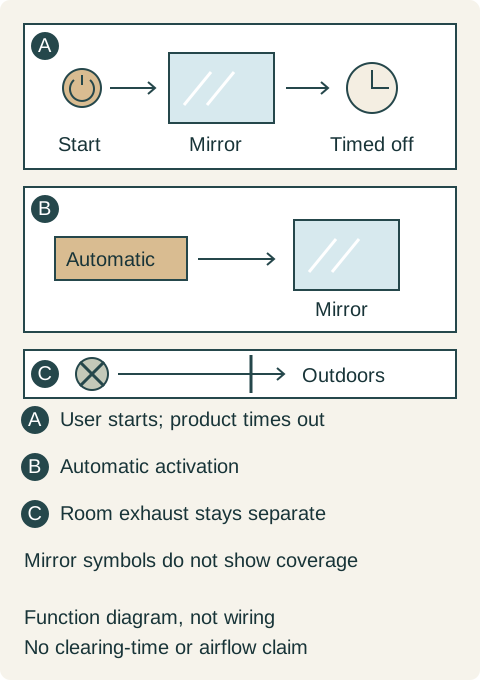
Teaching example Original function diagram for two equipped mirror-cabinet options. A represents user activation followed by the product’s timed operation; B represents automatic activation without a user start command. C shows bathroom exhaust as a separate room function, with air leaving the room. Mirror symbols are not clearing-area maps. The plain-cabinet alternative is discussed in the article. No wiring, sensor threshold, clearing time or product shape is specified.
A timer does not promise an instantly clear mirror
The period before automatic shutoff is an operating duration, not a statement of how quickly a fogged mirror will clear. Similarly, the word automatic does not establish immediate results whenever someone enters the bathroom. Ask the supplier what performance and coverage information applies to the exact product, and distinguish documented information from an attractive demonstration.
Do not assume the entire mirrored face or every door receives the same treatment. Establish the relevant viewing area and whether it suits the users at their actual basin positions. If that information is unavailable, leave the whole-face claim unresolved. A person who must move to an awkward position to find a usable reflection has not necessarily gained the convenience sought.
A dry showroom test can show where controls are, how a door moves and whether the shelves work. It cannot by itself demonstrate post-shower defogging. Ask for appropriate product evidence or a representative demonstration without inventing a universal clearing time. Also confirm what remains usable and what service is available if the electrical feature stops working; a service assumption should not be hidden in the purchase decision.
Keep ventilation in the bathroom plan
EPA's bathroom-remodeling guidance treats ventilation as a way to remove unwanted room moisture. It calls for checking actual fan performance and exhausting outdoors, rather than assuming that a running motor proves the job is done.
A clear mirror is therefore not a measurement of room humidity or proof of adequate exhaust. Keep any required ventilation assessment and moisture repair in the project even when buying the defogging option. Conversely, a room-ventilation improvement does not tell you whether this particular household will like the mirror during its preferred grooming sequence. Evaluate both jobs without offering one as a substitute for the other.
This distinction affects the budget discussion. Compare the optional mirror-cabinet upgrade with the plain-cabinet arrangement after retaining the necessary room work in both proposals. Deleting ventilation work to make the electronic cabinet appear affordable would compare different scopes, not alternative mirrors for the same bathroom.
Compare three complete arrangements
A plain mirror cabinet with suitable separate lighting remains a real option. It may preserve the desired shelves and avoid purchasing a function the household seldom needs. The owners must accept how and when they use the mirror after showering; calling that choice basic does not make it unsuitable.
A cabinet with user-started defogging may suit someone who prefers deliberate control and can incorporate activation into the routine. An automatically operated version may suit people who value avoiding that extra action. Neither mode guarantees superior storage or task lighting. Include the usable interior, door movement, selected lighting, professional installation scope and support for the exact electrical package in each comparison.
Avoid replacing a mirror cabinet with a flat defogging mirror without assigning its storage elsewhere first. Those are different complete purchases. A successful reflection feature is not compensation for leaving daily supplies without a practical place, and a larger base vanity may not be the change the owners intended to buy.
The household wants the feature without another remembered step
In a hypothetical renovation, two adults use the mirror after showering at varying times. They want to keep daily grooming supplies above the basin and retain their chosen base vanity. The plain-cabinet proposal fits the storage brief, but its accepted routine would require waiting or changing the sequence; the owners do not want that compromise.
They compare two equipped cabinet proposals whose shelf layouts, viewing positions, opening paths and installation scopes have been reviewed for this hypothetical room. The user-started option would work if they activated it as instructed, but both identify remembering another step as the inconvenience they want to avoid. A timed shutoff alone does not satisfy that preference.
They select the automatically operated cabinet after the supplier confirms the intended configuration and provides suitable evidence for their mirror-use expectations. They keep the reviewed lighting and the room's ventilation work in the purchase scope. The ordinary vanity drawers remain as selected because the new cabinet still houses the daily group. Their decision buys a particular operating convenience, not a promise of an always-dry bathroom.
If the required operating behavior or relevant mirror performance cannot be confirmed, hold that configuration out of the order. The alternative is a documented manual system the household will actually operate, or the plain cabinet with an accepted routine. A specific choice is useful only when the user knows what it will ask them to do.
Pure White
Cream White
Light Warm Gray
Gray
Navy
Black
Oak Tone
Dark Walnut Tone
Design study These finish studies are design references, not a list of currently orderable colors. Screens and lighting change the appearance; compare a physical sample before choosing.See all finish options →
The sample shows the door frame, a separate center panel, the face frame and the cabinet box. Each component has its own place in this Shaker construction.
Shaker construction: door frame, center panel, face frame and cabinet box. The cutaway helps locate these parts; confirm each material in the specifications for the selected cabinet.
01 / Door frame
The Shaker door has rails and stiles around a separate center panel. The frame and center panel are different components; confirm their materials in the specifications for the selected cabinet.
02 / Face frame
The face frame surrounds the opening at the front of the cabinet box and sits behind the doors. The face frame, door frame and cabinet box are separate parts.
03 / Cabinet box
The sample exposes the cabinet sides, interior surfaces and layered edges. The image does not establish the wood species or material specification of a selected cabinet.