Should cabinet lights follow the door, your hand or movement in the room?
Choose the event that should turn a cabinet light on before buying a sensor. Door position, deliberate hand control and timed motion detection serve different routines.
For an enclosed pantry, the useful request may be simple: light the contents whenever the door is open. For a glass-front display, the owner may want the light on while the doors stay closed. Those requests call for different control behavior. Decide what should trigger the light before ordering something described only as automatic or touchless.
A sensor is not a lighting purpose. It can respond perfectly to the event it was designed to detect and still frustrate the person using the cabinet. A door-controlled display that goes dark when closed, or a timed light that switches off during a quiet search, can be the wrong purchase without being a defective product.
Door position is a clear signal for enclosed storage
Armacost describes its pressure-operated cabinet switch as turning the light on when a door or drawer opens and off when it closes. That named function follows the furniture position rather than requiring a separate hand command.
The cabinet must provide a suitable, repeatable relationship between the moving front and the selected switch. Ask the cabinet and lighting suppliers to coordinate that detail. A switch cannot simply be added wherever it is easiest to hide if the closed door does not operate it as intended.
For paired doors, explain the expected result: either door open should illuminate the shared interior, and both closed should turn it off. Have the supplier demonstrate an approved arrangement that delivers that result. Do not assume that a switch watching one leaf knows what the other leaf is doing, or improvise a wiring scheme from the desired behavior.
Include soft-close travel and final door alignment in the demonstration. The doors should close normally, without the owner pressing a corner to make the light respond. A display sample can prove the operation more clearly than a photograph showing a tiny sensor near a hinge.
A hand-controlled light stays separate from the cabinet door
Armacost's touchless dimmer uses infrared sensing for deliberate hand operation, including switching and dimming. It is a different function from the company's pressure-operated door switch, even though both avoid a conventional wall-switch action.
This can suit a display that should remain lit behind closed doors or a work surface where the user wants an intentional command. Place the sensor where that command is easy to perform. Hiding it behind stored objects can turn a convenient gesture into a search for an invisible target.
Test ordinary tasks near the proposed sensor: reaching for a mug, wiping the cabinet edge, returning a tall container and opening the adjacent door. If those movements change the light unintentionally, revise the location or choose another control. The objective is not merely to activate the light once during a demonstration; it is to separate the intended command from everything else people do there.
The command also needs to be understandable to a guest. Decide whether the appearance benefit of a concealed sensor is worth explaining its location. A visible, easily reached control can be the better choice for a cabinet used by many people.
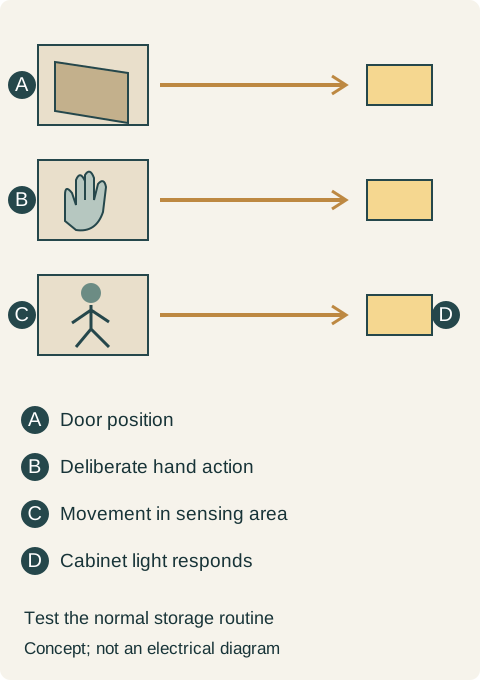
Teaching example Three control concepts: A responds to the door position, B to a deliberate hand action, and C to movement within the selected sensor’s field. D represents the cabinet light. Arrows show triggers, not wiring, detection angles or installation distances.
Motion detection has its own timing and conditions
Armacost's named PIR switch activates in darkness when it detects motion and switches off after a period without detection. Its behavior includes both an ambient-light condition and timing, not just whether a cabinet door is open.
That distinction matters for a person standing still to read package labels or arrange a collection. Try the longest normal quiet task, not just walking up to the cabinet. If the light goes out before the task is finished, check the actual permitted settings and coverage; do not assume every sensor has an adjustable delay or detects an unmoving person.
Also test the room with its normal other lights on. A product designed to activate only in darkness may behave differently from what a buyer expects in a bright kitchen with a shadowed cabinet interior. Darkness at the sensor and visibility inside the cabinet are not interchangeable conditions.
Nearby circulation matters as well. The household may welcome a light that responds to approaching the pantry, or may dislike a display flashing on whenever someone crosses the room. Evaluate the intended sensing area with the proposed furniture placement. These are selection observations, not a calculation of a universal detection distance.
An enclosed pantry and a display get different controls
Consider a hypothetical kitchen where the owners frequently leave a pantry door open while finding ingredients. They also have a glass-front dish cabinet that provides evening display light. They initially ask for the same motion control everywhere to simplify the order.
In the proposed pantry trial, the timed behavior interrupts a quiet label-reading task. The owners instead select a coordinated door-position arrangement: opening either pantry leaf lights the interior, and closing both turns it off. They verify normal closure and the behavior with either leaf open. Their decision follows the task without requiring repeated gestures.
For the dish cabinet, opening the door is not the desired trigger. They select a separately demonstrated hand control that remains usable with the doors closed and is clear of the normal mug-retrieval path. They accept showing guests where it is. The two controls are intentionally different because one supports storage access and the other supports a chosen display scene.
Include the control in the complete lighting package
Identify the proposed fixture, power supply, control and any required interface together. Matching plugs or the word LED does not prove compatibility. The responsible supplier should confirm the electrical combination and installation requirements; the buyer's operating trial does not replace that review.
Keep control components accessible for their specified service and cleaning needs. A sensor head, its connection and the power supply need a coordinated location before cabinetry closes the route. Review what happens after normal power interruption and whether any selected setting must be restored, rather than assuming memory behavior from a different showroom system.
The order should state the operation in ordinary language alongside the component identities. Opening either pantry door turns the light on; closing both turns it off. The display is controlled intentionally with its doors closed. Those sentences let the final walkthrough check the function the household actually purchased.
Pure White
Cream White
Light Warm Gray
Gray
Navy
Black
Oak Tone
Dark Walnut Tone
Design study These finish studies are design references, not a list of currently orderable colors. Screens and lighting change the appearance; compare a physical sample before choosing.See all finish options →
A dimmer does not always preserve the same white light. Compare linked warm-dimming, separate white-color control and fixed-white dimming through the kitchen tasks you actually use.
A light rail can hide a fixture while also blocking useful light. Compare the work surface and seated sightline before finalizing the cabinet underside.
The sample shows the door frame, a separate center panel, the face frame and the cabinet box. Each component has its own place in this Shaker construction.
Shaker construction: door frame, center panel, face frame and cabinet box. The cutaway helps locate these parts; confirm each material in the specifications for the selected cabinet.
01 / Door frame
The Shaker door has rails and stiles around a separate center panel. The frame and center panel are different components; confirm their materials in the specifications for the selected cabinet.
02 / Face frame
The face frame surrounds the opening at the front of the cabinet box and sits behind the doors. The face frame, door frame and cabinet box are separate parts.
03 / Cabinet box
The sample exposes the cabinet sides, interior surfaces and layered edges. The image does not establish the wood species or material specification of a selected cabinet.