How to check a cabinet certification before you approve the order
Match the certification to the manufacturer and cabinet line being quoted. A company name, an old certificate and a test claim are different pieces of evidence.
If a cabinet proposal relies on KCMA quality certification, verify the specific line before treating the claim as part of your purchase. The seller's name may differ from the manufacturer, and a familiar company name does not resolve which construction is being offered. Ask for the line designation used on the order acknowledgment, then connect it to current certification information.
KCMA describes its quality program as testing cabinet structure, door and drawer operation, and finishes. That is broader than a loose hinge or surface demonstration. It is still a defined program, not an answer to every installation or maintenance question. This guide does not claim that any usaKT.com cabinet is certified.
KCMA's certified-company directory offers separate filters for quality, environmental and severe-use certification. Read the selected category. Evidence for one program should not silently stand in for another requirement written into your project. A general company listing is a useful starting point for identity, but the purchase needs the relevant program and product scope.
Keep the wording exact when a dealer provides a document. Tested to a standard, certified under a program and manufactured by a listed company are not interchangeable statements. A laboratory report may support a specific result without establishing permission to use a certification mark. Record what the document actually establishes rather than editing it into a stronger claim in the bid comparison.
Read the scope and date together
A historical certificate published by KCMA illustrates why the full document matters: it refers to named cabinet lines, carries issue and expiration dates, and directs readers to current listing information. It is evidence of how a certificate is scoped, not evidence that those lines remain certified today. Use an older PDF to identify what needs checking, then obtain the current record.
Do not crop away the product names or date when saving evidence. If the record covers several pages, retain the page naming the lines as well as the page explaining validity. A screenshot of only the seal loses the information needed to connect the claim to your order. Save the source location and the day it was checked with the project documents.
Resolve a mismatch before choosing the cheaper alternative
Consider a hypothetical builder comparing two cabinet proposals. Both meet the room layout. Proposal A identifies a line whose current quality certification is confirmed for the proposed scope. Proposal B comes from the same manufacturer, but its different construction line is not named in the supplied document. The builder's specification requires that quality certification.
The builder asks for clarification of Proposal B and receives no matching current evidence before selection. It remains an unresolved alternative; the absence of a matching record is not proof that its cabinets failed a test. The builder selects Proposal A because its documented scope meets the stated requirement. The drawing and order acknowledgment retain that exact line, so a later lower-priced substitution cannot inherit the earlier approval.
A homeowner without that specification may weigh other documented performance evidence and still choose a different line. That is a different decision. The important step is making it openly, rather than comparing two prices as if their supporting evidence were identical. Do not invent a certification premium or a lifespan saving without a project-specific basis.
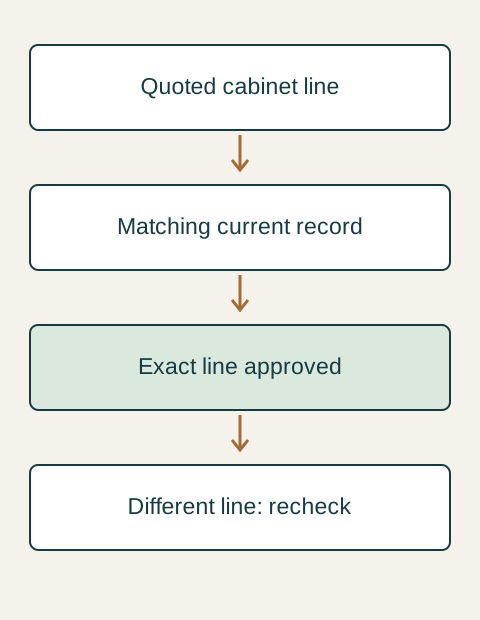
Teaching example Hypothetical document check: approval follows the quoted line and its matching current record. Substituting a different line requires a new check. This diagram is not a certification seal.
Keep installation and warranty questions separate
A verified certification does not establish the strength of your wall, the condition of hidden framing or the suitability of an installer’s fasteners. It also does not tell you what delivery damage, replacement labor or a finish repair will cost. Review the installation instructions and warranty for the selected cabinet independently.
At order approval, retain the quoted manufacturer and line, the relevant current evidence, and the configuration the evidence covers. If the supplier changes the line or construction, reopen that comparison before release. The finished record should let another buyer identify exactly what was selected and why, without relying on a logo copied onto the sales sheet.
Pure White
Cream White
Light Warm Gray
Gray
Navy
Black
Oak Tone
Dark Walnut Tone
Design study These finish studies are design references, not a list of currently orderable colors. Screens and lighting change the appearance; compare a physical sample before choosing.See all finish options →
A dramatic clip may show one surface or joint under one condition. Look for the tested assembly, method and result before applying it to a whole cabinet.
The sample shows the door frame, a separate center panel, the face frame and the cabinet box. Each component has its own place in this Shaker construction.
Shaker construction: door frame, center panel, face frame and cabinet box. The cutaway helps locate these parts; confirm each material in the specifications for the selected cabinet.
01 / Door frame
The Shaker door has rails and stiles around a separate center panel. The frame and center panel are different components; confirm their materials in the specifications for the selected cabinet.
02 / Face frame
The face frame surrounds the opening at the front of the cabinet box and sits behind the doors. The face frame, door frame and cabinet box are separate parts.
03 / Cabinet box
The sample exposes the cabinet sides, interior surfaces and layered edges. The image does not establish the wood species or material specification of a selected cabinet.