What does a cabinet durability demonstration actually prove?
A dramatic clip may show one surface or joint under one condition. Look for the tested assembly, method and result before applying it to a whole cabinet.
A short video can make a cabinet material look remarkably tough. It may also leave out the information needed to use that result when buying cabinets. A surface sample, a shelf, a joint and a complete installed assembly answer different questions. Watch for what was actually tested, how it was tested and what result was measured before treating the demonstration as a promise about everyday use.
Identify the thing being demonstrated
Is the object a loose material sample, a finished door, a drawer assembly or a whole cabinet with its mounting system? Look for the product identity and configuration. A strong result on one component does not automatically describe another component made from similar-looking material. Likewise, a hardware demonstration may not represent that hardware installed in the cabinet you are considering.
For example, a clip showing a finished board resisting a brief spill leaves the joints and edges of a cabinet outside the demonstration unless they are part of the specimen. That does not make the clip worthless. It makes it a narrow observation. Keep the conclusion tied to the exposed surface and the stated conditions, rather than changing it into a claim that an entire vanity is waterproof.
Look for conditions and a defined result
A useful test description identifies how the specimen was supported, the applied condition, its duration and what counted as a pass or failure. A video ending while the object still looks intact may not show the later inspection or whether it continues to operate correctly. Ask for the reported method and result rather than estimating performance from the most dramatic moment.
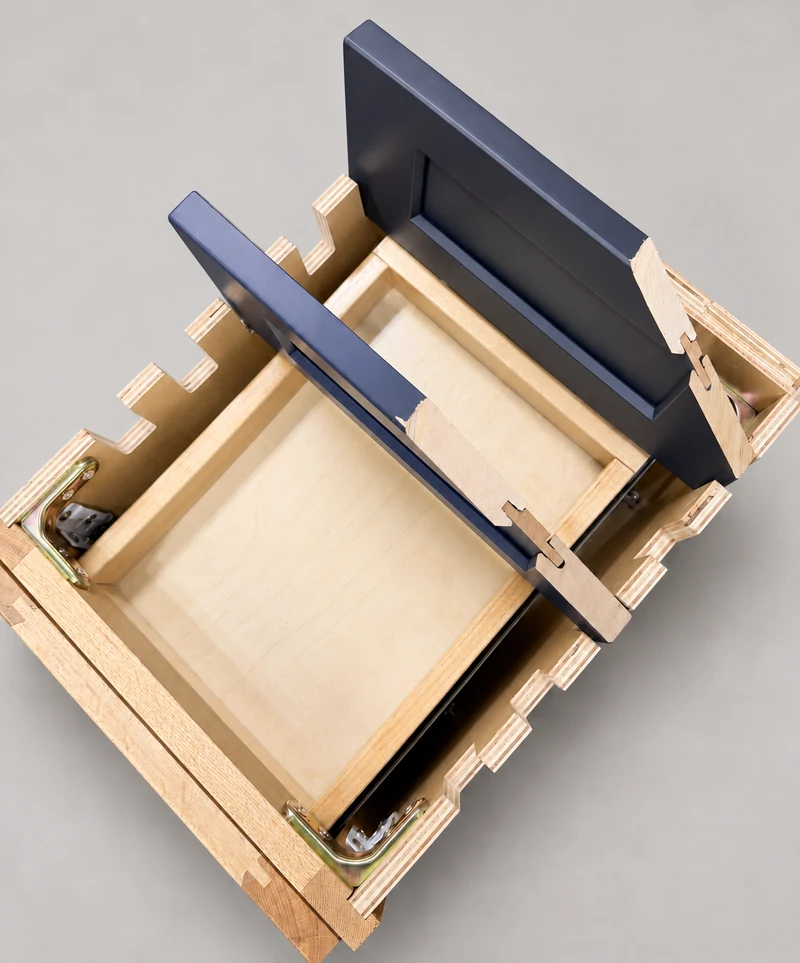
Physical sample Cabinet performance involves components and their connections. This photograph is a construction illustration, not a test result.
For a documented program example, KCMA describes testing across cabinet structure, door and drawer operation, and finish quality. The separate categories show why one demonstration cannot answer every performance question. This example does not state that usaKT.com products hold KCMA certification.
Two videos are not comparable merely because both show weight or liquid. Different specimen sizes, supports, exposure conditions or endpoints can change what the demonstration means. If the methods are not identified, keep the results separate. Do not turn unlike clips into a ranking based on which one looks more punishing.
Also distinguish a test condition from an everyday-use allowance. A tested event is not automatically an instruction to expose the cabinet to that event, a published load rating or a prediction of how many years it will last. Use the actual product’s installation, care and load information for those decisions. Do not reproduce destructive demonstrations on a showroom display or an installed cabinet.
Ask the question your project needs answered
If you want to store heavy cookware, ask for the relevant shelf or drawer specification in the selected assembly. If you are concerned about the finish around a sink, ask for the documented care requirements and applicable performance information. If the claim relies on certification, ask which product line and configuration the evidence covers. The evidence should answer the component-level question that affects your choice.
Keep the claimed result, supporting document and exact selection together. When a configuration changes, check whether the same evidence still applies. A demonstration can be a useful starting point for a question, and a properly documented test can support a defined conclusion. Neither needs to become a universal promise to be valuable; the useful result is knowing what has been shown and what still requires an answer.
Pure White
Cream White
Light Warm Gray
Gray
Navy
Black
Oak Tone
Dark Walnut Tone
Design study These finish studies are design references, not a list of currently orderable colors. Screens and lighting change the appearance; compare a physical sample before choosing.See all finish options →
Borrow the design idea, then test it against your room and cabinet list. A project award does not identify every product or establish how each part performs.
A ranked list can hide its comparison rules. Find the tested product, the scoring priorities and the missing conditions before applying the result to your cabinet order.
The sample shows the door frame, a separate center panel, the face frame and the cabinet box. Each component has its own place in this Shaker construction.
Shaker construction: door frame, center panel, face frame and cabinet box. The cutaway helps locate these parts; confirm each material in the specifications for the selected cabinet.
01 / Door frame
The Shaker door has rails and stiles around a separate center panel. The frame and center panel are different components; confirm their materials in the specifications for the selected cabinet.
02 / Face frame
The face frame surrounds the opening at the front of the cabinet box and sits behind the doors. The face frame, door frame and cabinet box are separate parts.
03 / Cabinet box
The sample exposes the cabinet sides, interior surfaces and layered edges. The image does not establish the wood species or material specification of a selected cabinet.