Treat a supplier acknowledgment as a record to compare with the issued cabinet purchase order, not as proof that every requested detail transferred correctly. Match the documents, inspect the product and service lines, and resolve unexplained differences with the supplier. The review should establish which items are represented, what has changed and what remains unconfirmed. A matching grand total cannot reveal an omitted component balanced by an unintended addition elsewhere.
Diagram Reconcile both directions and preserve resolved differences. This diagram is not an order acknowledgment or shipment record.
Match the documents before checking the items
Confirm the project, buyer reference, supplier order reference and revision covered by the acknowledgment. Keep the issued purchase order and its referenced quotation available. If the supplier has divided the order into separate acknowledgments, record that relationship and review the complete group. Do not assume the first file received covers every item or that a later file automatically replaces all earlier ones.
Showplace describes sending its dealer an acknowledgment for detailed review before production. This illustrates the practical purpose of checking the supplier's entered order. It does not establish your supplier's correction window or mean that every ordering system waits for a separate approval. Ask what action is required for the specific order you are handling.
Work from the purchase order to the acknowledgment to find requested items that are absent or combined. Then work back from the acknowledgment to identify additions, substitutions or duplicated entries. If the supplier groups several components into a package line, obtain enough detail to confirm the package contents. A different line count is not automatically an error, but it must be understandable.
Compare quantities, selling units, dimensions, finish choices, assembly condition and selected options against the issued requirement. Give particular attention to notes attached to individual items. A correct cabinet description may still omit a requested finished side or special preparation. Do not rely only on the header finish description when a line carries its own exception or option code.
Review the transaction details that can drift
Check the quoted item amounts and scope of included services, documenting any difference rather than silently adjusting your internal copy. Confirm the ship-to location and receiving contact separately from the billing details. A buyer's office address may belong on an invoice while the cabinets are intended for a project site; correctly identifying the customer does not settle the destination.
Read schedule wording carefully. A requested arrival date and an estimated shipment date describe different events, even when they appear in similar-looking fields. Ask the supplier what its stated date means and whether any selection or release condition remains outstanding. Do not translate an acknowledgment date into a delivery commitment that the supplier has not actually made.
Send a discrepancy list that can be answered
For each difference, identify the affected buyer line, supplier line and requested correction or explanation. Imagine a finished end panel appears on the purchase order but not as a separate acknowledgment line. Ask whether it is included in a cabinet assembly or omitted. This produces an answer about the actual supply rather than an unnecessary duplicate order based only on document appearance.
Keep requests, supplier responses and accepted corrections as separate statuses. Marking a PDF does not establish that the supplier updated its system. Where an item is unresolved, ask explicitly how that affects processing of the relevant work. Avoid assuming a question automatically places the order on hold, or that an informal answer has corrected every affected document.
Close the reconciliation with a usable record
Obtain a revised acknowledgment or another clear supplier record showing the resolved differences, then check the full affected scope again. A correction to a cabinet size may alter an option, quantity grouping or price elsewhere. Record the final relationship between the purchase order and supplier documents so later staff can distinguish current information from the superseded versions retained for history.
Provide the confirmed product and destination details to the people planning receipt, without treating the acknowledgment as evidence that goods have shipped. Keep unresolved items visible with named follow-up responsibility. This review is an operational comparison of what was requested and entered; it does not determine legal precedence between documents. Its practical result is a supply record that purchasing, the supplier and receiving staff can all use consistently.
Pure White
Cream White
Light Warm Gray
Gray
Navy
Black
Oak Tone
Dark Walnut Tone
Design study These finish studies are design references, not a list of currently orderable colors. Screens and lighting change the appearance; compare a physical sample before choosing.See all finish options →
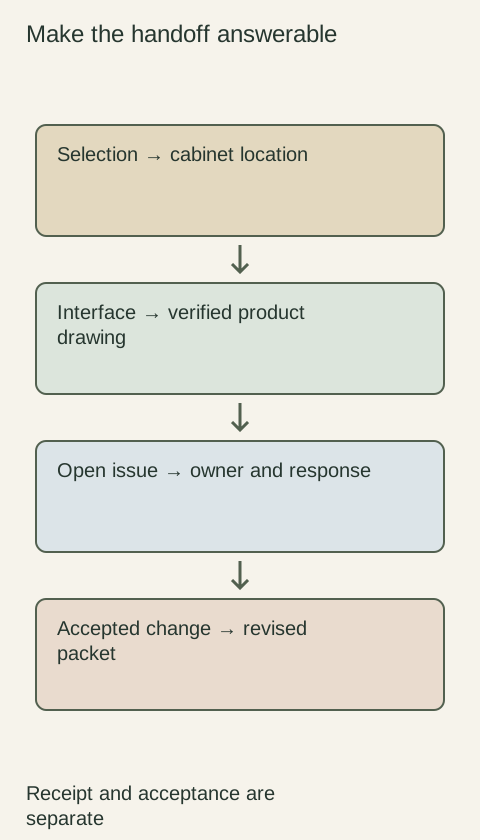
Translate the design into identifiable products, details and responsibilities. A useful handoff lets another professional price and build the intended arrangement without reconstructing private conversations.
The sample shows the door frame, a separate center panel, the face frame and the cabinet box. Each component has its own place in this Shaker construction.
Shaker construction: door frame, center panel, face frame and cabinet box. The cutaway helps locate these parts; confirm each material in the specifications for the selected cabinet.
01 / Door frame
The Shaker door has rails and stiles around a separate center panel. The frame and center panel are different components; confirm their materials in the specifications for the selected cabinet.
02 / Face frame
The face frame surrounds the opening at the front of the cabinet box and sits behind the doors. The face frame, door frame and cabinet box are separate parts.
03 / Cabinet box
The sample exposes the cabinet sides, interior surfaces and layered edges. The image does not establish the wood species or material specification of a selected cabinet.