How do you choose shelf spacing for folded bathroom linens?
Fold the actual linens as the household normally does, build the intended stacks and test retrieval within the usable shelf opening before selecting spacing or cabinet configuration.
A linen cabinet's empty volume does not tell you whether the towels will work comfortably on its shelves. Folding changes the footprint, thickness and exposed edge of each piece. A stack can fit mathematically yet leave no convenient way to remove a towel. Start with the household's folding habit and the quantity that belongs in this cabinet, then evaluate the opening around that real group.
Use representative linens and familiar folds
Gather the types that will actually be stored here, including the thicker or larger pieces that might otherwise be overlooked. Fold them in the usual way without compressing them to create a flattering measurement. Measure the resulting width, depth and height, and note which edge the user normally grasps when taking a piece from the stack.
Different folds can change those dimensions, but a new fold is useful only if the household is willing to repeat it. Try folding after an ordinary laundry cycle instead of relying on a display arrangement prepared for the cabinet test. If family members fold differently, either allow for that variation or agree on a practical method before choosing narrowly fitted compartments.
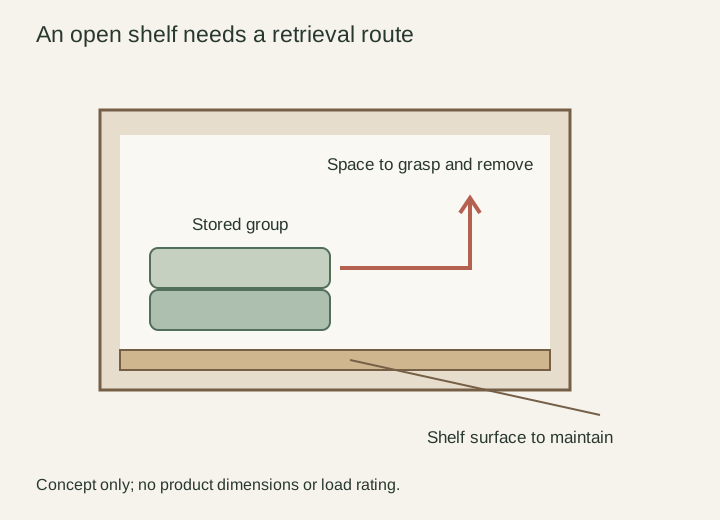
Diagram A folded stack needs space for fingers and removal as well as storage. Use the real textiles and shelf opening; the diagram supplies no required spacing.
Measure the opening that the stack must pass through
Check usable shelf depth and width, along with the clear height above the stored group. Account for the selected cabinet's door opening, hinges, frame or other components that affect access. A shelf may be deep enough for a stack while the entrance or the user's hand position makes it inconvenient to place that stack inside.
For adjustable shelves, confirm the actual adjustment positions and any limitations in the selected product. Do not assume a shelf can be placed at every desired height or that unused supports can be moved freely. Plan the resulting compartments together: making a lower opening taller can reduce another opening that is assigned to a different group of linens.
Test the stack through removal and return
Place the intended quantity in the proposed opening. Retrieve the item the user would normally choose without pressing the remaining stack into the shelf above. Check whether the folds remain recognizable and whether the unused pieces can stay in place. Then return a piece or replenish the stack in the same way the household would after laundry.
Try both a full and a partly used stack. A full stack tests crowding; a smaller group tests whether pieces spread, slump or become difficult to distinguish. The aim is not a permanently perfect display. It is a shelf arrangement that still works between restocking visits, without requiring the entire group to be refolded after ordinary retrieval.
Work through a clearance example
In a hypothetical example, a shelf opening has 10 inches of clear height. Each towel in the chosen fold is about 3 inches thick, so a stack of 3 reaches about 9 inches and leaves about 1 inch above it. Those measurements show that the stack fits at rest; they do not establish that the user can grasp and remove a towel comfortably.
During the practical test, suppose the user must compress the stack to reach the desired piece. Compare a shorter stack, a different repeatable fold or another confirmed shelf position. Evaluate what each change does to the neighboring compartments and the rest of the linen inventory. The solution should preserve both usable access and a credible home for the pieces removed from this stack.
Choose spacing from a complete restocking cycle
Do not make every opening follow the largest towel in the collection. Compare separate assignments for bulky bath linens and smaller hand towels, using the quantity of each that belongs here. A tall opening may be useful for one group while encouraging an unstable pile of another. Shelf spacing and the grouping of contents should be decided together.
Where different linens look similar when folded, test whether the visible edge lets the user choose correctly before disturbing the stack. Change the grouping or orientation if necessary. This is a retrieval test as well as a fit test, and it can reveal that additional compartments are more useful than a higher pile.
Follow the clean, ready-to-store linens from the place where they are folded to the cabinet. Determine whether they arrive as individual pieces, a carried stack or a group in a basket. That affects how the shelf is replenished and which opening must accept the group. Keep used textiles on their separate household route rather than counting them as part of the ready-to-use stack.
Record the fold, intended stack and tested shelf position with the cabinet plan. Recheck when the household changes linen sizes or the cabinet model. A useful spacing decision is based on ordinary folding, access and replenishment, with enough flexibility for real variation; maximum theoretical stack height is only a starting measurement.
Pure White
Cream White
Light Warm Gray
Gray
Navy
Black
Oak Tone
Dark Walnut Tone
Design study These finish studies are design references, not a list of currently orderable colors. Screens and lighting change the appearance; compare a physical sample before choosing.See all finish options →
Place the tower where its door, contents and tall side panel work with basin use, light and the room's approach; compare complete positions rather than simply filling leftover wall space.
Give ready-to-use linens, towels currently in use and items awaiting laundry distinct destinations, then test the route between them instead of treating the vanity as storage for every stage.
It is useful when the intended objects remain easy to retrieve and the household accepts their visibility and upkeep; test those conditions before replacing enclosed storage with a shelf.
The sample shows the door frame, a separate center panel, the face frame and the cabinet box. Each component has its own place in this Shaker construction.
Shaker construction: door frame, center panel, face frame and cabinet box. The cutaway helps locate these parts; confirm each material in the specifications for the selected cabinet.
01 / Door frame
The Shaker door has rails and stiles around a separate center panel. The frame and center panel are different components; confirm their materials in the specifications for the selected cabinet.
02 / Face frame
The face frame surrounds the opening at the front of the cabinet box and sits behind the doors. The face frame, door frame and cabinet box are separate parts.
03 / Cabinet box
The sample exposes the cabinet sides, interior surfaces and layered edges. The image does not establish the wood species or material specification of a selected cabinet.