It is useful when the intended objects remain easy to retrieve and the household accepts their visibility and upkeep; test those conditions before replacing enclosed storage with a shelf.
An open lower shelf can make a vanity feel visually lighter and put selected objects in view. It also leaves those objects as part of the room's everyday appearance. The right question is not whether a neatly styled shelf looks attractive, but whether the actual household can use and maintain that arrangement without needing the closed storage it replaces.
Give the shelf an everyday job
Choose a defined purpose: folded linens ready for use, a removable group of suitable supplies or a display area with limited contents. Do not count the same space as all of these at once. A decorative object occupies room that cannot simultaneously hold a full towel stack, and a large basket may conceal the open appearance that originally attracted you.
Lay out the intended contents in their ordinary condition. Include mixed sizes and the quantity likely to be present between restocking, rather than using only the most photogenic pieces. If the shelf will usually hold half-empty packages or objects you prefer out of sight, consider whether an enclosed compartment better matches that real collection.
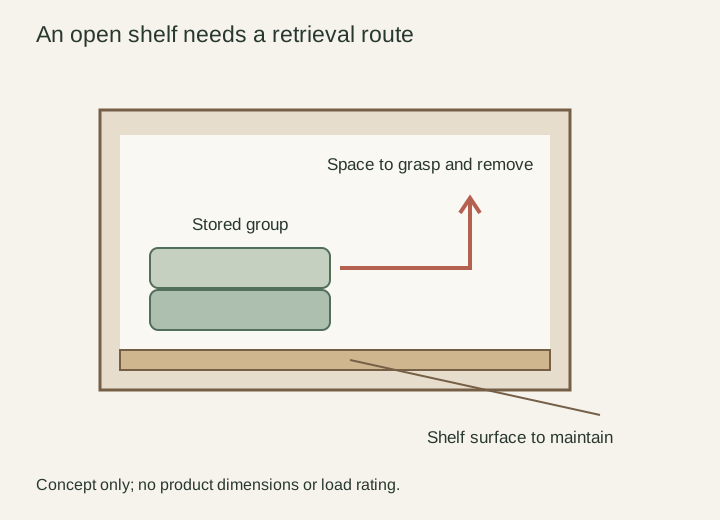
Diagram A stored group needs room for retrieval and access to the shelf beneath it. The schematic supplies no product dimensions or load rating.
Check retrieval at the shelf's actual height
Test the shelf opening, depth and position from the user's normal approach. Can the intended person see the needed object and grasp it without disturbing the surrounding group? A low shelf may be easy to look at from across the room but less convenient to use from a standing position beside the basin. Judge that movement with the people who will perform it.
If a basket is part of the plan, test the loaded basket rather than its empty dimensions. Its rim, handles and contents must pass through the opening, and it needs a destination when removed. A basket that must be emptied before it can come out does not provide the simple group access its appearance may suggest.
Include ordinary cleaning and restocking
Distinguish the basket's outside fit from its useful capacity. A thick rim, tapered sides or a liner may leave less room for the intended folded group than the shelf outline suggests. Try the contents inside the actual container, then return that loaded container to the shelf. The benefit must survive both tests rather than stopping when the basket alone fits.
Try removing the contents and reaching the shelf surface, corners and surrounding cabinet parts for the care described by the product guidance. Decide where those contents wait during that task. An arrangement that looks restrained can still involve considerable handling if every small object must be moved separately each time the shelf needs attention.
Also observe the proposed location during ordinary bathroom use. If water reaches the shelf or stored items during the household's routine, reconsider the placement and follow the relevant product care instructions. An open shelf is not automatically an appropriate drying area for used textiles. Choose its contents based on their condition and the actual environment, rather than assuming that visibility proves suitability.
Compare a worked household arrangement
In a hypothetical guest bathroom, a small group of folded, ready-to-use hand towels stays visible on a lower shelf. Visitors can identify the supply, the towels come out without upsetting the remaining stack, and the owner has an easy restocking and shelf-care routine. The shelf has a limited assignment that the household can sustain.
Now imagine a busy shared bathroom using the same opening for bulky reserves, individual toiletries and decorative objects. Supplies obscure the intended display, and routine cleaning requires moving many unrelated pieces. A closed compartment or a different assignment may serve that household better. The change is justified by actual use, not by a rule that open storage is always tidy or always troublesome.
Decide what the open shelf replaces
Compare the proposed cabinet with an enclosed alternative using the same inventory. Identify the items that lose a drawer or door compartment and give them confirmed locations. Do not assume the open shelf preserves the capacity of the storage it replaces merely because its outside width is similar. Interior obstructions and access requirements still matter.
Keep essential daily storage separate from optional decoration in the comparison. A mostly empty shelf can be an intentional aesthetic choice if the rest of the bathroom stores everything needed. Select the open format when its visible purpose, retrieval and maintenance all work with the household's routine; choose another configuration when achieving the photograph would require continually relocating ordinary belongings.
Pure White
Cream White
Light Warm Gray
Gray
Navy
Black
Oak Tone
Dark Walnut Tone
Design study These finish studies are design references, not a list of currently orderable colors. Screens and lighting change the appearance; compare a physical sample before choosing.See all finish options →
A wide, shallow drawer is useful when low-profile items need a visible layout or an uninterrupted span; choose it only after checking the actual interior height and the room needed to use it.
Place the tower where its door, contents and tall side panel work with basin use, light and the room's approach; compare complete positions rather than simply filling leftover wall space.
Use a lower storage zone and an upper layer only when both remain accessible; judge the arrangement by the work required to retrieve and return the lower items.
The sample shows the door frame, a separate center panel, the face frame and the cabinet box. Each component has its own place in this Shaker construction.
Shaker construction: door frame, center panel, face frame and cabinet box. The cutaway helps locate these parts; confirm each material in the specifications for the selected cabinet.
01 / Door frame
The Shaker door has rails and stiles around a separate center panel. The frame and center panel are different components; confirm their materials in the specifications for the selected cabinet.
02 / Face frame
The face frame surrounds the opening at the front of the cabinet box and sits behind the doors. The face frame, door frame and cabinet box are separate parts.
03 / Cabinet box
The sample exposes the cabinet sides, interior surfaces and layered edges. The image does not establish the wood species or material specification of a selected cabinet.