How do you keep ready-to-use towels separate from towels awaiting laundry?
Give ready-to-use linens, towels currently in use and items awaiting laundry distinct destinations, then test the route between them instead of treating the vanity as storage for every stage.
A towel-storage problem is often a movement problem. The clean stack fits the cabinet, but a used towel has no obvious next destination, or the laundry container is awkward to reach. The towel then lands on a counter, shelf or nearby pile. Choosing a larger vanity does not resolve that missing step unless the cabinet plan includes where each stage of the household's routine occurs.
Name the stages before assigning cabinet space
Identify the linens that are clean and ready to be taken from storage. These form the reserve that the vanity or linen cabinet must accommodate. Keep that assignment distinct from the towels the household has already put into use. The visible difference should be understandable to the people using the room, without requiring them to inspect every folded item.
Then identify the household's destination for towels awaiting laundry. Follow the applicable textile care instructions and household routine for handling and washing; the cabinet plan does not determine a universal wash interval or treatment. Its job is to make the destination clear and accessible so that items in different stages do not accidentally return to the same storage group.
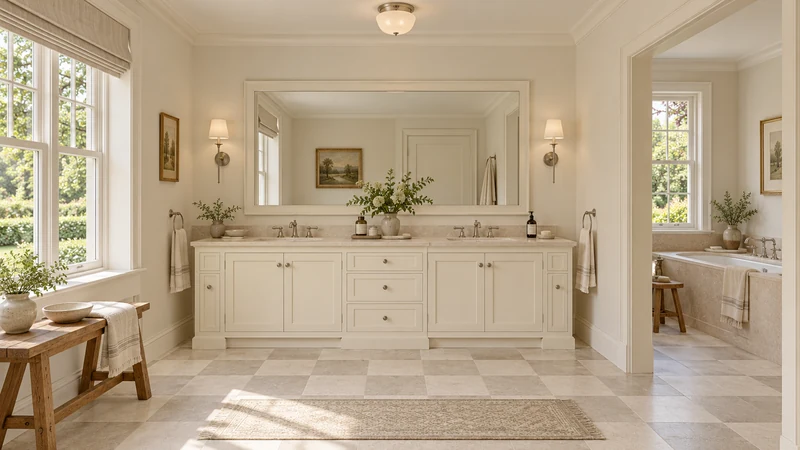
Design study The design study shows towels at the vanity wall and in the adjacent bathing area. Their different locations help illustrate a room-wide route; it does not document a household hygiene practice.
Trace the route from taking a towel to putting it away
Start at the clean supply and move to the place where the towel is used. Locate the intended position for the towel while it is in use, with the chosen fixture or accessory appropriate to that purpose. Check access from the actual basin or bathing area. The storage cabinet does not automatically replace a suitable location for this intermediate stage.
Continue to the laundry collection point. Can the user reach it without crossing another person's active preparation area or opening a cabinet that is usually blocked? If a lid or door must open, include that movement. A container is useful only if the towel can be placed in it and later removed through a route that the household will actually use.
Design the collection and removal task together
Compare a freestanding collection point with any cabinet-based option using the same intended load and access task. For a built-in container, verify the selected system's compatibility, usable opening and removal instructions. Do not assume an ordinary door bay is a suitable enclosure or that a container that fits empty will be manageable when loaded.
Test how the contents leave for the laundry area and how the empty container returns. Include any bag, handle or removable insert that belongs to the selected arrangement. The user should not have to unload onto the clean-linen shelf to free a stuck container. If the route only works after moving unrelated toiletries, reconsider the location before allocating valuable vanity space to it.
Work through a missing-destination example
Imagine a hypothetical household with ready-to-use hand towels in a vanity drawer and a designated place for the current towel near the basin. When the current towel is taken out of use, the household's laundry basket sits beyond a doorway that is often obstructed during the routine. Towels consequently collect on the vanity's open shelf beside the fresh stack.
The household tests a more accessible collection location and preserves the drawer for ready-to-use supplies. After use, the towel has a recognizable route that does not pass through the fresh-linen storage. This improves the arrangement without requiring more cabinet volume. If collection must remain elsewhere, the alternative is a workable carrying routine, not simply labeling the ambiguous shelf and leaving the access problem intact.
Check the cycle after laundry returns
For a shared bathroom, make the current-use locations understandable as well. If someone cannot tell which towel is already assigned, a nearby fresh stack does not resolve the uncertainty. Review the arrangement with the household and provide visitors with a clear starting supply and onward destination, without relying on folded appearance to communicate the towel's status.
Follow the cleaned, ready-to-store textiles back from the laundry area. Make room for the normal returned quantity in the assigned cabinet before assuming the routine is complete. A storage plan can appear adequate just before laundry day yet overflow when the full household supply returns. Compare actual folded groups and shelf access rather than selecting a stock quantity from a generic rule.
Keep stage and destination clear when visitors or household members change. A simple explanation or a recognizable container may help, but the physical route still needs to work. Choose the vanity around the ready-to-use storage it must provide, and coordinate the other stages with the room. The useful result is a repeatable cycle with clear destinations, not a cabinet that becomes the temporary landing place for every towel.
Pure White
Cream White
Light Warm Gray
Gray
Navy
Black
Oak Tone
Dark Walnut Tone
Design study These finish studies are design references, not a list of currently orderable colors. Screens and lighting change the appearance; compare a physical sample before choosing.See all finish options →
Fold the actual linens as the household normally does, build the intended stacks and test retrieval within the usable shelf opening before selecting spacing or cabinet configuration.
Use them when repeated confusion has a clear cause, such as similar personal items or an unclear return location; choose labels and boundaries that match the household's actual sharing arrangement.
Place the tower where its door, contents and tall side panel work with basin use, light and the room's approach; compare complete positions rather than simply filling leftover wall space.
The sample shows the door frame, a separate center panel, the face frame and the cabinet box. Each component has its own place in this Shaker construction.
Shaker construction: door frame, center panel, face frame and cabinet box. The cutaway helps locate these parts; confirm each material in the specifications for the selected cabinet.
01 / Door frame
The Shaker door has rails and stiles around a separate center panel. The frame and center panel are different components; confirm their materials in the specifications for the selected cabinet.
02 / Face frame
The face frame surrounds the opening at the front of the cabinet box and sits behind the doors. The face frame, door frame and cabinet box are separate parts.
03 / Cabinet box
The sample exposes the cabinet sides, interior surfaces and layered edges. The image does not establish the wood species or material specification of a selected cabinet.