UV-cured or waterborne cabinets? Compare the complete finish system
Waterborne and UV-cured describe different parts of a coating process. Compare finished doors, matching components and replacement options before paying for a finish label.
A cabinet finish can be both waterborne and UV-cured. Waterborne describes the coating formulation and its liquid carrier; UV-cured identifies a curing route. They are not opposite grades on a durability scale. When quotations use those words as if they were competing materials, first identify the actual finish system on the actual parts. A useful comparison concerns the completed cabinet, including its door edges, visible ends and matching trim, rather than the most impressive word beside its color name.
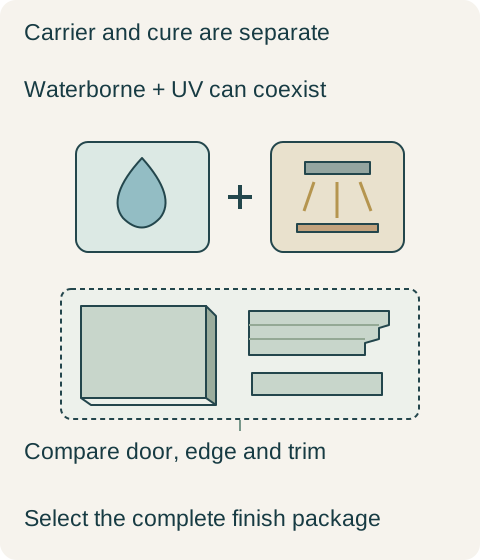
Separate the carrier from the curing route
Sherwin-Williams describes waterborne UV coatings with a flash-off stage before UV exposure. Its Aqualight range includes applications for profiled and planar surfaces. That is a concrete example of waterborne application and UV curing belonging to the same system.
Start a comparison with separate fields for coating identity, application and cure. A description such as waterborne clear topcoat still leaves the curing route unspecified. UV-cured clear finish leaves other formulation details unspecified. Neither entry tells you whether the finish is clear or opaque unless that is stated separately. Keeping these descriptions apart also prevents a clear interior-panel finish from being mistaken for the exterior painted-door system merely because both include UV in their names.
Cefla describes UV polymerization in its CVS profile-finishing system and uses multiple lamps for all-around curing. Its example makes an important distinction visible: the process includes equipment arranged for the workpiece, not simply a coating bearing a UV label.
Teaching example Conceptual comparison for the hypothetical order: a flat door and a matching shaped cornice must belong to the accepted finished package. The diagram is not a curing-line specification.
Buy the door shape that was actually finished
A smooth flat sample represents that sample. A kitchen may also contain profiled doors, recessed pulls, narrow moldings and finished side panels. Lay those components beside the sample in the purchasing discussion. The practical question is whether the offered production route covers that group, with the appearance the design needs. Do not assume UV is restricted to slab doors; equally, do not assume a flat-door offer includes every shaped accessory in the same finish.
Inspect a finished door from the front, from an angle and while open. Follow the finish around the perimeter and into its visible profile. Place the proposed molding and exposed end beside it under the same light. This lets you separate a pleasing individual surface from a coordinated kitchen package. A color match does not settle differences in texture, sheen or the appearance of a routed edge. Decide which differences are acceptable while the components can still be selected together.
A production method is not a household performance rating
UV-cured does not specify scratch resistance, resistance to a particular cleaner or the appearance of a later repair. Waterborne alone does not specify those properties either. Evaluate any performance statement against the identified finish and the test or care instruction supporting it. If the seller claims a test result, the useful document identifies what was tested and the relevant finish. A coating-process name cannot substitute for that connection.
Also separate manufacturing UV exposure from resistance to daylight in the installed room. These are different questions. Do not infer that a UV-cured door cannot change color beside a sunny window, or that it needs sunlight to complete curing at home. Obtain the finished product with its applicable care and service instructions. For a homeowner, the everyday choice is the appearance and maintenance of the delivered cabinet, not the purchase of a factory curing process to reproduce in the kitchen.
A matching cabinet run can matter more than a favored label
Consider a hypothetical kitchen with flat doors, matching exposed ends and a shaped cornice retained in the design. The first proposal supplies an attractive factory-finished UV door, but its standard accessories do not include the chosen cornice in that finish. The second proposal uses an identified non-UV waterborne system across the doors, ends and cornice. The owners initially favor the first proposal because its finish sounds more advanced.
They examine the alternatives as complete assemblies. In this hypothetical comparison, the separate finish proposed for the first cornice creates a sheen difference the owners dislike. The second supplier presents coordinated finished components and documents the agreed performance and care for its system. The owners select the second package, keep their cornice and accept its stated production schedule. The reason is a demonstrated appearance across the specified parts, not a claim that non-UV waterborne finishes are generally tougher.
The first package could suit a different design that uses its available flat components and omits the cornice. Here, however, removing that detail would change the approved room. The decision therefore keeps the design requirement and changes the finish package. Neither supplier receives credit for an accessory that is absent from its completed offer. The comparison has a result even though no universal price or hardness ranking is possible.
Plan replacements without promising invisible repairs
Before ordering, distinguish a later replacement door from a local touch-up. A replacement can be made as a complete component; a touch-up attempts to alter part of an existing surface. Ask which service route accompanies the chosen cabinet system and what information identifies it. Do not expect a retail can labeled waterborne, or a generic UV repair product, to reproduce an unknown factory combination.
For the selected hypothetical kitchen, the owner keeps the accepted door-and-trim sample identification and the finish record with the order. A visibly damaged door is assigned to the supplier’s replacement assessment, while small marks follow its approved care or repair advice. Matching a future part remains a separate evaluation of the existing room. The original finish label is useful history, but it is not a guarantee that every later batch or repair will be invisible.
Pure White
Cream White
Light Warm Gray
Gray
Navy
Black
Oak Tone
Dark Walnut Tone
Design study These finish studies are design references, not a list of currently orderable colors. Screens and lighting change the appearance; compare a physical sample before choosing.See all finish options →
Compare the actual countertop products, heat-source routine and fabrication proposal. A fired porcelain slab and resin-bound quartz are different materials, but neither label replaces a complete kitchen specification.
The sample shows the door frame, a separate center panel, the face frame and the cabinet box. Each component has its own place in this Shaker construction.
Shaker construction: door frame, center panel, face frame and cabinet box. The cutaway helps locate these parts; confirm each material in the specifications for the selected cabinet.
01 / Door frame
The Shaker door has rails and stiles around a separate center panel. The frame and center panel are different components; confirm their materials in the specifications for the selected cabinet.
02 / Face frame
The face frame surrounds the opening at the front of the cabinet box and sits behind the doors. The face frame, door frame and cabinet box are separate parts.
03 / Cabinet box
The sample exposes the cabinet sides, interior surfaces and layered edges. The image does not establish the wood species or material specification of a selected cabinet.