A finish that feels dry is not automatically ready for stacking, packing or ordinary cabinet use. Treat touch-dry, recoat, handling and full service as different decisions. The relevant instruction belongs to the exact coating system and its application conditions. A generic wait overnight note is not a substitute for that information.
Read the heading above the time
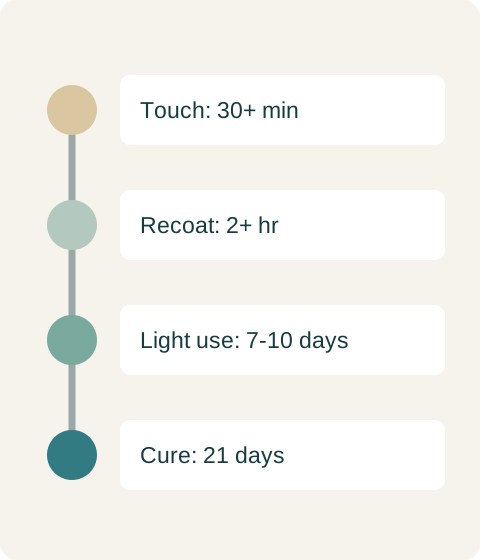
For a concrete example, General Finishes High Performance lists touch-dry at 30+ minutes, recoat at 2+ hours, light use at 7-10 days and cure at 21 days. Its drying guidance assumes ideal 70°F/21°C and 50% humidity. These figures describe that coating, not an unidentified factory cabinet finish.
Being ready for another coat answers a process question: can the next application proceed under the specified conditions? Returning a shelf to service asks a different question about contact with stored items and cleaning. Packing adds sustained contact with wrapping and other parts. Even if a finish can be recoated, the recoat entry does not authorize those other uses. If the document says nothing about packaging, record that gap rather than treating the shortest published time as permission.
Record the coating product, the completed operation and the conditions required by its instructions. A repaired face may have a different timeline from the untouched cabinet next to it. When a further coat is added, update the affected part record instead of retaining a release date calculated before the repair. A calendar entry is useful only when it identifies what was applied and which milestone it represents.
Diagram General Finishes High Performance example only. The four intervals are not drawn to scale; listed drying conditions are 70°F/21°C and 50% humidity. No packaging permission is shown.
When can dishes go back on a refinished shelf?
Suppose a refinisher uses that product and completes a coat at 9 a.m. under the stated conditions. The 2+ hour recoat figure makes 11 a.m. the earliest time-based candidate for the next coat, subject to actual dryness; it does not authorize putting dishes on the surface at 11. If the final coat is completed the next morning, the service schedule is based on that final application. At 24 hours, the job has not reached the published 7-10 day light-use period or 21-day cure point. In this hypothetical order the owner chooses to keep the refinished shelf unloaded until the 21-day cure point, provided the required conditions remain satisfied and no defect is found. Other cabinets stay in use. The owner accepts the longer wait rather than planning light use during the earlier period. The figures also provide no packaging clearance, so the team does not convert a recoat time into approval to stack wrapped doors.
If the surface remains tacky, develops an imprint or transfers color, stop the affected use and document the product and sequence for the finisher. More waiting is not a diagnosis by itself. Nor does every unexpected mark prove defective material. The application record lets the finisher distinguish a missed condition, incompatible layer or other problem from an ordinary release milestone. Do not cover the symptom with another product before that assessment.
The handoff now names a specific shelf, a known finish and a defined use restriction. A later repair coat changes that shelf’s schedule; it does not rewrite the history of untouched parts. Keep the coating instructions with the owner’s care record so a future touch-up is assessed against the material actually present, rather than against a vague description such as water-based paint.
Pure White
Cream White
Light Warm Gray
Gray
Navy
Black
Oak Tone
Dark Walnut Tone
Design study These finish studies are design references, not a list of currently orderable colors. Screens and lighting change the appearance; compare a physical sample before choosing.See all finish options →
A color name does not identify a finish system. Compare the decorative surface, the core, the edge and the repair method before choosing a cabinet front.
The sample shows the door frame, a separate center panel, the face frame and the cabinet box. Each component has its own place in this Shaker construction.
Shaker construction: door frame, center panel, face frame and cabinet box. The cutaway helps locate these parts; confirm each material in the specifications for the selected cabinet.
01 / Door frame
The Shaker door has rails and stiles around a separate center panel. The frame and center panel are different components; confirm their materials in the specifications for the selected cabinet.
02 / Face frame
The face frame surrounds the opening at the front of the cabinet box and sits behind the doors. The face frame, door frame and cabinet box are separate parts.
03 / Cabinet box
The sample exposes the cabinet sides, interior surfaces and layered edges. The image does not establish the wood species or material specification of a selected cabinet.