For side-view grooming, compare the actual mirror arrangement rather than the phrase “triple mirror.” A cabinet can have several reflective surfaces and only one moving door. A triptych mirror can have a fixed center and separately adjustable wings without providing enclosed storage. Choose the structure that gives the intended view from the basin or preparation position, then complete the cabinet and lighting arrangement around it.
Locate the mirrors before counting them
KOHLER describes the Catalan single-door cabinet with mirrors on the front and back of its door and on the interior back wall. Those locations explain how one cabinet can offer several mirrors while retaining a single door.
The two faces of that door move together. They are not independently adjustable side wings. The interior back mirror stays in the box, and stored objects may occupy part of its view. This does not make the cabinet defective; it means the buyer must assess the particular views it offers rather than infer them from a count of reflective surfaces.
Robern's CM4740T specification identifies a triptych mirror with side panels on piano hinges that adjust to reflect either side of the user. Its drawing shows a center mirror and two wings. This is a mirror assembly, not a medicine cabinet with shelves hidden behind those panels.
Likewise, three cabinet doors across a wide vanity do not by themselves promise the same result. Hinge positions, reflecting faces and permitted movement determine what the doors can show. A symmetrical closed elevation reveals little about that working geometry.
Start from the view needed during the task
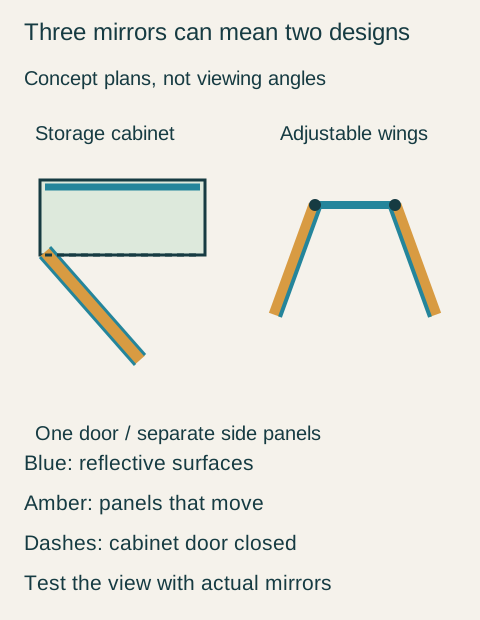
Teaching example Concept plans, viewed from above. At left, a storage cabinet has a fixed mirrored back and a single door with reflective faces on both sides; the dashed door is its closed position. At right, a fixed center mirror has separate adjustable side wings. Blue marks reflective faces, amber marks movable panels. These are different structures, not product dimensions or prescribed viewing angles.
Name the desired view precisely: a side hairline, an ear area, or another specific part of the grooming routine. Looking at the side of the face is not the same test as seeing the back of the head. Do not assume that a product's side-view description guarantees every rear view from every basin position.
Try the selected arrangement with actual mirrors and the intended user. A paper outline can establish the space a panel occupies, but it cannot prove a reflection. Use a properly supported demonstration rather than asking someone to hold loose heavy mirrors while another person works beneath them.
Check the task with both hands available if that is how it is normally performed. A view that works only while one hand holds a small mirror may be acceptable for a quick inspection but fail a routine requiring both hands. Keep the intended stance and basin distance realistic; moving far across the room to find a reflection changes the proposed use.
A buyer rejects storage that does not provide the required view
In a hypothetical remodel, the owner wants to arrange hair near both ears while keeping both hands free. The initial purchase list names a “triple-mirror cabinet,” with the assumption that the mirrors will function like adjustable wings. A demonstration of the proposed single-door cabinet disproves that assumption: at the intended basin position, its permitted door positions do not provide the two side views she needs without moving to an awkward place.
The cabinet remains a useful storage product, but it fails her specific grooming requirement. She then tries a separate triptych arrangement. With its wings adjusted within the selected product's permitted movement, the real mirror demonstration gives the required views while both hands remain free. This result applies to that user and arrangement; it is not a claim that every triptych provides every viewing angle.
The proposed side sconces initially occupy part of the wing movement. The revised layout uses a reviewed lighting position outside that movement, and the demonstration is repeated with the actual light placement represented. The faucet, basin use and cleaning access also remain workable. The buyer selects the triptych only after this complete arrangement passes.
Close the storage decision at the vanity below
This owner already keeps daily supplies in the vanity drawers and had not assigned essential items to the proposed mirror cabinet. Checking those drawers confirms that the independent mirror does not leave a missing storage job. Had wall storage been essential, a different mirror-and-cabinet arrangement would have needed comparison before eliminating it.
Specify the mirror assembly, its intended adjustment space, the selected lighting and the vanity storage together. Confirm the mounting requirements with the installer; adjustable wings do not justify improvised supports or modified hinges. The useful purchase is the arrangement that delivers the required reflection without borrowing space from the light, faucet or storage that the bathroom still needs.
Pure White
Cream White
Light Warm Gray
Gray
Navy
Black
Oak Tone
Dark Walnut Tone
Design study These finish studies are design references, not a list of currently orderable colors. Screens and lighting change the appearance; compare a physical sample before choosing.See all finish options →
Add the dimensions that contribute to the finished assembly, including lights and required end pieces. The sum of the mirror-cabinet widths alone can understate what must fit above the vanity.
The sample shows the door frame, a separate center panel, the face frame and the cabinet box. Each component has its own place in this Shaker construction.
Shaker construction: door frame, center panel, face frame and cabinet box. The cutaway helps locate these parts; confirm each material in the specifications for the selected cabinet.
01 / Door frame
The Shaker door has rails and stiles around a separate center panel. The frame and center panel are different components; confirm their materials in the specifications for the selected cabinet.
02 / Face frame
The face frame surrounds the opening at the front of the cabinet box and sits behind the doors. The face frame, door frame and cabinet box are separate parts.
03 / Cabinet box
The sample exposes the cabinet sides, interior surfaces and layered edges. The image does not establish the wood species or material specification of a selected cabinet.