Should a trash compactor replace the kitchen bin cabinet?
A compactor earns its appliance space by reducing the bulk of a suitable waste stream. It does not eliminate the containers needed for other groups. Compare the complete disposal arrangement, handling and ongoing supplies before removing a bin cabinet.
Choose a trash compactor when a substantial stream of suitable waste is bulky enough to justify a dedicated appliance, and the household accepts its handling, supplies and care. Choose a multiple-bin cabinet when convenient separation and frequent removal matter more than reducing the bulk of the remaining waste. A compactor can replace a particular bin task; it does not automatically replace the entire sorting cabinet.
Compression changes bulk, not the job of sorting
KitchenAid describes a powered ram pressing trash into a denser load. Its cited guidance also explains that the ram stops above the drawer bottom, so the earliest small additions may not be compressed.
The purchasing implication is to examine what remains after the household separates its waste. A large pile of incoming packaging is a poor basis for the choice if much of that material goes to a different collection stream and will never enter the proposed machine. Likewise, a kitchen that empties its small residual bin frequently may gain little from buying capacity that it does not intend to accumulate.
Keep the appliance's permitted contents and the collection service's accepted materials as separate requirements. Neither can be inferred from a picture of cans in a compactor advertisement. The cabinet plan should show the actual groups the household keeps apart, using its established disposal arrangements. A press does not sort a mixed load after the lid closes.
Compression also does not remove the mass of the material loaded. If the smaller package encourages more waste to accumulate before removal, the final bag can contain more material than the uncompressed bag it replaces. Fewer trips and easier handling are different objectives. Choose a manageable routine without testing personal strength on a deliberately overfilled load.
Count all the containers that remain
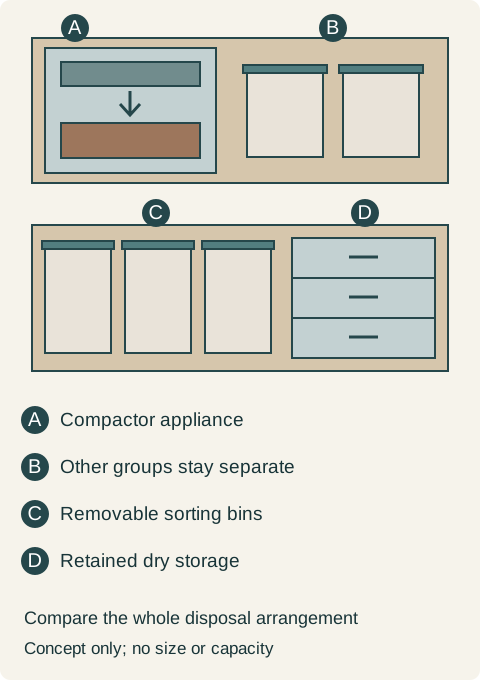
Draw the proposal as a complete disposal area. Label the compactor's assigned stream, each separate container, the spare bags and any items waiting for their normal trip out. Compare that with the same groups in the pullout-cabinet proposal. Keeping the same assignments prevents an appliance option from looking smaller merely because its other bins have disappeared from the rendering.
Some separate containers can be deliberately located elsewhere. That is a real layout choice when the route suits their use; it is not recovered kitchen space if the family will instead leave an unplanned bag beside the sink. A container for frequent preparation scraps and a container for occasional packaging need not share a location, but each needs a workable home.
Distinguish the selected appliance's installed opening from a bin cabinet's complete exterior. The pullout includes its box, runners, front and containers; the appliance includes its installation requirements and appropriate surrounding construction. There is no universal exchange in which removing one automatically creates a finished opening for the other. Price the actual cabinet revision, not just the two visible fronts.
Teaching example Conceptual cabinet allocations. Above: a compactor still has separate containers beside it. Below: removable bins share a pullout cabinet while neighboring dry storage remains. The shaded block represents compacted contents; it is not a capacity, loading or compression-ratio diagram. No cabinet dimensions are implied.
A holding cycle changes availability
KitchenAid's cited Solid cycle holds the ram down after compression and locks the drawer while it remains down. That state belongs in the use plan for a model offering the function.
A household attracted to extended compression should consider when the receiving drawer will be unavailable and how that fits its cleanup routine. The kitchen may produce new waste throughout meal preparation rather than in one batch. Select and use the appliance's functions according to its instructions; do not design the kitchen around forcing access during a locked state.
A multiple-bin pullout has a different tradeoff. Several categories can be accessed within the same furniture assembly, but the person still needs to reach the intended bin and remove it as designed. Rear containers and overlapping tasks remain relevant. Neither arrangement makes a busy cleanup area work merely by hiding it behind a matching front.
Include supplies and the cabinet budget
Whirlpool's cited guidance calls for bags designed specifically for the applicable compactor. Ordinary kitchen liners should not be assumed to substitute just because they fit the drawer.
For a purchasing comparison, include the available compatible supplies, their storage and the household's willingness to keep them on hand. Include the machine, installation and any specified ongoing care items in the appliance proposal. Compare them with the complete pullout assembly and its chosen containers. A claimed reduction in bag changes alone does not establish a lower ownership cost.
Give the appliance space a concrete competing use. It may displace utensil drawers, a useful pan cabinet or some of the original sorting capacity. If another cabinet must grow to receive those contents, include that change. This is often the decisive budget question: does reducing this waste stream's bulk deserve the furniture and installation work being assigned to it?
A kitchen keeps the sorting cabinet
Consider a hypothetical renovation in which the family expects a compactor to remove a crowded recycling area. The initial drawing replaces the whole bin cabinet with the appliance and shows no other containers. Reviewing the actual routine reveals the error: the bulky material that caused the crowding is assigned to a separate collection stream, while the residual trash is removed frequently and does not dominate the space.
The family retains a multiple-bin pullout sized around its real groups and gives the largest container to the category that normally fills first. It preserves the adjacent utensil drawers and accepts its existing removal frequency. It does not buy a compactor merely to keep the appliance wall visually coordinated. This choice solves the stated sorting problem without pretending that compression removes categories from the plan.
For a different household with a substantial suitable residual stream and already convenient homes for every other category, a compactor may earn its place. That buyer accepts the appliance's supplies, care and bag-handling routine in exchange for reduced bulk. The final choice should remain understandable after the closed-front rendering is removed: what is compressed, what stays separate, where each group goes, and what cabinet function is surrendered.
Pure White
Cream White
Light Warm Gray
Gray
Navy
Black
Oak Tone
Dark Walnut Tone
Design study These finish studies are design references, not a list of currently orderable colors. Screens and lighting change the appearance; compare a physical sample before choosing.See all finish options →
A compactor can open for small items yet be awkward to empty. Check the complete drawer position, any required side opening, bag handling and the route away from the kitchen cabinet.
Bin volume does not tell you how much of a cabinet run the system consumes. Compare complete assemblies, their operating tasks and the neighboring storage left after each allocation.
An inset waste bin can accept scraps from the worktop without opening a cabinet front. Decide whether its fixed position and bucket below are worth giving up that part of the prep surface and storage.
The sample shows the door frame, a separate center panel, the face frame and the cabinet box. Each component has its own place in this Shaker construction.
Shaker construction: door frame, center panel, face frame and cabinet box. The cutaway helps locate these parts; confirm each material in the specifications for the selected cabinet.
01 / Door frame
The Shaker door has rails and stiles around a separate center panel. The frame and center panel are different components; confirm their materials in the specifications for the selected cabinet.
02 / Face frame
The face frame surrounds the opening at the front of the cabinet box and sits behind the doors. The face frame, door frame and cabinet box are separate parts.
03 / Cabinet box
The sample exposes the cabinet sides, interior surfaces and layered edges. The image does not establish the wood species or material specification of a selected cabinet.