A towel-warming drawer or ordinary cabinets with a heated rail?
Decide whether you want towels warmed before use or a place that also helps the towels in use dry. That distinction changes whether the bathroom cabinet should contain an appliance or remain ordinary linen storage.
A towel-warming drawer and a heated towel rail are different bathroom purchases. A drawer can provide a concealed appliance for warming an approved load before use. A rail provides a hanging location with its own warming and drying function. Decide which job matters before replacing ordinary cabinet storage with a heated appliance.
Start with the towel that is causing the dissatisfaction. Is it a clean towel that the household wants warm for the next bath, or a towel already in use that needs a better hanging arrangement between uses? Those are different starting points. A cabinet package chosen for the first does not automatically answer the second, even if both products are described as towel warmers.
Two manufacturer examples establish the difference
Wolf permits towel warming in model WWD30, with the Low setting and a stack no higher than the drawer pan sides. That permission is model-specific; follow its complete use instructions.
Amba describes its heated towel racks as warming and helping dry towels. Its drying guidance notes that airflow, towel thickness and layering affect the result. This is not a fixed drying-time promise.
These examples explain the purchase categories, not usaKT inventory. Do not infer towel suitability from the words warming drawer on an unrelated appliance, and do not treat a rail as a closed cabinet that happens to be warm. The proposed equipment must be selected for its documented purpose before its place in the cabinet plan is approved.
The warming permission cited for the drawer also does not establish a general damp-towel drying program. If drying is your reason to buy, ask for documentation addressing that function on the exact product. Keep the original question visible rather than substituting a different benefit because the concealed appliance looks attractive.
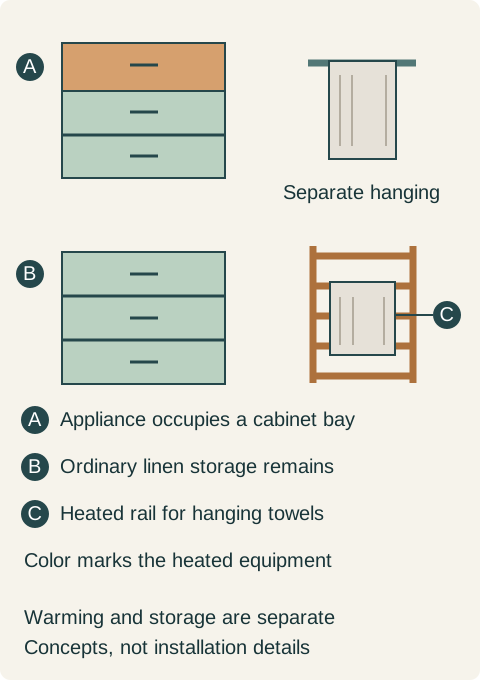
Teaching example Two hypothetical cabinet packages. A reserves a cabinet bay for a towel-warming appliance and retains a separate place for towels in use. B keeps the cabinet for ordinary storage and places a heated rail on the wall. C identifies the towels hanging on the rail. Warm colors distinguish proposed heated equipment, not operating temperatures; this is not an installation drawing.
What the heated drawer changes in the cabinet order
The appliance bay must be designed around the selected equipment. It is no longer an ordinary drawer that can be filled with whatever fits. Count the cabinet compartments left for linens and toiletries separately, and show where towels go after use. A heated cavity should not be counted a second time as unrestricted general storage.
Wolf's installation guide specifies appliance support, an anti-tip block and different standard or flush-inset arrangements. Those requirements make the enclosure an appliance installation, rather than a normal drawer with a heater added.
Ask for the complete proposal: selected unit, applicable front, cabinet opening, support and electrical provisions reviewed by the responsible professionals. Include the accessible controls and the front's relationship to the rest of the cabinetry. A coordinated decorative front does not make the appliance's interior or installation interchangeable with the neighboring drawers.
Wolf says bathroom installation of WWD30 is acceptable when its instructions are followed, while local requirements and inspection govern approval. That conditional statement does not approve every bathroom location or another warming-drawer model.
Resolve that project-specific condition before ordering a cabinet around the appliance. If the proposed location cannot be approved, compare another suitable arrangement or omit the feature. Merely finding enough nominal width in a vanity does not establish an acceptable appliance bay.
What remains different with a heated rail
The rail option keeps the cabinet as ordinary storage and uses part of the wall for the heated equipment. That can be helpful when the cabinet already has a useful interior. It can also be the wrong trade if the only proposed wall location compromises access to the linens, the basin or another regular bathroom task.
Include the towels in the room comparison. Show how they hang during normal use and how a person removes and returns them. A rail drawn empty can look much less prominent than the loaded arrangement the household will live with. Keep the wall installation and electrical review specific to the selected product; a decorative cabinet end is not automatically a substitute mounting location.
The rail's published warming and drying functions do not make it spare-linen storage. The household still needs a place for its clean reserve and a route to laundry. Nor should adding heat be used to infer disinfection or to choose a washing interval. This purchase comparison assigns equipment and storage roles; textile care remains governed by the applicable care instructions and household needs.
Their priority is the towel already in use
Consider a hypothetical bathroom renovation with useful linen drawers in the proposed cabinet. The owners initially request a hidden towel-warming drawer because they dislike taking a cool, damp towel from an overcrowded hook. They are offered an appliance bay within the cabinet and, as an alternative, ordinary drawers with a heated rail at a separately reviewed wall location.
Following the towel through an ordinary day changes the comparison. The appliance proposal prepares an approved load for warming, but the owners would still need an appropriate destination for the towels they have already used. It also replaces a drawer they intend to use for clean linens. They have little interest in loading a warming appliance before each bath; the more important task is hanging the towel afterward.
They choose the ordinary cabinet package and the specified heated rail, after confirming that the intended towels can hang in the proposed position without blocking cabinet access. The equipment and electrical arrangements receive their separate professional review. The clean reserve stays in the drawers, the current towels have a defined hanging location, and towels leaving use go to the existing laundry collection point.
The choice does not promise that every towel will dry by a particular time. It selects equipment whose stated function addresses the owners' actual reason for changing the room, while retaining storage they use. They decline the concealed appliance because its warming routine is not the one they want to buy.
When the drawer deserves the bay
A different household may already have a satisfactory hanging arrangement and specifically want to prepare warm towels before bathing. If an approved model, permitted contents and a suitable installation are confirmed, a warming drawer can serve that distinct routine. Compare the whole cabinet proposal with and without it, including the remaining linen capacity and the appearance of the selected front.
Keep the decision concrete: which towel enters the equipment, when it is removed, and where it goes next. If those answers describe a useful warming routine, the appliance bay may earn its place. If the household chiefly needs a better place for towels already in use, preserve ordinary storage and evaluate the appropriate hanging equipment instead.
Pure White
Cream White
Light Warm Gray
Gray
Navy
Black
Oak Tone
Dark Walnut Tone
Design study These finish studies are design references, not a list of currently orderable colors. Screens and lighting change the appearance; compare a physical sample before choosing.See all finish options →
Give ready-to-use linens, towels currently in use and items awaiting laundry distinct destinations, then test the route between them instead of treating the vanity as storage for every stage.
Compare locations by the vessels leaving the drawer, their intended destination and the people using that area. A matching appliance stack is only part of the decision.
Place the tower where its door, contents and tall side panel work with basin use, light and the room's approach; compare complete positions rather than simply filling leftover wall space.
The sample shows the door frame, a separate center panel, the face frame and the cabinet box. Each component has its own place in this Shaker construction.
Shaker construction: door frame, center panel, face frame and cabinet box. The cutaway helps locate these parts; confirm each material in the specifications for the selected cabinet.
01 / Door frame
The Shaker door has rails and stiles around a separate center panel. The frame and center panel are different components; confirm their materials in the specifications for the selected cabinet.
02 / Face frame
The face frame surrounds the opening at the front of the cabinet box and sits behind the doors. The face frame, door frame and cabinet box are separate parts.
03 / Cabinet box
The sample exposes the cabinet sides, interior surfaces and layered edges. The image does not establish the wood species or material specification of a selected cabinet.