Should you buy a shallow tilt-out shoe cabinet or open flat shelves?
Compare the open compartment and the actual footwear, not just closed depth. A deeper fixed shelf can occupy less working passage than a shallow cabinet with its front tilted out.
A tilt-out shoe cabinet saves depth when closed, but its open compartment and the shoes inside determine whether it works at an entry. Compare that complete shape with flat shoe shelves before buying the shallowest body. The useful choice depends on footwear shape and the room during retrieval, not merely the neat closed elevation.
The shoe changes orientation with the compartment
A flat shelf supports footwear in a relatively direct resting position. A tilt-out compartment holds it in a different arrangement and moves it as the front opens. The shoe must fit the insert, clear surrounding parts throughout that movement and remain accessible for removal. Overall cabinet depth cannot answer those questions.
Bring the bulkiest ordinary pair, including soles, heel shape and any tall upper. A pair count in a product description is not a guarantee that every mix of shoes fits. Do not assume a boot shaft will fold acceptably just because the shoe portion fits; use the footwear's intended storage condition when testing.
The STÄLL assembly drawing from IKEA shows a compartment pivoting beyond the closed face. It is a concrete example of why the visible thin cabinet and the opened storage are different outlines. Use the prescribed installation and attachment for the selected product; a wall-attached design should not be treated as a loose movable screen merely because its body is narrow.
The person reaches into the compartment from the front. Add that position to the opening movement, along with the nearby entry door and any bag carried into the room. A cabinet that leaves an appealing empty hallway when closed may still put its active front in the only useful arrival route.
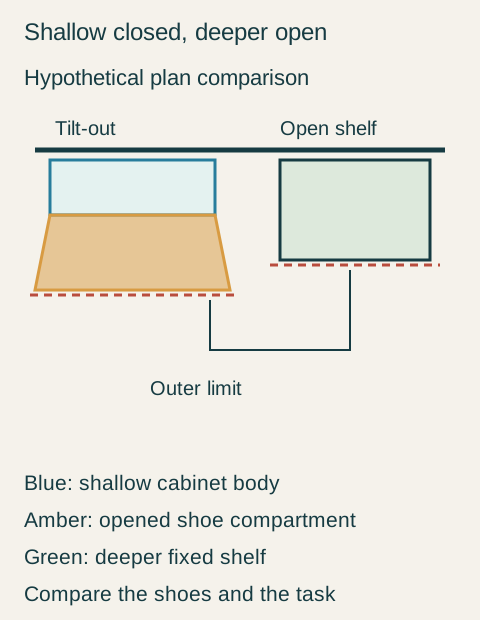
Teaching example Hypothetical plan comparison: the blue shallow cabinet has an amber tilt-out compartment extending farther into the passage when open. The green open shelf is deeper when stored but has no front to tilt out. Dashed lines mark the respective outer limits. The concept shows neither IKEA dimensions nor a required passage width.
An open flat shelf has a different cost. It projects farther at all times, and the shoes remain visible, but it does not add a tilting front during retrieval. A shelf cabinet with hinged doors would need its own door comparison; do not give it the open-shelf result while omitting its doors from the drawing.
A deeper shelf leaves more space during this task
In a hypothetical comparison, the distance from the storage wall to the opposite fixed boundary is 42 inches. A proposed tilt-out body occupies 7 inches when closed, and its compartment adds 8 inches when open. Its outer edge then sits 15 inches from the wall, leaving 27 inches before including the person. These are illustrative planning dimensions, not an IKEA specification or a clearance recommendation.
The alternative in this hypothetical room is an open shelf unit 12 inches deep. It leaves 30 inches to the same opposite boundary, with no extra front movement. The deeper stored unit therefore leaves more space during retrieval in this particular comparison. The person's working position and the entry door still need checking; the arithmetic alone does not approve the route.
The footwear trial provides the deciding evidence. The owner's ordinary boots fit the proposed flat shelves without changing their stored shape, while the selected tilt-out insert does not accommodate that mixed collection. The owner chooses the open shelf unit after confirming the complete arrival and shoe-changing sequence with the room's necessary passage preserved.
Accept the visibility that comes with the choice
The order specifies actual shelf openings for the retained footwear and a supported assembly appropriate to its location. It does not promise the hidden appearance of the rejected cabinet. The owner accepts visible shoes in exchange for the tested access and fit, and keeps temporary bags from occupying the retrieval position.
In another entry, a tested collection of suitable shoes and a less constrained opening area could favor the tilt-out cabinet. The purchase should follow that test. Closed depth is a useful measurement, but it cannot stand in for the open compartment or the footwear it must hold.
Pure White
Cream White
Light Warm Gray
Gray
Navy
Black
Oak Tone
Dark Walnut Tone
Design study These finish studies are design references, not a list of currently orderable colors. Screens and lighting change the appearance; compare a physical sample before choosing.See all finish options →
Entry gear and clean laundry can share a room without sharing every surface. Assign the arrival, washing and departure tasks before choosing one continuous cabinet run.
Separate daily supplies, reserve packages and objects that belong elsewhere. Cabinet size should reflect a usable inventory, not everything temporarily piled in the laundry room.
The sample shows the door frame, a separate center panel, the face frame and the cabinet box. Each component has its own place in this Shaker construction.
Shaker construction: door frame, center panel, face frame and cabinet box. The cutaway helps locate these parts; confirm each material in the specifications for the selected cabinet.
01 / Door frame
The Shaker door has rails and stiles around a separate center panel. The frame and center panel are different components; confirm their materials in the specifications for the selected cabinet.
02 / Face frame
The face frame surrounds the opening at the front of the cabinet box and sits behind the doors. The face frame, door frame and cabinet box are separate parts.
03 / Cabinet box
The sample exposes the cabinet sides, interior surfaces and layered edges. The image does not establish the wood species or material specification of a selected cabinet.