Thin natural-stone veneer cabinet fronts: choose the surface you will touch
Flexible stone veneer offers a different cabinet experience from a printed stone image or a polished slab. Compare the finished texture, protection treatment and proposed curve before selecting the front.
Choose thin natural-stone veneer for a cabinet when the actual stone surface is part of the attraction, and when the finished front suits the way you will handle and clean it. If the goal is simply a controlled stone-colored image, a decorative surface may satisfy that brief more directly. The meaningful comparison is between completed fronts seen and touched in the room, not between the word natural and a photograph of stone.
A stone face does not mean a solid-stone door
Slate-Lite describes its stone veneers as flexible, with a natural-stone surface, and identifies furniture, doors and curves among the applications. That establishes a specific facing option; it does not establish a finished cabinet-door assembly.
Its technical guide identifies a glass-fiber-reinforced polyester carrier beneath the stone. It also notes that protective impregnation or sealing can deepen color, depending on the decor, and warns that acid cleaners can damage the stone surface.
For a cabinet comparison, separate three things in the sales presentation: the decorative face being selected, the completed door that carries it, and the cabinet on which that door operates. A photograph demonstrating the material on a wall answers only part of this purchase. Ask to see a finished furniture application or a representative completed front, so a decision about stone character does not accidentally become an order for loose cladding.
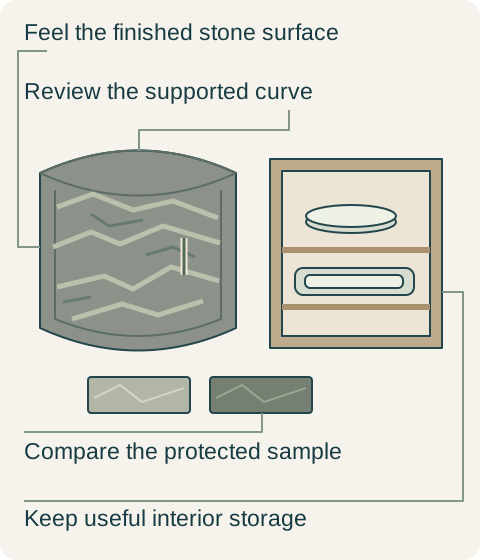
Teaching example Hypothetical curved serving cabinet with natural-stone facing, an open storage view and separate untreated and protected appearance samples. Colors and texture are illustrative; the drawing gives no bend radius, coating recipe or fabrication approval.
Start with your hand, then look from across the room
Compare the actual texture at the places the hand approaches. Hold the pull, move the door through normal operation and inspect the surrounding face. A surface can be appealing in a large wall photograph yet feel wrong beside a frequently used handle. Conversely, someone who dislikes a perfectly uniform plastic-like surface may value the tactile variation. Neither reaction can be settled by the natural-stone label or by magnifying the pattern on a screen.
Then step back to the ordinary viewing distance. Include the side light from the nearby window and the evening light that will actually remain in the room. Look for patches or ridges that draw more attention than expected, and decide whether you enjoy them. Do not require the front to resemble a polished countertop sample unless the offered completed surface really has that appearance. Matching a broad color family is a different design objective from reproducing another material’s finish.
A flexible facing can suit a curve without becoming a folding door
If the furniture has a curved front or rounded end, judge the offered curve as a finished piece. Trace where the pattern turns, where an edge is visible and where the moving front meets the fixed cabinet. The useful question is whether that particular construction gives the intended continuous appearance. It is not whether a loose sheet bends impressively in a demonstration. Flexibility during fabrication does not turn the installed facing into an operating hinge or establish that any corner can be wrapped.
Keep the fabricator’s supported geometry rather than drawing a tighter curve after the material has been selected. Compare the completed curved proposal with a faceted or flat alternative of similar overall size. A curve may be worth buying for its silhouette; it may also leave less useful space for the chosen contents. Open the proposed cabinet and test the intended trays or serving pieces before paying for an exterior shape whose storage has never been resolved.
Approve the protected appearance
Use the actual proposed protective treatment on the appearance sample. Keep an untreated offcut beside it only to explain the difference; approve the completed condition that is intended for delivery. If the treated sample no longer works with the adjacent paint or flooring, change the combination before ordering. Do not select a pale raw sample and then assume that the final protective work is visually neutral.
Review that treated sample as a group of fronts, not just a small square. A strongly marked area can become a prominent feature when it lands beside a pull or along a meeting line. Decide whether the composition should emphasize variation or distribute it more evenly. Save the accepted arrangement with the door identities, while recognizing that a natural material selection is not a promise of an identical future replacement.
Make the maintenance choice before committing to the texture
Have the supplier demonstrate the permitted routine on the completed sample using the intended cleaning tools. Look at the result after it dries, and decide whether that amount of attention is reasonable for this furniture. Someone who wants a quick, familiar wipe across every kitchen surface should compare the alternative front under the same practical test. A preferred appearance is not a reason to conceal an inconvenient care routine from the people who will live with it.
A curved serving cabinet keeps its stone character
Consider a hypothetical dining room with a curved serving cabinet. The owners compare a smooth stone-pattern decorative front and a natural-stone veneer front made to the fabricator’s supported curve. They prefer the latter’s actual texture and the way it looks under the room’s side light. The completed sample includes the selected handle, finished perimeter and protective treatment, and its interior still accepts their serving trays.
The protected sample is darker than the raw selection they first liked. They accept that finished tone and choose the neighboring wall paint against it, rather than asking the fabricator to omit protection to recover the raw color. They order the complete veneered fronts with the demonstrated care routine and accepted surface arrangement. They decline the smoother alternative because the tactile surface was the reason for this particular purchase, not because natural stone proves a superior cabinet.
For delivery, compare the finished group with that accepted condition before filling the cabinet. Separate an unwanted layout, an unfinished edge and a surface feature that was already accepted in the sample; they are different issues. The purchase is successful when the texture, completed treatment, usable interior and operating front all match the chosen furniture, rather than when a carton merely carries the right stone name.
Pure White
Cream White
Light Warm Gray
Gray
Navy
Black
Oak Tone
Dark Walnut Tone
Design study These finish studies are design references, not a list of currently orderable colors. Screens and lighting change the appearance; compare a physical sample before choosing.See all finish options →
A sintered surface can clad cabinetry, but the backing, bond and finished perimeter define the door. Decide how the stone appearance should continue across the kitchen before ordering.
Compare the actual countertop products, heat-source routine and fabrication proposal. A fired porcelain slab and resin-bound quartz are different materials, but neither label replaces a complete kitchen specification.
The sample shows the door frame, a separate center panel, the face frame and the cabinet box. Each component has its own place in this Shaker construction.
Shaker construction: door frame, center panel, face frame and cabinet box. The cutaway helps locate these parts; confirm each material in the specifications for the selected cabinet.
01 / Door frame
The Shaker door has rails and stiles around a separate center panel. The frame and center panel are different components; confirm their materials in the specifications for the selected cabinet.
02 / Face frame
The face frame surrounds the opening at the front of the cabinet box and sits behind the doors. The face frame, door frame and cabinet box are separate parts.
03 / Cabinet box
The sample exposes the cabinet sides, interior surfaces and layered edges. The image does not establish the wood species or material specification of a selected cabinet.