For a curved cabinet end, specify which way the substrate bends and how it becomes a finished supported component. The words flexible plywood do not establish the required curvature, visible finish or load-bearing role. A sheet that bends easily can still be the wrong product orientation or an incomplete purchase.
The bend axis belongs on the panel order
Columbia’s Radius sheet distinguishes long-grain column-bend and cross-grain barrel-bend configurations. Turning the sheet in a cutting diagram is not a substitute for identifying the intended bend axis and available dimensions. The curved component drawing should show that axis relative to its height and wrap direction.
The same product sheet lists a minimum radius of 12 inches. It notes that smaller curves may require significant force, but that observation should not be treated as an unconditional approval to specify a tighter completed part. The fabricator must reconcile the substrate, actual curve reference and finish layers in the final assembly.
Radius is described as a substrate for curved applications to be covered with laminate, paper-backed veneer or other thick surfaces, and is not designed for structural or exterior use. A raw flexible sheet therefore does not replace the cabinet’s supporting construction or arrive with the desired decorative finish already established. These are explicit product-role limits.
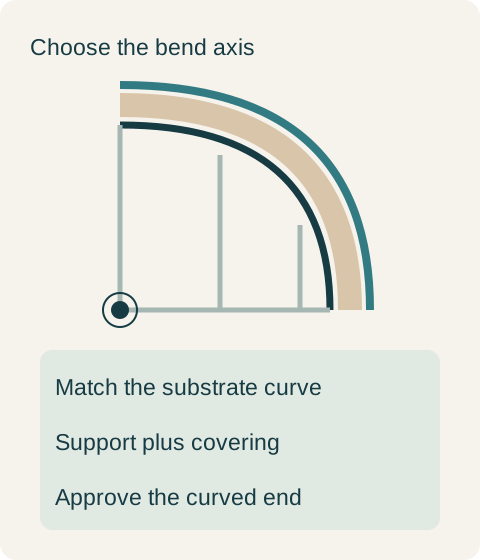
Diagram Conceptual plan view of curved substrate, support and covering; the dot marks the bend axis out of the drawing. Not to scale; no forming force, support spacing or fabrication recipe is specified.
Enlarge the curve and retain a separate supporting cabinet
Suppose a hypothetical decorative cabinet end is initially drawn with a substrate curve of 10 inches. The selected product’s published minimum is not met. The design is revised to a 16-inch substrate curve, and the fabricator accepts the resulting supported assembly with a compatible paper-backed veneer covering and completed edge treatment. The buyer approves this revised finished end; the load-bearing cabinet remains a separate supporting construction.
In the hypothetical revision, the accepted drawing identifies the same curve reference used in the fabricator’s review. It does not label the outside finished surface with a substrate dimension and assume they are identical. The quote includes shaping, support, covering and finish, rather than charging for a bending sheet and leaving the rest to an unspecified site operation.
A flat finish sample cannot show the completed curve
Review a representative curved piece with its actual covering direction and edge. A veneer pattern that looked calm on a flat chip may read differently as it wraps around the end. The covering also has its own forming and bonding requirements. The substrate’s ability to flex is not evidence that every laminate or veneer can follow it unchanged.
Keep the approved bend direction, radius reference, support construction and finish package together. If a later design tightens the curve or swaps the decorative layer, revisit the completed component rather than reusing the old sheet description. That is how a curved-end purchase remains a defined cabinet part instead of a promise that a flexible material will solve every geometry.
Pure White
Cream White
Light Warm Gray
Gray
Navy
Black
Oak Tone
Dark Walnut Tone
Design study These finish studies are design references, not a list of currently orderable colors. Screens and lighting change the appearance; compare a physical sample before choosing.See all finish options →
Plywood has directional properties despite its cross-laminated construction. Identify the actual panel and its design direction before rotating a shelf cut to suit the visible grain.
Identify whether the visible cabinet end is an applied decorative panel, a finished structural side or a different construction option before approving the quote.
The hidden back of a veneered panel is part of its construction. Specify it with the face, core and bonding method before assuming a decorative panel will remain flat.
The sample shows the door frame, a separate center panel, the face frame and the cabinet box. Each component has its own place in this Shaker construction.
Shaker construction: door frame, center panel, face frame and cabinet box. The cutaway helps locate these parts; confirm each material in the specifications for the selected cabinet.
01 / Door frame
The Shaker door has rails and stiles around a separate center panel. The frame and center panel are different components; confirm their materials in the specifications for the selected cabinet.
02 / Face frame
The face frame surrounds the opening at the front of the cabinet box and sits behind the doors. The face frame, door frame and cabinet box are separate parts.
03 / Cabinet box
The sample exposes the cabinet sides, interior surfaces and layered edges. The image does not establish the wood species or material specification of a selected cabinet.