Thermofoil or painted cabinet fronts: compare the finished door package
A wrapped film and an applied paint coating can produce similar colors through different constructions. Choose the actual profile, completed surfaces and acceptable upkeep, not a promise that either label is always better.
Thermofoil can be a sensible choice when the offered wrapped profile, finish and complete matching package suit the kitchen. Painted fronts are a sensible choice when the desired coating and door construction are available and their maintenance expectations fit the household. Comparing the same shade is not enough. Look at how the surface follows the profile, what finishes the reverse and fixed parts, and which repair route the seller actually supports. Neither category is a universal quality grade.
A film follows the shaped component
Northern Contours describes gluing a routed engineered core, then bonding thermofoil over its face and sides using heat, vacuum and pressure. Its resulting components do not require separate face-edge banding. The relevant detail for a buyer is the completed transition around the profile. A color chip cannot show whether the offered inner corner, outer edge and handle area have the appearance and feel you want. View the full finished door in the actual style.
The Composite Panel Association distinguishes paint coatings applied to composite substrates in liquid or powder form. A painted door therefore need not be a solid-wood door. If the proposals use different underlying constructions, list that difference before attributing everything you see to paint versus foil. A routed panel and an assembled frame-and-panel door can differ even when both are painted. The surface choice and the construction choice need to remain recognizable in the comparison.
Profiles deserve more attention than small color chips
Inspect a finished corner, the inner contour and the reverse together. Consider where a hand touches the door, where a pull interrupts the face and how the door looks when open. Do not assume that two collections with similar style names use the same outline. A slightly different profile can change the shadow around the center more than a small difference between color chips. Select the shape you actually saw rather than expecting the alternate process to reproduce it automatically.
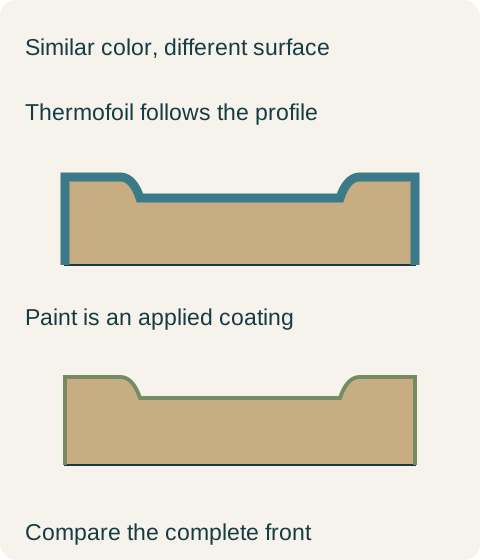
Diagram Conceptual sections compare a wrapped surface and an applied coating over shaped cores. Layer thickness is exaggerated; the drawing does not establish the construction of an unidentified door or promise a repair result.
The preferred wrapped profile can decide the purchase
In a hypothetical kitchen, the owners compare a painted door with a thermofoil door in a similar pale tone. They prefer the finished thermofoil profile and its face-to-edge transition. The matching fixed panels and trim have also been shown, and the proposed appliance arrangement satisfies the selected products’ requirements. They choose the thermofoil package, accepting its specified care and replacement approach. They do not buy it on the assumption that any later damage can be hidden with the paint supplied for the other proposal.
The alternative decision could favor paint when the particular coating, texture or custom finish matters more. That is a reason to select an available, approved painted package, not to assume every color can be supplied on every style. The hypothetical owners have already found a wrapped finish they like, so a broader theoretical paint palette adds no value to their order. A purchase comparison should reward useful differences instead of collecting options the household will never use.
Touch-up is a defined capability, not a reset button
KraftMaid describes its paint touch-up pens as suitable for small imperfections; larger or significant damage may require different treatment or professional help. Even a documented touch-up route has a limited scope. Buying painted fronts does not mean the owner can repeatedly spot-paint any worn area and always reproduce the factory appearance. If easy cosmetic correction matters, examine the permitted result and its limits before giving that feature a value in the comparison.
For a wrapped front, distinguish a color blemish from a film that is no longer properly attached or a damaged supporting panel. The future decision might concern a replacement component rather than merely adding color. That does not establish that replacement is inevitable or that repairs are never possible; it tells the buyer not to borrow a paint-maintenance assumption. Retain the actual material and finish identification so that any later assessment starts with the correct construction.
Match the stationary surfaces as carefully as the doors
Exposed ends, face frames where present, fillers and trim remain visible after the fronts close. A door sample may be the favorite object in the showroom while leaving the room’s corners unresolved. Compare the assembled relationship of these parts, including any intentional difference in surface material. The buyer in the example accepts the offered companion panels before ordering. A later substitute that changes their sheen is a visible change to the chosen package, even if its color name is similar.
Compare totals for the same cabinet arrangement and supplied work. A painted quote with additional finishing of fixed parts and a thermofoil quote for doors alone are not interchangeable offers. Conversely, a price difference need not measure the expected life of the surfaces. Use the agreed scope, finish and component list to see what is being bought, and leave undocumented lifespan rankings out of the decision.
Approve the surface you will actually use
Open the sample, touch it normally with permission, and look at it beside the selected neighboring parts. Keep the care document with the accepted finish record. Heat and steam suitability still belongs to the actual cabinet-and-appliance pairing; a manufacturing process name cannot close that separate review. Once the complete wrapped or painted package meets the intended appearance and use, record that selection so a familiar color name cannot quietly substitute for a different construction.
Pure White
Cream White
Light Warm Gray
Gray
Navy
Black
Oak Tone
Dark Walnut Tone
Design study These finish studies are design references, not a list of currently orderable colors. Screens and lighting change the appearance; compare a physical sample before choosing.See all finish options →
A color name does not identify a finish system. Compare the decorative surface, the core, the edge and the repair method before choosing a cabinet front.
Review the cabinet finish, appliance instructions and exposed edge locations together before choosing foil-covered doors near equipment that produces heat or steam.
Compare the actual countertop products, heat-source routine and fabrication proposal. A fired porcelain slab and resin-bound quartz are different materials, but neither label replaces a complete kitchen specification.
The sample shows the door frame, a separate center panel, the face frame and the cabinet box. Each component has its own place in this Shaker construction.
Shaker construction: door frame, center panel, face frame and cabinet box. The cutaway helps locate these parts; confirm each material in the specifications for the selected cabinet.
01 / Door frame
The Shaker door has rails and stiles around a separate center panel. The frame and center panel are different components; confirm their materials in the specifications for the selected cabinet.
02 / Face frame
The face frame surrounds the opening at the front of the cabinet box and sits behind the doors. The face frame, door frame and cabinet box are separate parts.
03 / Cabinet box
The sample exposes the cabinet sides, interior surfaces and layered edges. The image does not establish the wood species or material specification of a selected cabinet.