Foil-covered cabinet doors near heat: check the actual product pairing
Review the cabinet finish, appliance instructions and exposed edge locations together before choosing foil-covered doors near equipment that produces heat or steam.
Before choosing foil-covered cabinet doors near heat-producing equipment, verify the requirements of both the cabinet finish and the exact appliance. Identify the exposed door edges and nearby surfaces in the proposed arrangement. Neither the word thermofoil nor the presence of a generic heat shield supplies a universal clearance or proves that a particular pairing is suitable.
Physical sample Use the visible face-to-edge transition to locate questions about a chosen door finish. This is not a thermofoil identification or a heat-resistance demonstration.
Separate the forming process from service conditions
The Composite Panel Association describes formable decorative films applied over shaped substrates. Heat used to form a surface during manufacturing does not establish the temperatures or exposures permitted during its service life. Obtain the finished door’s own information.
Confirm the finish name, supporting door material and how the face transitions around its edges to the reverse. A smooth wrapped appearance can hide where a surface terminates. Look at a finished sample and keep its product identification; do not infer the construction from a photograph of a painted-looking door or from a color name shared with another collection.
Describe the equipment and its operating modes
Provide the appliance model and its installation and use instructions to the person coordinating the cabinet purchase. Identify relevant vents, exhaust outlets and the surfaces that may face them. Include special operating modes when the appliance documentation distinguishes them, rather than discussing only ordinary cooking or warming.
For portable equipment, record the intended operating location as well as where it is stored. A device may be parked near a cabinet but used elsewhere. The practical review should describe actual use, including opening a lid or releasing steam, without operating equipment against a sample cabinet to test whether damage occurs.
Treat protective accessories as product-specific components
KraftMaid offers a heat shield in the context of cabinets adjacent to ovens or ranges and thermofoil or laminate surfaces. That manufacturer example does not identify a universal accessory suitable for every cabinet and appliance combination.
If a shield is required or proposed for the selected products, establish its approved identity, location and inclusion in the order. Have the responsible installer reconcile it with the appliance requirements. Do not assume an added barrier permits reduced clearances, covers a blocked vent or substitutes for a missing installation detail. A decorative side panel is not automatically a heat-protection component either.
A worked decision before the cabinet order is released
Imagine a buyer who prefers a foil-covered door finish and already has a selected oven. The cabinet quote does not mention heat-related requirements, while the buyer has saved only a retailer photograph of the oven. The next useful step is to obtain the exact appliance documentation and cabinet finish requirements, then identify the affected edges on the cabinet drawing.
If the review identifies an approved protective component, include it explicitly rather than assuming the installer will supply it later. If the product pairing remains undocumented, resolve the finish choice or equipment arrangement before release. This is more reliable than selecting an arbitrary spacing from an unrelated online project, even when that project looks similar.
Inspect the edges without attempting a heat test
At receiving, examine the finished perimeter and reverse transition for lifting, bubbling or damage, and document anything unexpected before installation. Do not peel an edge to inspect the adhesive or warm it with a hair dryer to see whether it will reattach. The appropriate response depends on the specific finish system and the supplier’s assessment.
Keep the final appliance model, cabinet finish identification, relevant instructions and any approved accessory detail in the installer’s package. If an installed edge later changes near equipment, record the location and operating history, and arrange an assessment while following the appliance’s instructions. Replacing the door without resolving the exposure question may leave the same uncertainty in place. A complete purchase decision accounts for both the surface and how nearby equipment will actually be used.
Pure White
Cream White
Light Warm Gray
Gray
Navy
Black
Oak Tone
Dark Walnut Tone
Design study These finish studies are design references, not a list of currently orderable colors. Screens and lighting change the appearance; compare a physical sample before choosing.See all finish options →
A painted door, a wood-grain side and a plywood cabinet box can belong to the same cabinet. Here is how to read those parts, what the sample photos actually show, and which details to put on a quote.
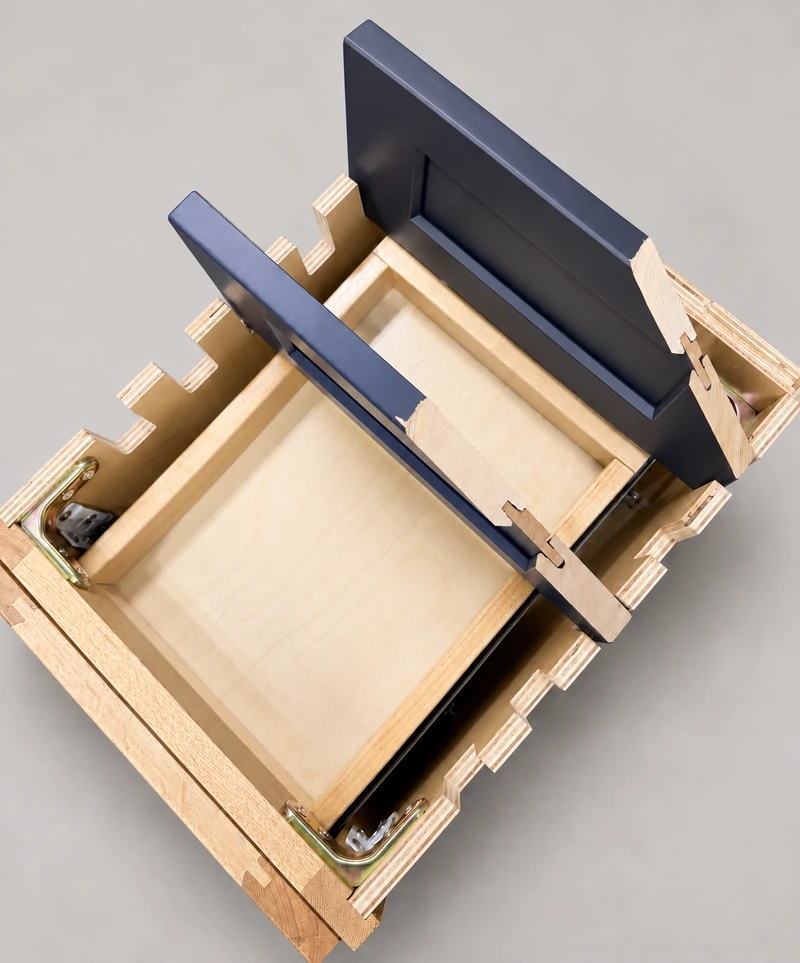
The sample shows the door frame, a separate center panel, the face frame and the cabinet box. Each component has its own place in this Shaker construction.
Shaker construction: door frame, center panel, face frame and cabinet box. The cutaway helps locate these parts; confirm each material in the specifications for the selected cabinet.
01 / Door frame
The Shaker door has rails and stiles around a separate center panel. The frame and center panel are different components; confirm their materials in the specifications for the selected cabinet.
02 / Face frame
The face frame surrounds the opening at the front of the cabinet box and sits behind the doors. The face frame, door frame and cabinet box are separate parts.
03 / Cabinet box
The sample exposes the cabinet sides, interior surfaces and layered edges. The image does not establish the wood species or material specification of a selected cabinet.