Thermally modified wood or brown-stained wood for cabinets?
A brown color can come from different processes. Thermal modification changes the wood; choose it for an identified component benefit rather than treating darker color as a cabinet quality grade.
Choose thermally modified wood when the specified material and complete cabinet component provide a benefit you actually want, such as the offered through-section color or a justified movement-related design advantage. If the goal is simply a brown finished appearance, compare an ordinary stained-wood cabinet as a serious alternative. Similar color does not mean similar material properties. Conversely, modified wood is not automatically the stronger, tougher or better cabinet. The decision belongs to the finished component and its construction, not to the darkness of a sample.
The treatment changes the wood, not only its appearance
Thermory describes heat-and-steam modification throughout the board, reducing moisture uptake and improving dimensional stability relative to untreated wood. That is a material change. A brown stain name, by contrast, identifies a color treatment without establishing that this modification occurred. A proposal saying only heat treated is also incomplete for this comparison: ask for the actual material process identity rather than reading a cabinet benefit into those words. The buyer needs to know what material is being compared before evaluating why it might be worth selecting.
SWM Wood describes its Thermowood as brown throughout and distinguishes product classes, including a stability-oriented class for indoor furniture. This is not a reason to substitute an outdoor board for a cabinet rail. It shows why the offered material needs an identity beyond a brown photograph. For an exposed edge or machined recess, inspect a cut sample from the actual stock together with its final finish. The relevant appearance is what the fabricated part reveals, not just the broad face shown before machining.
Dimensional stability and toughness answer different questions
The ThermoWood handbook reports reduced impact and splitting strength in its cited tests. A movement-related advantage therefore cannot be used as proof of better resistance to every kind of damage. In a cabinet, a broad visible end panel and a narrow rail around a routed feature have different jobs. Decide what each part must do before accepting a blanket material upgrade. The same dark wood can be an appealing decorative selection without establishing that an existing thin detail should be copied unchanged.
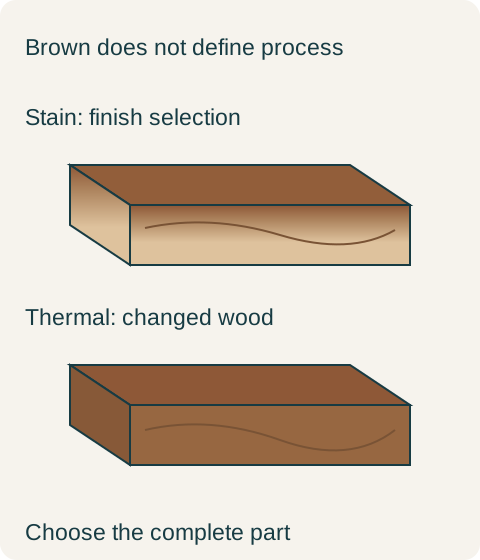
Diagram Conceptual material comparison. A colored surface and a brown-through-section board illustrate different process identities; stain penetration and thermal color uniformity are not specified. Neither drawing states strength or cabinet suitability.
When a brown finish is the whole objective
Consider a hypothetical cabinet order with already satisfactory door construction and indoor service conditions. The owner likes the same brown appearance on both completed sample sets: an ordinary stained-wood option and a thermally modified alternative. The latter offer includes a different approved fabrication process and a higher complete price. The owner selects the stained-wood cabinet because color is the objective and there is no project need for the alternative material’s specific benefits. The choice preserves the accepted door design and finish without paying for a property the project does not use.
That outcome is not a general price ranking. It depends on the actual hypothetical offers, with completed parts compared on equal scope. If machining exposes the wood section as an intentional feature and the modified sample gives the desired result, a different project could prefer it. The useful question is what feature of the finished cabinet would be lost by choosing the ordinary stained option. If the answer is only a process label that nobody values in use, that label does not explain the purchase.
A changed material can require a changed shop process
The handbook notes that PVAc bonding may need longer pressing and drying because modified wood absorbs water more slowly. The cabinet implication is practical: a familiar adhesive name does not establish that the old production cycle is appropriate for the new stock. For a completed-door offer, the selected shop process belongs to the manufacturing scope. The buyer should compare the resulting component, not prescribe a universal extra pressing time. This also explains why purchasing attractive loose boards and asking an unrelated shop to copy an old door is a different project from buying a qualified finished assembly.
For an original comparison, keep the species, intended component, visible finish and completed dimensions identifiable. If an offer changes species as well as the thermal process, do not attribute the resulting grain, weight or price difference entirely to modification. If it changes the construction from a framed door to a veneered slab, record that too. A meaningful comparison can contain several changes, but it should not hide them behind a shared brown color name. The selected stained option in the example is a whole door, not a claim that stain duplicates every property of the alternative.
Through-section color does not finish the purchasing decision
Color within the wood answers where the color is, while a finished sample answers what the exposed part looks and feels like. Those are different observations. Inspect the face, the intended edge profile and any visible recess as one component. Do not infer a ready-to-use cabinet surface from an unfinished brown board. Nor should a buyer assume that future marks will be invisible merely because the underlying material is also brown. A visible defect can change shape or sheen as well as color; a matching hue alone is not an appearance acceptance standard.
In the hypothetical order, the owner keeps the approved stained sample as the reference for the fronts and exposed matching components. The thermal alternative is not rejected as unsuitable wood; it simply does not solve an additional requirement of this purchase. This is a completed choice with a clear consequence. The budget goes toward the chosen cabinet package, and the shop does not quietly swap in a different stock because it happens to look similarly brown before finishing.
An order for modified wood should identify that material, the intended parts and the accepted finished assembly. An order for a stained cabinet should identify the actual wood construction and finish selection without borrowing thermal-modification claims. For either route, the best comparison connects a material property to a particular use in the cabinet. A darker color, an outdoor durability story or the word modified cannot perform that reasoning on its own. Select the construction that delivers the valued result, and retain the finished reference that made the choice concrete.
Pure White
Cream White
Light Warm Gray
Gray
Navy
Black
Oak Tone
Dark Walnut Tone
Design study These finish studies are design references, not a list of currently orderable colors. Screens and lighting change the appearance; compare a physical sample before choosing.See all finish options →
Locate and document a painted joint line, distinguish an appearance change from looseness or damage, and request an assessment before filling or repainting.
Compare the actual countertop products, heat-source routine and fabrication proposal. A fired porcelain slab and resin-bound quartz are different materials, but neither label replaces a complete kitchen specification.
The sample shows the door frame, a separate center panel, the face frame and the cabinet box. Each component has its own place in this Shaker construction.
Shaker construction: door frame, center panel, face frame and cabinet box. The cutaway helps locate these parts; confirm each material in the specifications for the selected cabinet.
01 / Door frame
The Shaker door has rails and stiles around a separate center panel. The frame and center panel are different components; confirm their materials in the specifications for the selected cabinet.
02 / Face frame
The face frame surrounds the opening at the front of the cabinet box and sits behind the doors. The face frame, door frame and cabinet box are separate parts.
03 / Cabinet box
The sample exposes the cabinet sides, interior surfaces and layered edges. The image does not establish the wood species or material specification of a selected cabinet.