Give a tall stockpot a usable exit, not just enough shelf height
Check the complete pot, lid knob and side grips through the opening and into the user’s hands. A tall interior can hide a lower front obstruction that prevents straightforward removal.
Choose a stockpot’s storage location by the complete route from its resting position into the user’s hands and onto a suitable surface. Interior shelf height alone cannot approve that route. The lid knob, side handles, front rail and open door can each change the result. Plan this as an empty, cooled cookware-storage task; moving a pot full of food is a separate activity.
Decide the form in which the pot will be stored
Represent the exact stockpot with its side handles and the lid arrangement the household intends to use. If the lid stays on, include its highest point. If stored separately, give it an actual assigned location and include the resulting extra handling in the routine. Do not compare the height of an uncovered pot with a plan that silently assumes its lid will remain on.
Record the full handle-to-handle extent and the space needed to grip each intended handhold. The body can fit a shelf while its handles approach the side boundaries too closely for comfortable control. Also identify any smaller cookware nested inside. Removing that content may be part of the agreed sequence, but the plan should not hide that extra step behind a simple statement that the stockpot fits.
Compare the front opening with the interior
Trace the available opening with the door in its actual usable position. Include the lower edge of a fixed rail, shelf supports, hinges and any front component that narrows the passage. An interior cavity can be taller than the clear opening at its entrance. Keep those measurements and boundaries separate so the largest internal dimension does not become the claimed exit height.
Follow the highest part of the pot as it moves forward. Then include the hands and the lift needed to clear the supporting surface or any retaining edge. A path that clears the knob while the pot rests motionless may disappear when the person begins to lift it. Do not assume that tilting will solve the problem until the whole empty-pot motion and control have been checked.
ABCD
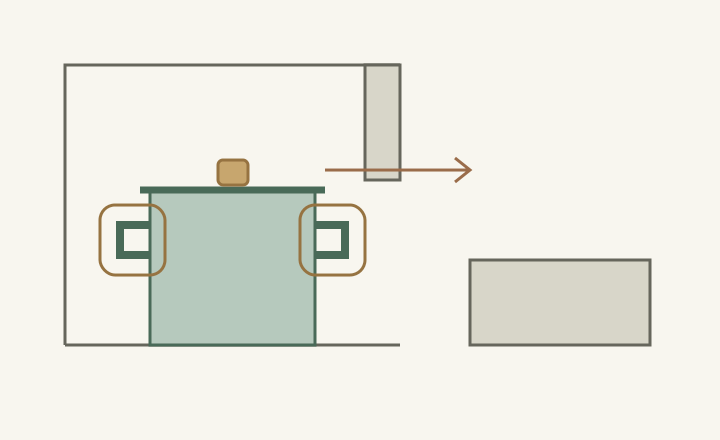
Diagram The straight arrow crosses the front obstruction to flag an unverified exit. Hand regions are illustrative, not prescribed clearances or ergonomic dimensions. The drawing does not recommend tilting or removing the fixed front part.
A
Include the lid’s highest point in the stored form.
B
Leave usable access to the intended grips.
C
An interior fit does not prove passage through the front.
D
Complete the route to a suitable stable destination.
Check the user’s position outside the cabinet
Place the intended user where the pot can be grasped with the cabinet open. Include nearby doors, an adjacent drawer and any island edge that limits standing or turning. The destination matters too: a pot that can leave the opening may still be awkward to set down if the only available counter requires reaching across the open door or a neighboring appliance.
Use an appropriate lightweight representation or a controlled cold, empty-pot demonstration suited to the person. This is a layout check, not a lifting-capacity test. If the person cannot maintain comfortable control at the proposed height, compare another location rather than asking them to prove they can manage the existing plan. A tall pot stored high and the same pot stored low create different handling tasks.
Look for the front restriction that an empty-cabinet measurement misses
In a hypothetical cabinet, the stockpot with its lid fits beneath the shelf above. The interior measurement is accepted as sufficient. During the exit check, the lid knob meets a fixed front rail before the pot can move straight out, and lifting only brings it closer to the obstruction. The unused height farther inside the cabinet does not solve the entrance problem.
Compare a location with an appropriate opening, an approved different cabinet configuration or storing the lid separately if that suits the household. Verify the complete revised route. Do not remove or cut a fixed rail as an improvised storage adjustment, and do not rely on an awkward tilt that has never been checked with the pot’s handles and the user’s stance.
Preserve the complete sequence after the cabinet is filled
Test removal and return with representations of neighboring contents present. Confirm where any nested pieces or separate lid wait during the task and whether the stockpot can go back without rearranging unrelated daily items. Consider frequency: an occasional pot may justify a longer deliberate sequence, but that sequence still needs a workable place for every item temporarily moved.
Save the stored form, clear front boundary, grip positions and destination with the storage assignment. Check the support and full stored load separately. Revisit the route after adding a lid, moving a shelf or changing a nearby door. The useful location is one that holds the stockpot and lets the household retrieve and return it under the conditions actually planned.
Pure White
Cream White
Light Warm Gray
Gray
Navy
Black
Oak Tone
Dark Walnut Tone
Design study These finish studies are design references, not a list of currently orderable colors. Screens and lighting change the appearance; compare a physical sample before choosing.See all finish options →
Give lids recognizable positions and usable grips. Compare separate slots, shallow storage and lids kept with pots by the actual retrieval and return sequence.
A pan collection can fit and still exceed the applicable system limit or be awkward to lift. Verify what the rating includes, total the real load and assess the user’s retrieval separately.
The sample shows the door frame, a separate center panel, the face frame and the cabinet box. Each component has its own place in this Shaker construction.
Shaker construction: door frame, center panel, face frame and cabinet box. The cutaway helps locate these parts; confirm each material in the specifications for the selected cabinet.
01 / Door frame
The Shaker door has rails and stiles around a separate center panel. The frame and center panel are different components; confirm their materials in the specifications for the selected cabinet.
02 / Face frame
The face frame surrounds the opening at the front of the cabinet box and sits behind the doors. The face frame, door frame and cabinet box are separate parts.
03 / Cabinet box
The sample exposes the cabinet sides, interior surfaces and layered edges. The image does not establish the wood species or material specification of a selected cabinet.