Check the complete drawer load and the lift before assigning cast-iron cookware
A pan collection can fit and still exceed the applicable system limit or be awkward to lift. Verify what the rating includes, total the real load and assess the user’s retrieval separately.
Assign cast-iron cookware to a drawer only after checking both the complete installed system’s load suitability and the person’s lifting task. These are separate decisions. A drawer can contain the collection geometrically while its applicable capacity remains unverified; an adequately specified drawer can still place a heavy pan where the intended user cannot handle it comfortably. Neither a large box nor smooth movement answers both questions.
Establish what the stated rating actually covers
Identify the installed drawer system, its size and configuration, and obtain the applicable capacity and loading conditions from the responsible cabinet or hardware documentation. Confirm that the stated value applies to the completed drawer and its installation. A number associated with a runner alone should not be treated as approval for any drawer bottom, attachment or cabinet into which it might be fitted.
Hettich’s cited technical section defines its indicated load capacity to include the drawer itself and its contents. This example shows why a rating must be read with its definition. Do not transfer that definition or a capacity from a different system without checking the actual installed arrangement.
Count everything included in the applicable load definition
Inventory the pans, lids and any other pieces sharing the drawer, using their actual weights or reliable product information. Include organizers and other additions as the system definition requires. Keep the empty drawer’s weight distinct where relevant, and avoid counting the same part twice. If needed information is missing, obtain it before assigning the complete heavy collection; do not infer it from drawer size.
In an entirely hypothetical example, a total moving-assembly limit is 40 kg. The empty drawer is 8 kg, the added organizer is 2 kg and the cookware is 34 kg. The total is 8 + 2 + 34 = 44 kg, exceeding the hypothetical limit by 4 kg. Comparing only 34 kg of cookware with 40 kg would miss the problem. These are teaching values, not a product rating.
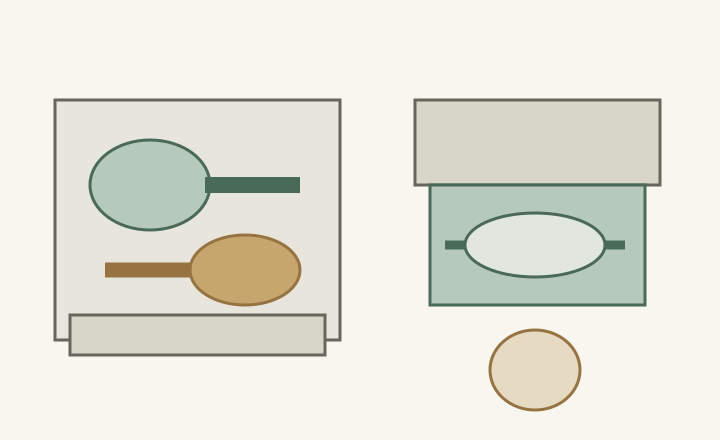
ABCD
Diagram The left view prompts complete load accounting; the right prompts a separate handling check. The shapes carry no weights and do not show a certified system, approved load distribution or recommended installation height.
A
Inventory every item in the planned load.
B
Check what the rating includes about the drawer itself.
C
Place the chosen pan where its grips can be reached.
D
Assess the user’s lift independently of capacity.
Follow the system’s conditions when distributing the collection
Use the applicable loading and installation conditions to decide where the items can be placed. Do not assume that keeping a total below a headline number permits any concentration of weight or any organizer arrangement. Confirm the completed assembly with the responsible supplier or installer, including the drawer support and cabinet installation that the system requires.
If the collection exceeds the verified arrangement, compare splitting it among separately verified locations or selecting a suitable different system. Dividing cookware between drawers does not automatically approve either drawer; each resulting load and its support still need checking. Avoid stacking additional heavy pieces in an unverified rear corner merely because the front region appears full.
Choose a position that supports a controlled everyday lift
Check access to the intended pan’s main and helper grips with the drawer extended as designed. Include the height from which the user lifts, the forward reach and the stable destination. A low position can reduce the height of storage yet still make repeated bending and lifting awkward. A higher location changes the task again. Compare actual use rather than assigning a universal best height for heavy cookware.
Plan the sequence with lightweight representations first. Any handling demonstration should use cold, empty cookware and remain appropriate to the person; it is not a strength test or a way to test the drawer’s structural limit. If a pan cannot be controlled comfortably in the proposed position, change the assignment instead of using the rating as evidence that the person should manage it.
Keep the approved inventory from growing unnoticed
Record the verified system, the capacity definition, the items assigned and the agreed loading arrangement. Keep the cookware needed most often accessible without first lifting a heavy stack of unrelated pieces. After adding a pan, insert or lid collection, revise the load record and check the retrieval sequence again. Extra empty area is not evidence of spare weight capacity.
The final storage choice should answer both questions plainly: the complete installed assembly is suitable for its documented load, and the user has a practical route to lift and return the intended pan. Preserve any unresolved capacity condition until it is confirmed, rather than replacing it with a successful opening demonstration.
Pure White
Cream White
Light Warm Gray
Gray
Navy
Black
Oak Tone
Dark Walnut Tone
Design study These finish studies are design references, not a list of currently orderable colors. Screens and lighting change the appearance; compare a physical sample before choosing.See all finish options →
Check the complete pot, lid knob and side grips through the opening and into the user’s hands. A tall interior can hide a lower front obstruction that prevents straightforward removal.
The useful orientation is the one that lets the pan come out. Check its rim, the cabinet opening and the withdrawal path before choosing divider spacing.
The sample shows the door frame, a separate center panel, the face frame and the cabinet box. Each component has its own place in this Shaker construction.
Shaker construction: door frame, center panel, face frame and cabinet box. The cutaway helps locate these parts; confirm each material in the specifications for the selected cabinet.
01 / Door frame
The Shaker door has rails and stiles around a separate center panel. The frame and center panel are different components; confirm their materials in the specifications for the selected cabinet.
02 / Face frame
The face frame surrounds the opening at the front of the cabinet box and sits behind the doors. The face frame, door frame and cabinet box are separate parts.
03 / Cabinet box
The sample exposes the cabinet sides, interior surfaces and layered edges. The image does not establish the wood species or material specification of a selected cabinet.