Stainless steel or quartz-composite kitchen sink: choose the use you will see
Compare the actual sink finish, care routine and sound treatment. A colored composite is not maintenance-free stone, and a stainless sink need not stay scratch-free to serve its purpose.
Choose stainless steel when you like the metal surface and can accept the marks it develops in daily use. Choose a quartz-composite sink when its offered matte color and feel suit the kitchen and you accept that product’s cleaning routine. Neither material name settles bowl shape, noise, mounting or the complete installed cost. Start with two sinks that actually meet the household’s working requirements, then compare what you will see and maintain. An attractive material is not a useful choice if it comes in a bowl you dislike using.
Stainless steel has a visible working surface
BLANCO acknowledges that stainless sinks acquire scratches in use and advises cleaning brushed surfaces along their brushing direction. The practical decision is whether that evolving metal surface is acceptable to the owner. Inspect the offered finish from the position where you normally stand, not only under a showroom spotlight. If the household rejects the first fine line as a failed purchase, it has set an expectation the material choice does not support. A used sink can still fit the intended kitchen even when it no longer looks untouched.
Granite or quartz composite is a manufactured material, not a basin carved from a stone slab. BLANCO describes SILGRANIT as quartz sand combined with an acrylic matrix and other components, colored through its thickness. That named example explains the category without making every composite formula equivalent. Compare the actual offered sink’s surface, rather than borrowing performance claims from another brand with a similar color. A stone-like appearance does not identify the exact material any more than a steel-colored surface identifies the construction of every metal sink.
BLANCO’s US SILGRANIT care instructions include daily washing, rinsing and drying, plus periodic limescale care. Color therefore should not be chosen on the assumption that cleaning disappears. Consider the household’s water and normal routine: who dries the basin, what gets left after cooking, and where the appropriate cleaning product will be kept. The point is not to predict a universal stain on every sink. It is to decide whether the upkeep belonging to the selected surface is a reasonable part of this kitchen.
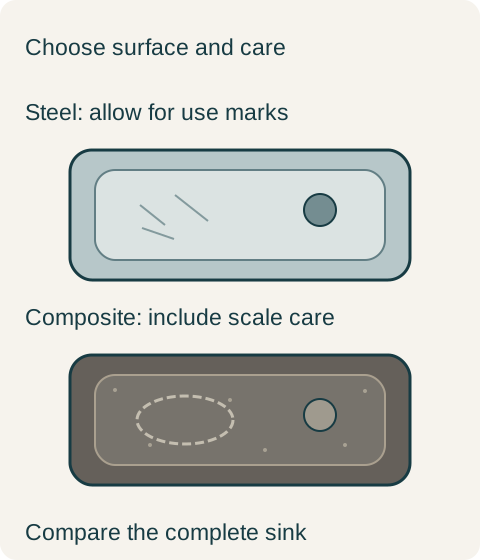
Diagram Conceptual sink-surface comparison. Fine lines on steel represent possible use marks; the pale ring on composite represents removable deposits to consider in care, not an inevitable defect or product test.
A household chooses the matte composite for a specific reason
In a hypothetical remodel, both shortlisted sinks have an accepted bowl arrangement and mounting package. The owners prefer how the composite sample’s matte surface sits beside their countertop, and they already rinse and dry the basin after the evening cleanup. They choose that composite model and keep its limescale-care instructions with the kitchen information. They do not select it because it is called stone or because someone promised it would never show a mark. The steel option remains suitable, but its visible metal finish is not what these owners want.
Another household could keep stainless because it likes a working metal surface and accepts its use marks. That is a complete preference, not an admission that the kitchen is cheaper or less refined. For a meaningful comparison, put both actual finishes beside the intended counter and faucet. A render can help with composition, but it cannot reproduce the full tactile and reflected appearance. In the hypothetical project, the owners make the color decision from the offered sink surface and then retain the identified model, rather than ordering any composite in a similarly named shade.
Noise is a property of the supplied sink assembly
KOHLER’s kitchen-sink guide identifies SilentShield sound absorption on its stainless sinks to reduce noise from water, dishes and disposals. This is a specific assembly feature, not a material-wide noise ranking. When sound matters, compare the actual sink and its sound treatment. A sales conversation that contrasts a bare metal sample with a complete composite bowl has changed more than the material. The homeowner is buying the installed fixture, so the relevant question is how the offered assembly addresses the sounds that bother the household.
Do not let a quiet-sounding material description override a poor working shape. Keep the accepted bowl interior and the way the family handles its usual cookware in view while comparing materials. If one option changes the bowl or divider arrangement, record that as a functional difference. It may be enough to decide the purchase, but it should not be credited to the surface material. The hypothetical owners already accepted both bowl arrangements, which lets them choose the matte finish without sacrificing the use they require.
Keep the entire installation in the comparison
A nominal sink width is not a complete replacement specification. The selected bowl, mounting detail and required support must suit the actual top and cabinet. That remains true after a material choice has been made. Compare the installed package, including the identified drain components and any agreed accessory, rather than only the basin’s advertised price. If one proposal changes the cutout or supplied parts, make that difference visible before choosing. A lower item price does not demonstrate a lower completed sink purchase when the scopes differ.
Pure White
Cream White
Light Warm Gray
Gray
Navy
Black
Oak Tone
Dark Walnut Tone
Design study These finish studies are design references, not a list of currently orderable colors. Screens and lighting change the appearance; compare a physical sample before choosing.See all finish options →
Compare the largest cookware, tasks that need separate bowls and the drain arrangement below. A lower divider changes how a pan crosses the middle; it does not remove the divider.
Match the selected sink to the cabinet interior, front and countertop drawing. Worked examples show why bowl width and nominal cabinet size do not settle the fit.
Compare the actual countertop products, heat-source routine and fabrication proposal. A fired porcelain slab and resin-bound quartz are different materials, but neither label replaces a complete kitchen specification.
The sample shows the door frame, a separate center panel, the face frame and the cabinet box. Each component has its own place in this Shaker construction.
Shaker construction: door frame, center panel, face frame and cabinet box. The cutaway helps locate these parts; confirm each material in the specifications for the selected cabinet.
01 / Door frame
The Shaker door has rails and stiles around a separate center panel. The frame and center panel are different components; confirm their materials in the specifications for the selected cabinet.
02 / Face frame
The face frame surrounds the opening at the front of the cabinet box and sits behind the doors. The face frame, door frame and cabinet box are separate parts.
03 / Cabinet box
The sample exposes the cabinet sides, interior surfaces and layered edges. The image does not establish the wood species or material specification of a selected cabinet.