A linked split-depth pantry is more than a rack on the door
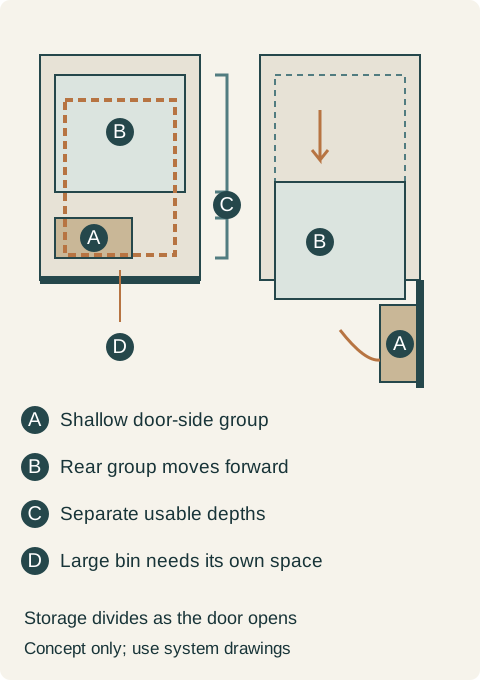
A linked pantry separates the groceries into door-side and rear shelves as it opens. That improves access to shallow groups but changes the depth available for large containers.
Choose a linked split-depth pantry when small packages benefit from being presented in shallow groups and the selected trays also hold the rest of your groceries. Do not choose it solely because the open showroom cabinet looks full. Dividing the cabinet front-to-back changes the shape of the storage available for bulk bins, long boxes and large bags.
Kesseböhmer's TANDEM example automatically draws the rear shelves forward as the pantry opens. A separate door-side group becomes visible beside them. The manufacturer's US page also states that the door shelves are supported by the cabinet, not the hinges. Those are features of this specified assembly, not claims about every basket fixed to a cupboard door.
A conventional door rack moves with its door while the interior shelves stay where they are. It needs space between the closed door and the retained shelf contents. Simply screwing a basket onto the door neither shortens the existing shelves nor moves their rear contents forward. A deep jar at the back remains a rear-access problem.
The linked assembly reserves room for both groups and their travel. Its guides, supports and connection coordinate the motion. Treat the cabinet and mechanism as one purchase; replacing a designed support with ordinary door hinges is not an equivalent configuration. The manufacturer's statement about cabinet support does not remove the need for the actual cabinet's permitted construction and loading conditions.
Teaching example Conceptual plan views show shallow door-side storage and rear storage together when closed, then the door-side group swinging aside while the rear group moves forward. A wide bin is compared with the separate storage depths. Not a fitting or loading diagram.
Divided depth is different from empty cubic volume
Draw the usable inside outline of each tray, including its retaining edge and the space needed to remove a package. A large flour bin cannot bridge the moving front and rear groups just because their combined depths appear large enough. It must fit and be handled within one permitted storage zone.
Try the door-side arrangement with the packages that will really be there. A shallow group can make labels easy to find, but a bulky refill bag may need the rear group or another cabinet. Shelf-height adjustment does not increase a tray's depth. Nor does a photograph of small matching jars show how a household's mixed grocery packaging will fit.
Keep the bulk bin in the comparison
In a proposed pantry, small jars and packets fit the door-side trays, while cartons fit the rear trays. A broad flour bin spans too much front-to-back depth for either group. The household compares keeping the linked pantry with relocating that bin to an existing deep base drawer, versus retaining a simpler pantry with a suitably deep shelf. The base drawer is already occupied by daily cookware, and displacing the pans would harm cooking access. The household therefore selects the deep-shelf pantry for this location. The attractive split view does not justify losing another working storage zone.
For a household whose inventory fits the separate trays, the linked arrangement may be worthwhile. Evaluate the open door-side group and the forward rear group together in the room: they create a different standing and grocery-loading position from a narrow whole-frame pullout viewed from its sides.
The order should include the complete linked system and its supported cabinet, with the accepted contents on their actual trays. This makes the comparison about groceries the kitchen can store and retrieve, rather than a claim that every moving pantry increases capacity.
Pure White
Cream White
Light Warm Gray
Gray
Navy
Black
Oak Tone
Dark Walnut Tone
Design study These finish studies are design references, not a list of currently orderable colors. Screens and lighting change the appearance; compare a physical sample before choosing.See all finish options →
A tall pullout brings several storage levels forward together. Independent trays move only the selected level. Compare the loaded movement and side access, not just the amount visible in an empty display.
Shelves and inner drawers solve different access problems. Compare the same inventory at its actual height, including the outer door, usable interior and restocking routine.
Depth can add rows without adding useful access. Compare straight rows, raised organizers and pullout storage with the actual cans and the shelf’s loading information.
The sample shows the door frame, a separate center panel, the face frame and the cabinet box. Each component has its own place in this Shaker construction.
Shaker construction: door frame, center panel, face frame and cabinet box. The cutaway helps locate these parts; confirm each material in the specifications for the selected cabinet.
01 / Door frame
The Shaker door has rails and stiles around a separate center panel. The frame and center panel are different components; confirm their materials in the specifications for the selected cabinet.
02 / Face frame
The face frame surrounds the opening at the front of the cabinet box and sits behind the doors. The face frame, door frame and cabinet box are separate parts.
03 / Cabinet box
The sample exposes the cabinet sides, interior surfaces and layered edges. The image does not establish the wood species or material specification of a selected cabinet.