Spice drawer or cabinet shelf? Choose by the labels you can actually read
The best layout exposes the label while leaving room to grasp the container. Test the collection from your normal cooking position before choosing a rack.
Choose spice storage by how you identify and retrieve the jar, not by how many matching containers appear in an organizer photo. An upright jar in a low drawer presents its lid to you; the same jar on a shelf presents its side. A sloped tray changes the view again. The useful arrangement makes the name readable from your ordinary position and lets you take that jar without disturbing the rest.
Test the labels on the containers you already use
Gather a representative mix: short and tall jars, a grinder, a rectangular tin and any container whose name appears only on the side. Place them on a temporary surface at the proposed storage height. Look from where you will actually stand. A label that reads clearly in a close-up picture may disappear when the container sits at the back or below your sightline.
For an upright drawer arrangement, check whether lid labels would be useful and whether you are prepared to maintain them. A new brand or replacement lid can break the system. Keep product identity, dates and any important package information available; a decorative label is not a reason to discard the information you still need.
A stepped rack trades floor depth for a different view
A raised rear tier may expose side labels that disappear on a flat shelf. It also changes the height of the loaded collection and the path used to remove the back jar. Check those together. The rear container must clear the shelf above while your hand reaches past the front group; seeing the name is only part of the task.
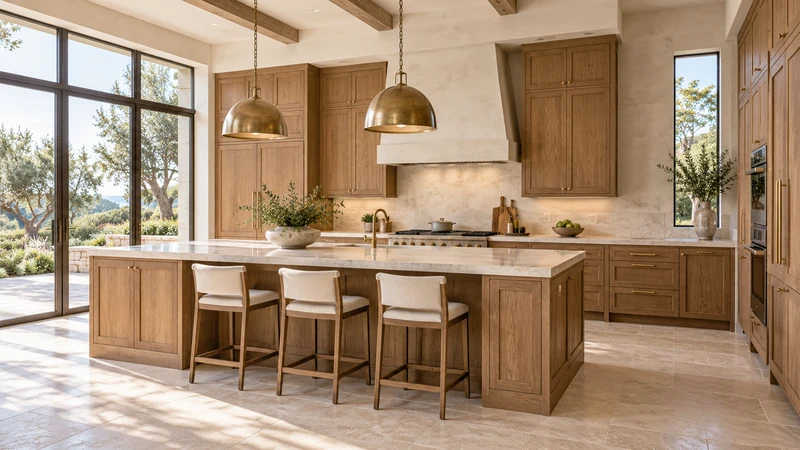
Design study Drawers and wall cabinets provide different viewing angles. The room image does not show a spice organizer or establish interior clearances.
A sloped drawer insert uses depth to recline the jars. Compare the loaded insert with the actual drawer, including jar shoulders and caps. Do not assume the capacity shown with matching short jars applies to a grinder or tall refill bottle. If a different container has to lie across the display, the proposed label-reading advantage may disappear.
Try an occupied layout, including the back position
Choose a spice from the middle of the trial arrangement, then one from the back. Can you identify it, grip it and return it without moving neighboring containers? Try with the door open as it normally would be, or the drawer extended to its actual stop. A row hidden behind the front of the cabinet may look accessible only when an empty organizer is photographed from above.
Consider the return path during cooking. A space that requires turning every jar to an exact angle can lose its readability quickly. Give the containers a consistent orientation that is easy to restore, or use a small lift-out group if that better suits the way you cook. The group still needs a landing place and should not become a heavy container you dislike moving.
Separate the working selection from the reserve supply
A compact daily selection can remain readable while larger refill packages live in a separate, appropriate pantry location. Mark where each reserve belongs and retain its package information. This avoids designing the most convenient drawer around the largest bottle you buy only occasionally. It also makes a missing working jar visible instead of hiding it among duplicate packages.
Before choosing the cabinet accessory, note the proposed storage location, viewing direction, tallest loaded point and the containers that do not fit the main pattern. Decide how new purchases will join the system. The right answer may be a simple shelf with readable front-facing labels, rather than an elaborate rack that fits only a curated collection.
Pure White
Cream White
Light Warm Gray
Gray
Navy
Black
Oak Tone
Dark Walnut Tone
Design study These finish studies are design references, not a list of currently orderable colors. Screens and lighting change the appearance; compare a physical sample before choosing.See all finish options →
The sample shows the door frame, a separate center panel, the face frame and the cabinet box. Each component has its own place in this Shaker construction.
Shaker construction: door frame, center panel, face frame and cabinet box. The cutaway helps locate these parts; confirm each material in the specifications for the selected cabinet.
01 / Door frame
The Shaker door has rails and stiles around a separate center panel. The frame and center panel are different components; confirm their materials in the specifications for the selected cabinet.
02 / Face frame
The face frame surrounds the opening at the front of the cabinet box and sits behind the doors. The face frame, door frame and cabinet box are separate parts.
03 / Cabinet box
The sample exposes the cabinet sides, interior surfaces and layered edges. The image does not establish the wood species or material specification of a selected cabinet.