Solid surface or quartz countertops: choose the finish you can live with
Solid surface and quartz are different engineered materials. Compare the offered joint appearance and future surface treatment, then keep ordinary heat protection and the complete installed design in the decision.
Solid surface and quartz are not interchangeable names for a manufactured countertop. If inconspicuous joints and a documented route for renewing surface wear are central priorities, a suitable solid-surface proposal deserves serious consideration. If you prefer the offered quartz slab and accept its visible joints and care limits, choose that finished package on its own merits. Do not turn scratch resistance into a promise of no scratches, or repairability into a promise that any damage can disappear. The useful choice is between surfaces the household likes and can maintain.
The material and the joint are part of the appearance
Corian describes its sheet as a homogeneous acrylic-and-mineral material, with inconspicuously bonded joints; irregular veined patterns need particular seam consideration. That is a reason to look at a finished joint in the selected design, not to promise every seam will be invisible. A quiet plain field and a strongly patterned field present different visual expectations. The household should accept the actual joined result rather than approving a small unjoined chip and imagining an unlimited unbroken surface.
Cambria states that its quartz needs no sealing or polishing, has visible seams, and should not receive abrasive pads or topical treatments. Those are specific product-care and appearance boundaries. No-sealing maintenance does not mean the owner should try any method that removes a mark. Keep the original finish in view when considering the quartz option: a surface that looks dull after inappropriate scrubbing is not improved simply by adding a coating. The accepted care method belongs with the selected product.
Corian’s care bulletin allows removal of minor cuts and scratches, but says uniform semi-gloss or gloss restoration is difficult without professional tools and techniques. Removing the mark is only part of the desired result; the treated area must also belong visually to the surrounding top. This makes the selected sheen important to a buyer who values repairability. Ask to see a professionally finished example of the proposed surface rather than assuming any local sanding will leave the same appearance. The instruction is not permission to start sanding an unidentified countertop.
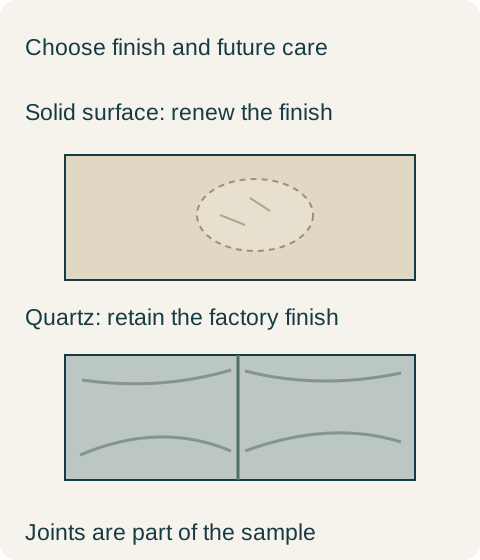
Diagram Conceptual surface choices. The upper patch indicates an area requiring a blended finish after renewal; the lower line indicates a visible slab joint. The diagram is not a polishing method, a damage guarantee or a promise that every solid-surface joint disappears.
A preference for a quiet working surface leads to solid surface
In a hypothetical kitchen, the owners want a calm, lightly patterned worktop and consider occasional professional renewal acceptable. After viewing finished examples, they choose the proposed matte solid surface and its agreed joint treatment. They accept that daily wear may remain visible between maintenance visits; they are not buying a surface that must stay untouched-looking. The quartz alternative offers a pattern they also like, but keeping that particular slab appearance matters less to them than the renewal route and joined appearance they have selected. Their final choice includes the whole fabricated top in that finish.
Before placing the order, view the sample from the kitchen’s ordinary sight lines. Reflected light can make a change in finish more noticeable than it seemed on a sample held flat in the hand. Include the exposed edge, where people will touch the top and see its outline from a seated position. The household in the example accepts the matte finish on both the working face and the proposed edge. It does not reserve an expectation of a different gloss level that the approved sample never showed.
Heat protection remains part of either kitchen
Corian’s care bulletin prohibits direct hot cookware and calls for trivets; Cambria also recommends heat protection beneath hot cookware and heat-generating appliances. Repairability is not a cooking method, and a stone-like slab is not a universal hot-pan landing area. Choose where the family will use its protective items as part of ordinary cooking. In the hypothetical kitchen, that routine is already accepted. There is no need to invent a temperature at which either proposed top becomes safe for every pot or appliance.
Keep joint location and fabrication details with the chosen finish. The attraction of a quiet joined surface does not remove the need for proper support or a designed opening. An edge that looks thick does not settle what lies beneath it. Those details should be included in the proposal the buyer accepts, rather than being silently borrowed from the other material. This comparison does not require an integrated basin: it concerns the working top and its joints even when both proposals use the same separately selected sink.
Compare renewal expectations with actual upkeep
A household may prefer to tolerate ordinary marks without arranging refinishing, or it may value the possibility of restoring a working surface later. Neither preference needs to be disguised as an objective ranking. Be clear about the intervention you would actually accept. A professional visit can mean clearing the work area and coordinating access; the possibility of renewal has value only if the owner is willing to use that route. Conversely, a preference for the quartz sample should include acceptance of its own care instructions, not a plan to apply solid-surface techniques to it.
Compare complete fabrication and installation offers, including the accepted finish, joints, edge and required supporting work. Keep future repair as a product-specific possibility rather than adding an invented lifetime maintenance saving to the price. In this kitchen, the chosen matte solid surface fits the desired joined appearance and the owners’ willingness to renew a working top. If a substitute changes the sheen or seam appearance, review it as a change to those reasons for buying, even if it is still called solid surface.
Pure White
Cream White
Light Warm Gray
Gray
Navy
Black
Oak Tone
Dark Walnut Tone
Design study These finish studies are design references, not a list of currently orderable colors. Screens and lighting change the appearance; compare a physical sample before choosing.See all finish options →
Compare the actual countertop products, heat-source routine and fabrication proposal. A fired porcelain slab and resin-bound quartz are different materials, but neither label replaces a complete kitchen specification.
The sample shows the door frame, a separate center panel, the face frame and the cabinet box. Each component has its own place in this Shaker construction.
Shaker construction: door frame, center panel, face frame and cabinet box. The cutaway helps locate these parts; confirm each material in the specifications for the selected cabinet.
01 / Door frame
The Shaker door has rails and stiles around a separate center panel. The frame and center panel are different components; confirm their materials in the specifications for the selected cabinet.
02 / Face frame
The face frame surrounds the opening at the front of the cabinet box and sits behind the doors. The face frame, door frame and cabinet box are separate parts.
03 / Cabinet box
The sample exposes the cabinet sides, interior surfaces and layered edges. The image does not establish the wood species or material specification of a selected cabinet.