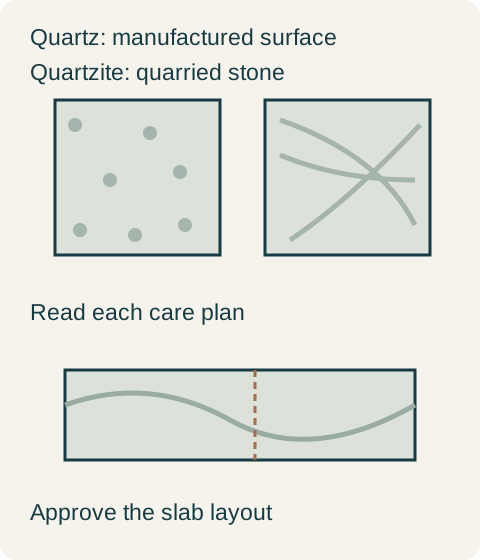
Quartz surfacing and quartzite are not interchangeable material names. If a cabinet-and-top proposal says only quartz stone, clarify which is being supplied before comparing the price. The choice can affect slab selection, care and fabrication scope even when the samples have similar pale backgrounds and flowing veins.
A mineral ingredient and a quarried rock are different products
The Natural Stone Institute identifies quartzite as a metamorphic rock formed from sandstone. Cambria describes its manufactured quartz surfaces as natural quartz crystals combined with binders and pigments. A quartzite-look design in that product category is still manufactured quartz surfacing; resemblance does not change its material identity.
The distinction matters without declaring either category universally superior. A buyer who specifically wants the geological variation of a quarried slab is buying something different from a buyer who accepts a manufactured design. Keep the actual product or stone identity on the proposal, rather than relying on the vein pattern or a short translated name.
No sealing does not mean no care
Cambria states that its quartz surfaces do not need sealing and recommends a hot pad or solid trivet. For natural stone, the Natural Stone Institute says sealing can improve stain resistance but does not make stone stain-proof; some stones do not need it. The selected quartzite needs its own care plan, not an automatic annual sealing rule copied from a different stone.
Teaching example Two conceptual slab categories and a countertop cut layout. Patterns are illustrative and cannot identify stone or predict the appearance of any product.
Choose the documented quartz option when sealing is the deciding task
In a hypothetical kitchen, the owner likes both a natural quartzite slab and a documented Cambria quartz design but wants to avoid periodic sealer treatment. The selected quartzite proposal includes a stone-specific sealing plan. With the appearance of both accepted and the fabrication scope aligned, the owner chooses the quartz option. The order retains its care instructions and a trivet practice. The result follows that owner’s maintenance preference; it does not claim that every quartzite requires the same treatment or that quartz is immune to damage.
Small samples do not settle the whole countertop
Cambria’s technical sheet warns that small samples do not show every design characteristic, variation is expected, and seams remain visible with possible changes in pattern and shade. Manufactured quartz should therefore not be promised as perfectly identical or visually seamless. Review the actual slab appearance and planned seams for either proposed material.
For a kitchen with a prominent island and surrounding cabinets, compare the complete view: broad pattern movement, the edge appearance and the transitions between pieces. A small chip may establish a background tone while missing the feature that will dominate the island. Approving that broader layout is a different decision from choosing the cabinet paint beside it.
Compare installed packages with the same scope
Align thickness, edge treatment, cutouts, fabrication, support requirements and installation in the quotations. Do not infer the cabinet support detail from a stone name or a hardness description. The exact chosen top still needs its documented supporting construction. No generic cost ranking can replace an actual quote for the same completed kitchen.
The final record should identify manufactured quartz by product and design, or quartzite by the selected stone and slab allocation, together with the approved layout and care plan. This makes the purchase understandable after installation: the owner knows what surface is present, what appearance was accepted and what maintenance belongs to it.
Pure White
Cream White
Light Warm Gray
Gray
Navy
Black
Oak Tone
Dark Walnut Tone
Design study These finish studies are design references, not a list of currently orderable colors. Screens and lighting change the appearance; compare a physical sample before choosing.See all finish options →
A ranked list can hide its comparison rules. Find the tested product, the scoring priorities and the missing conditions before applying the result to your cabinet order.
The sample shows the door frame, a separate center panel, the face frame and the cabinet box. Each component has its own place in this Shaker construction.
Shaker construction: door frame, center panel, face frame and cabinet box. The cutaway helps locate these parts; confirm each material in the specifications for the selected cabinet.
01 / Door frame
The Shaker door has rails and stiles around a separate center panel. The frame and center panel are different components; confirm their materials in the specifications for the selected cabinet.
02 / Face frame
The face frame surrounds the opening at the front of the cabinet box and sits behind the doors. The face frame, door frame and cabinet box are separate parts.
03 / Cabinet box
The sample exposes the cabinet sides, interior surfaces and layered edges. The image does not establish the wood species or material specification of a selected cabinet.