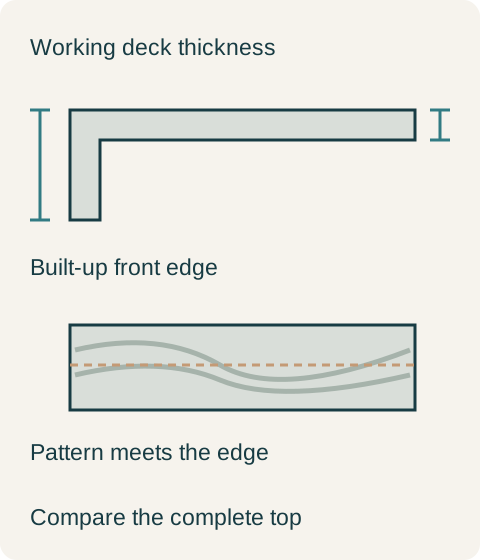
A solid-surface countertop can have a substantial-looking front edge while the broad working deck is a thinner sheet. That can be a documented fabrication method rather than a hidden defect. The purchase problem is a quote that states only the visible edge height and leaves the deck material, application and completed construction unclear.
Sheet thickness still has an application limit
Corian’s cited product overview restricts its 6 mm sheets to vertical or certain furniture applications. It does not provide a general permission to substitute that sheet for any kitchen countertop deck. A thin sheet covered by a solid-surface brand name is therefore not enough to establish an equivalent top assembly.
Corian’s edge bulletin describes layered stack edges and upright drop strips. One published illustration has a total edge height of 38 mm with a 12 mm deck sheet. The example shows why the edge silhouette and the deck thickness are separate dimensions; it is not a claim that the entire worktop contains a continuous solid slab as deep as the front.
The edge method also affects appearance. The same bulletin notes that larger particles can produce visible banding in stacked edges and that veined or reflective designs can appear differently at the edge. A thick edge should be reviewed in the selected pattern as a finished sample, not approved solely from its outline or a sample of another color family.
Diagram Conceptual deck and edge sections. The edge height is distinct from sheet thickness. No span, support spacing, cutting detail or load rating is specified.
Keep the documented deck when the edge heights look identical
Suppose two hypothetical proposals both show a 38 mm front edge. The first identifies a 12 mm working sheet and its reviewed buildup/support package. The second proposes a 6 mm facing over a base without documented approval for this countertop application. The buyer accepts the first complete top and rejects the second as an equivalent substitution. The matching visible height does not erase the change in the working material.
In that hypothetical purchase, the accepted drawing names deck thickness separately from total edge height and shows the chosen buildup. The buyer also approves its pattern transition at the edge. This does not mean a heavier-looking edge automatically carries more load; the full assembly and its support remain the basis for that assessment.
The support is part of the delivered top
A broad horizontal sheet, its edge detail and the cabinet support have different roles. Making the front look deeper does not automatically resolve a span, opening or special permanent load. The professional fabrication package must address the actual assembly. A material-only sheet quote and a finished installed top should not be compared as if their remaining responsibilities were the same.
Retain the exact surface product, working-sheet thickness, edge construction, selected pattern sample and support scope in the purchase record. This lets the buyer choose the desired edge appearance without overpaying for an imagined full-depth slab or accepting an undocumented thin-facing substitution. It also makes later changes visible before the top is fabricated.
Pure White
Cream White
Light Warm Gray
Gray
Navy
Black
Oak Tone
Dark Walnut Tone
Design study These finish studies are design references, not a list of currently orderable colors. Screens and lighting change the appearance; compare a physical sample before choosing.See all finish options →
A ranked list can hide its comparison rules. Find the tested product, the scoring priorities and the missing conditions before applying the result to your cabinet order.
The sample shows the door frame, a separate center panel, the face frame and the cabinet box. Each component has its own place in this Shaker construction.
Shaker construction: door frame, center panel, face frame and cabinet box. The cutaway helps locate these parts; confirm each material in the specifications for the selected cabinet.
01 / Door frame
The Shaker door has rails and stiles around a separate center panel. The frame and center panel are different components; confirm their materials in the specifications for the selected cabinet.
02 / Face frame
The face frame surrounds the opening at the front of the cabinet box and sits behind the doors. The face frame, door frame and cabinet box are separate parts.
03 / Cabinet box
The sample exposes the cabinet sides, interior surfaces and layered edges. The image does not establish the wood species or material specification of a selected cabinet.